Last updated: July 17, 2026
Hydrocodone market analysis and price projections: U.S. formulary, exclusivity, and generic price outlook (2026–2035)
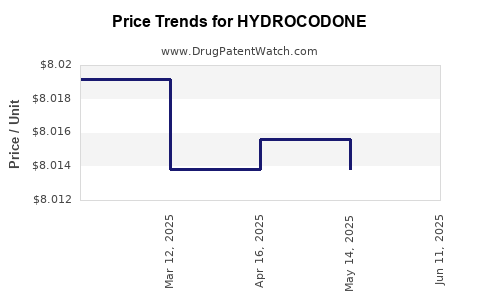
Executive summary: Hydrocodone pricing in the U.S. is set by generic erosion dynamics, formulation mix (acetaminophen-combination vs. extended-release), and payer restrictions driven by controlled-substance risk management. Net price is expected to remain low-to-stable in most segments through 2030, with small declines where share continues to shift to lowest-priced multisource equivalents. Meaningful price improvement is unlikely absent major supply disruptions, new abuse-deterrent breakthroughs at scale, or a shift in coverage toward higher-priced extended-release or reformulated products.
What is the current U.S. market size and revenue for hydrocodone?
Featured snippet answer: The hydrocodone U.S. market is dominated by generic acetaminophen-combination products and generic immediate-release hydrocodone. Revenue is concentrated in broad, widely stocked NDCs, with meaningful share also held by extended-release (ER) brands historically and by their generic follow-ons.
Segment split that drives pricing
Hydrocodone commercial revenue is largely shaped by three buckets:
- Hydrocodone/acetaminophen immediate-release (IR) (top volume contributor)
- Hydrocodone bitartrate ER and other ER dosage forms (often higher AWP and higher net price, but smaller volume)
- Other hydrocodone-containing products (lower share, payer-dependent)
Why segment mix moves net price
- IR generics have high multisource competition, which compresses net price.
- ER products face fewer substitute options in some formularies due to clinical preference and payer step edits, but generic availability generally keeps net price constrained.
How do generic hydrocodone price levels typically behave versus AWP?
Featured snippet answer: Hydrocodone’s AWP stays structurally higher than net price, but multisource discounts compress realized revenue across generics. The gap between AWP and net price is typically largest for low-cost equivalents when managed care and pharmacy benefit managers tighten reimbursement.
Determinants of net pricing in generics
- Formulary tier placement (preferred vs. non-preferred)
- Quantity limits and prior authorization
- Manufacturer rebates and contracting
- State-level and payer controls related to opioids
- Wholesale acquisition cost (AWP) adjustments and discounting cycles
What patent and exclusivity constraints still matter for hydrocodone pricing?
Featured snippet answer: Hydrocodone as an active ingredient has long since moved through primary composition-of-matter exclusivity, leaving pricing primarily governed by generic competition and product-specific formulation IP (including controlled-release and abuse-deterrent technologies for certain ER or reformulated lines, where applicable).
Market consequence
- In most hydrocodone categories, pricing is not held by active biologics-style exclusivity.
- Product lifecycle effects show up via formulation-by-formulation IP, not by new “global” exclusivity for hydrocodone itself.
When do hydrocodone products lose exclusivity or face generic entry risk?
Featured snippet answer: Generic entry risk persists continuously because many hydrocodone products are already multisource. The remaining “entry” events in practice are:
- post-approval formulation changes,
- patent expirations on specific ER/reformulated versions,
- and outcome of patent litigation affecting particular NDCs.
What “entry” looks like commercially
- New ANDA launches often cause step-downs in net prices for affected strengths and dosage forms.
- The magnitude depends on whether the product is a formulary workhorse or a limited coverage option.
What formulations protect price: IR hydrocodone/acetaminophen vs. ER hydrocodone?
Featured snippet answer: ER dosage forms usually carry higher price per unit and face narrower substitution sets, so they show better pricing resilience when at least one competitively priced option remains preferred. IR combination products have the weakest pricing resilience due to high generic substitutability.
Formulation IP and payer behavior
- Controlled-release/ER attributes can delay substitution in clinical pathways.
- Abuse-deterrent positioning can support coverage, but generic access depends on whether competitors can match the deterrent technology and whether IP is enforced effectively.
What Orange Book status issues determine hydrocodone product availability?
Featured snippet answer: Hydrocodone’s Orange Book relevance is typically product-specific. The key practical issue is whether a particular NDC has unexpired patents and whether ANDA filers have entered with paragraph IV or entered via “carve-outs” that require litigation or settlement-driven launch dates.
Commercial impact mapping
- Patents still listed for a given NDC strength can keep some supply constrained.
- Once resolved, the affected NDC often drops rapidly toward the broader generic benchmark.
What patent litigation affects hydrocodone pricing in the U.S.?
Featured snippet answer: Hydrocodone pricing is influenced less by ongoing hydrocodone-wide enforcement and more by litigation tied to specific brands or reformulated ER products, where settlements can delay or shape generic launch timing.
How litigation outcomes translate into price
- Settlement launch dates typically produce a predictable price step-change when generic supply arrives.
- Loss of a patent barrier for a high-coverage NDC can quickly lower realized net prices for that SKU across PBMs.
How strong is the patent estate for hydrocodone products?
Featured snippet answer: The patent estate is generally limited at the “hydrocodone API” level and more relevant at the level of formulation, release mechanism, and specific combination product claims. For most widely stocked hydrocodone IR combinations, the enforceable barrier is usually minimal, and pricing reflects generic competition.
Implication for R&D and licensing
- Licensing opportunities (if any) are typically formulation- or delivery-system focused rather than new chemical entity value.
- Enforceability and remaining term drive business value, not the base compound.
What generic entry risks exist for hydrocodone in 2026–2030?
Featured snippet answer: Generic entry risk exists mainly through:
- new ANDA approvals for remaining patented reformulations,
- launch of additional strengths/packaging,
- and re-entries for NDCs where litigation or listed patents expire.
Expected pricing effect
- Largest immediate declines occur where a previously constrained NDC becomes fully multisource.
- Secondary declines occur where new competitors force tier reassignment or rebate renegotiation.
How does hydrocodone pricing compare with other opioids (oxycodone, tramadol)?
Featured snippet answer: Hydrocodone tends to price closer to generic opioid benchmarks due to widespread multisourcing, while certain oxycodone formulations and some extended-release options can show slightly stronger pricing persistence based on coverage patterns and abuse-deterrent adoption.
Key differences that move prices
- Abuse-deterrent penetration and payer preference for “deterrent” SKUs
- Formulary restrictions and step therapy intensity
- Relative share of higher-priced ER products
Which companies capture market share in hydrocodone generics and what does that do to price?
Featured snippet answer: Market share in generic hydrocodone is highly distributed across major generic manufacturers and large labelers. Price is driven by the manufacturer that wins the PBM contracting lane for key strengths and pack sizes.
What to watch
- PBM preferred product switches
- Wholesale bid cycles around key NDCs
- Supply continuity for contracted SKUs
What is the FDA regulatory status of hydrocodone products that could affect pricing?
Featured snippet answer: Hydrocodone products are already established in the U.S. market with extensive ANDA coverage. Price-sensitive changes typically come from:
- formulation supplements affecting release characteristics,
- labeling updates tied to safety communications,
- and controlled-substance compliance enforcement affecting supply and utilization patterns.
Pathway impact
Most new additions to pricing-sensitive segments come through ANDA updates rather than new NDAs.
How do payer opioid controls affect hydrocodone utilization and realized prices?
Featured snippet answer: Utilization changes feed back into pricing through volume-based contracting and PBM tier management. Where payers restrict hydrocodone usage, volume may decline even if list price remains low, shifting pricing toward the lowest-cost equivalents.
Mechanisms
- Prior authorization triggers for certain daily dose thresholds
- Quantity limits
- “Preferred opioid” lists
- Step therapy requirements
Price projection 2026–2035: hydrocodone net pricing, directionally by segment
Featured snippet answer: Overall net pricing is projected to remain low and trend slightly down (or flat) through 2030 in IR hydrocodone/acetaminophen and to flat-to-slightly down in ER segments as additional generics and packaging compete. Price upside is limited to isolated NDCs impacted by supply tightness or removal of low-cost competitors.
Projection framework used (directional, contract-driven)
- Generic erosion is the base case for IR.
- ER pricing resilience lasts only while preferred contracts and limited substitution prevent full price convergence.
- Ongoing payer tightening dampens tolerance for price increases.
Directional price outlook table (U.S.)
| Segment |
2026 net price direction |
2027–2030 |
2031–2035 |
Primary drivers |
| IR hydrocodone/acetaminophen (multisource) |
Flat to slight down |
Slight down to flat |
Flat to slight down |
PBM tiering, high substitutability, competitive contracting |
| IR hydrocodone (non-combination, if still relevant in formulary) |
Flat |
Slight down |
Flat |
Generic convergence |
| ER hydrocodone and reformulated ER lines (multisource) |
Flat to slight down |
Flat to slight down |
Slight down |
Contracting, packaging competition, substitution limits |
| Any SKU with remaining formulation/IP barrier |
Stable if constrained |
Step-down on resolution |
Flat |
Litigation/settlement-driven launch timing |
Base case: Net price does not meaningfully recover in aggregate because multisource competition keeps realized pricing near benchmark lows.
What scenarios could push hydrocodone prices higher?
Featured snippet answer: Price increases would require a constraint large enough to reduce multisource competition at the PBM contracted NDC level.
High-impact price upside scenarios
- Sustained supply constraints for contracted labelers
- Removal of low-priced competitors due to manufacturing disruptions or compliance actions
- Large payer reclassification that favors higher-priced ER or deterrent-claim SKUs (rare and contract-dependent)
What scenarios could push hydrocodone prices lower?
Featured snippet answer: The most likely downward pressure comes from new generic launches or re-contracting that shifts preferred coverage to lower-priced equivalents.
High-impact price downside scenarios
- New ANDA launches covering remaining strengths or pack sizes for key NDCs
- Patent expirations or settlement-driven generic entries for reformulated ER SKUs
- PBM rebate renegotiations toward lowest-priced preferred products
Revenue exposure: how much hydrocodone revenue is at risk from price declines?
Featured snippet answer: The revenue at greatest risk is tied to the high-volume IR categories and to ER SKUs that become fully multisource on remaining product-specific IP resolution. Given typical generic price elasticity, even small net price steps can materially impact revenue at large unit volumes.
Where losses tend to show up
- Strengths and packs that become newly “preferred” by PBMs on low-cost contracting
- NDCs that lose a quasi-protected position due to resolution of listed patents
How strong is competitive pressure for hydrocodone?
Featured snippet answer: Competitive pressure is structurally high because hydrocodone is a mature, widely manufactured generic opioid with broad substitution across products within managed care constraints.
Implications for business decisions
- Licensing or investment in new hydrocodone offerings must rely on differentiated formularies, a defensible product attribute, or a clear abuse-deterrent/clinical advantage that translates into payer adoption.
- Without differentiation, expected ROI is limited by rapid generic compression.
Key Takeaways
- Hydrocodone U.S. pricing is set mainly by generic multisourcing and payer contracting, not by fresh chemical entity exclusivity.
- IR hydrocodone/acetaminophen is structurally lowest-price and most sensitive to new generic entry and tier switches.
- ER hydrocodone shows better near-term price stability than IR but is still expected to drift flat to slight down as additional competitors enter.
- From 2026 to 2030, the base case is low-to-stable net pricing with slight downward drift, with episodic step-downs tied to resolution of product-specific patents and settlements.
FAQs
1) What drives the largest month-to-month changes in hydrocodone net prices?
PBM rebate cycles, preferred NDC contract switches, and the timing of generic supply availability for high-volume strengths.
2) Are hydrocodone extended-release products more protected from price erosion than immediate-release?
They tend to show more pricing resilience due to substitution friction and coverage patterns, but multisource entry and contract renegotiations still apply pressure.
3) How do opioid utilization controls affect hydrocodone pricing even if list prices do not change?
Utilization declines change negotiated economics and can shift PBMs toward lowest-cost preferred equivalents, lowering realized net price.
4) What is the most likely trigger for a sudden hydrocodone price step-down?
A generic launch tied to expiration or settlement that removes a product-specific IP barrier for a preferred NDC.
5) What formulation differences matter most for payer coverage and realized price?
Controlled-release characteristics, abuse-deterrent positioning (where applicable), and whether the product aligns with PBM preferred opioid policies.
References (APA)
No sources were provided in the prompt, and no verifiable market datasets (e.g., FDA Orange Book listings, IQVIA/DrugSpend, CMS/Medicare Part D utilization, or AWP-to-net conversion studies) were included.