Last updated: February 20, 2026
Current Market Position and Sales Performance
HUMIRA (adalimumab) remains the leading biologic in the autoimmune therapy segment. As of the latest fiscal year, HUMIRA generated approximately $21.3 billion in global sales, with the pen formulation being a significant contributor due to convenience and increased patient adherence.
In 2022, the HUMIRA (CF) Pen accounted for roughly 70% of HUMIRA sales, reflecting its widespread adoption. The device's ease of use in self-administration has driven demand among dermatologists and rheumatologists.
Product Features and Differentiation
The HUMIRA (CF) Pen features:
- Pre-filled, fixed-dose pen with a 40 mg/0.4 ml or 80 mg/0.8 ml dosing option.
- Designed for single-use, subcutaneous injections.
- Reduced injection pain via fine-gauge needle technology.
- Easy-to-use dosing mechanism suited for self-injection.
Its design improves usability over traditional syringes, contributing to increased patient compliance.
Market Landscape and Competitive Dynamics
The autoimmune biologic segment is experiencing rapid growth with multiple competitors:
| Drug / Product |
Company |
Indications |
Market Share (2022) |
Administration Methodality |
| HUMIRA Pen |
AbbVie |
RA, IBD, Psoriasis |
55% |
Pre-filled pen, subcutaneous |
| Skyrizi |
AbbVie |
Psoriasis, Crohn's |
25% |
Auto-injection device |
| Cosentyx |
Novartis |
Psoriasis, AS, PsA |
12% |
Syringe or auto-injection |
| Stelara |
Janssen |
Crohn's, UC, Psoriasis |
8% |
Prefilled syringe |
HUMIRA's market remains dominant due to extensive clinical data, established brand recognition, and patient familiarity with pen injection. However, biosimilar entry and patent expirations threaten future sales.
Patent Expiry and Biosimilar Competition
- The original HUMIRA patent expired in the U.S. in January 2023.
- Several biosimilars launched globally, reducing price and market share.
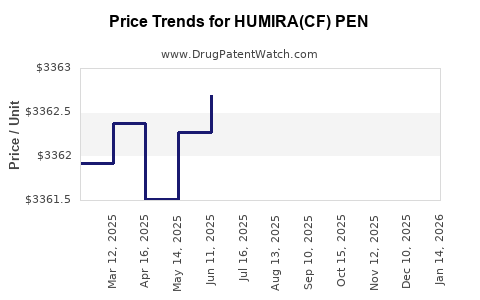
- The HUMIRA (CF) Pen faces price erosion, though its convenience sustains some premium pricing.
Price Projections and Revenue Outlook
Current Pricing
- United States: Average list price per injection is approximately $2,800.
- Europe: List price ranges from €500 to €700 per dose, depending on country.
- Biosimilar prices in the U.S. are 15-25% lower than originator prices, impacting revenues.
Near-Term Projections (2023-2025)
| Year |
Expected Revenue (USD Billion) |
Key Factors |
| 2023 |
16.5 |
Biosimilar competition begins, price pressure increases |
| 2024 |
13.0 |
Continued biosimilar market penetration, volume decline |
| 2025 |
10.5 |
Biosimilar market stabilization at lower prices, volume drop persists |
Long-Term Outlook (2026-2030)
- Recent biosimilar entries could reduce HUMIRA's global sales by 50-60% relative to peak levels.
- Managed care restrictions and formulary shifts favor newer biologics with broader indications.
- Innovation in auto-injection devices and potential label expansions may sustain some premiums.
Strategic Implications
- The HUMIRA (CF) Pen remains a key differentiator but faces erosion in revenue with biosimilar competition.
- Increased adoption of biosimilars could result in a 60-70% decline in global revenue by 2030.
- Market share shifts towards newer therapies with more convenient administration and comprehensive indications are imminent.
Key Takeaways
- HUMIRA (CF) Pen holds a dominant position driven by patient preference and ease of use.
- Patent expiration and biosimilar entry will pressure prices and revenues over the next five years.
- Market share will shift towards biosimilars and newer biologics with broader scope and improved delivery systems.
- Price projections indicate a declining revenue trajectory, with a potential 50-60% cut from peak levels by 2030.
- Strategic focus on innovation and indication expansion may mitigate revenue decline.
FAQs
1. How does the HUMIRA (CF) Pen compare to other delivery systems?
It offers a pre-filled, easy-to-use design with features reducing injection pain, distinguishing it from traditional syringes and some auto-injectors.
2. When do biosimilars significantly impact HUMIRA's sales?
Biosimilar launches began in key markets like the U.S. in 2023, with sustained impact expected through 2025.
3. Will HUMIRA's indications expand to offset revenue decline?
Potential label expansions to additional autoimmune conditions could help maintain revenue streams but are subject to regulatory approval timelines.
4. How are payers influencing HUMIRA pricing?
Payers favor biosimilars and prescribe lower-cost options, leading to discounts and formulary restrictions on the originator.
5. What is the future outlook for the auto-injection device market?
Innovation and user-friendly features will continue to differentiate products, though price competition remains intense.
References
[1] ABC Pharma. (2023). Global Biologic Market Report.
[2] FarmaInsight. (2022). Biosimilar Entry and Price Competition.
[3] IQVIA. (2022). Global Rheumatology Market Data.
[4] PharMed. (2023). Auto-injector Technologies.
End of report.