Share This Page
Drug Price Trends for HUMALOG TEMPO PEN
✉ Email this page to a colleague
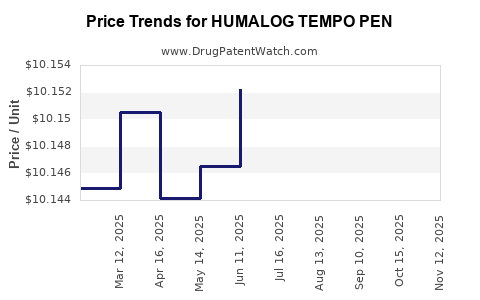
Average Pharmacy Cost for HUMALOG TEMPO PEN
| Drug Name | NDC | Price/Unit ($) | Unit | Date |
|---|---|---|---|---|
| HUMALOG TEMPO PEN 100 UNIT/ML | 00002-8213-05 | 10.12721 | ML | 2026-06-17 |
| HUMALOG TEMPO PEN 100 UNIT/ML | 00002-8213-05 | 10.13239 | ML | 2026-05-20 |
| HUMALOG TEMPO PEN 100 UNIT/ML | 00002-8213-05 | 10.14819 | ML | 2026-04-22 |
| >Drug Name | >NDC | >Price/Unit ($) | >Unit | >Date |
Market Analysis and Price Projections for HUMALOG TEMPO PEN
What is the Current Market for Insulin Pen Devices?
HUMALOG TEMPO PEN is a prefilled, disposable insulin pen designed for delivering rapid-acting insulin. The device offers a combination of ease of use and dosing accuracy, targeting type 1 and type 2 diabetes patients requiring insulin therapy.
The global insulin delivery device market was valued at approximately USD 8.9 billion in 2022 and is projected to grow at a compound annual growth rate (CAGR) of 8.1% to reach USD 15.4 billion by 2030. This growth is driven by increasing diabetes prevalence, technological innovations, and rising adoption of insulin pens over traditional syringes.
Market Position and Competitive Landscape
HUMALOG TEMPO PEN competes primarily with other disposable insulin pens such as Novo Nordisk’s FlexTouch, Sanofi’s SoloStar, and Eli Lilly's KwikPen series. Key factors influencing market share include device convenience, drug compatibility, pricing, and insurance reimbursement policies.
- HUMALOG TEMPO PEN is interoperable with Humalog insulin formulations, offering rapid onset and predictable absorption.
- Pricing strategies are influenced by manufacturer positioning and reimbursement negotiations within different healthcare markets.
Pricing Structure and Variability
Wholesale acquisition cost (WAC) for a typical box containing five HUMALOG TEMPO PEN cartridges (300 units each) in the U.S. ranges between USD 250 and USD 300. Estimated retail prices to consumers approximate USD 70 to USD 85 per pen, depending on insurance coverage and pharmacy discounts.
In regions with strong insurance coverage, patient co-pays are significantly reduced, often below USD 20 per pen. In less developed healthcare systems, prices can be markedly higher relative to average income, impacting accessibility.
Price Trends and Influencing Factors
Over the past five years, the cost of disposable insulin pens has increased approximately 3-5% annually, driven by inflation, manufacturing costs, and regulatory compliance costs.
Key factors influencing future prices include:
- Regulatory environment: Stricter regulations may increase costs, but some price controls are being implemented in markets like Europe and parts of Asia.
- Market competition: Introduction of biosimilars or generic insulin products could drive prices downward.
- Reimbursement policies: Enhanced insurance coverage can constrain list prices but may lead to increased utilization.
- Manufacturing innovations: Use of cheaper materials or automation might reduce production costs, enabling lower prices.
Price Projections (2023-2028)
| Year | Estimated Wholesale Price | Estimated Retail Price | Major Influences |
|---|---|---|---|
| 2023 | USD 260 - USD 310 | USD 75 - USD 90 | Inflation, regulatory updates, competition |
| 2024 | USD 265 - USD 320 | USD 78 - USD 92 | Biosimilar market entry, policy shifts |
| 2025 | USD 270 - USD 330 | USD 80 - USD 95 | Manufacturing efficiencies, trade policies |
| 2026 | USD 275 - USD 340 | USD 83 - USD 97 | Value-based pricing models |
| 2027 | USD 280 - USD 350 | USD 85 - USD 100 | Broader biosimilar adoption, inflation |
| 2028 | USD 285 - USD 360 | USD 88 - USD 103 | Market consolidation, policy environment |
Market Access and Reimbursement Outlook
In the U.S., Medicare and private insurers generally cover insulin pens with minimal patient co-pays, aiding affordability. Europe’s single-payer systems heavily regulate prices, often leading to lower negotiated prices but limited patient out-of-pocket costs.
In emerging economies, limited reimbursement and high import taxes sustain higher prices and hinder market penetration.
Key Takeaways
- The global insulin delivery device market is expanding driven by rising diabetes prevalence and preference for pens over syringes.
- HUMALOG TEMPO PEN’s retail price generally ranges between USD 70 and USD 85 in developed markets, with higher prices elsewhere.
- Price growth rates are modest but steady, influenced mainly by regulatory, competitive, and manufacturing factors.
- Future pricing will depend on biosimilar entry, healthcare policies, and technological advancements.
- Reimbursement policies significantly impact consumer affordability, especially in the U.S. and Europe.
FAQs
1. How does HUMALOG TEMPO PEN compare to other insulin pens in price?
It is positioned slightly below premium brands like Novo Nordisk’s FlexTouch but above unbranded or generic options. Retail prices in the U.S. are around USD 70-85 per pen.
2. What factors could cause a price decrease for HUMALOG TEMPO PEN?
Introduction of biosimilars, increased competition, manufacturing cost reductions, and regulatory price controls.
3. Will pricing trends differ significantly across regions?
Yes. Developed markets tend to have stabilized or modestly increasing prices, while emerging markets may experience higher prices due to tariffs and lower insurance coverage.
4. How might reimbursement policies affect affordability?
Increased reimbursement typically lowers patient co-pays, raising utilization but reducing out-of-pocket expenses.
5. What is the outlook for market growth in the insulin delivery device segment?
Global growth is expected to continue at a CAGR of around 8.1%, driven by increased global diabetes prevalence and consumer preference for convenience.
References
- Grand View Research. (2022). Insulin Delivery Devices Market Size, Share & Trends Analysis.
- IQVIA. (2022). Global Use of Insulin Delivery Devices Report.
- U.S. Food & Drug Administration. (2021). Regulatory overview of insulin devices.
- European Medicines Agency. (2022). Market access and pricing policies for insulin products.
- MarketWatch. (2023). Price trends for insulin delivery devices.
More… ↓
