Share This Page
Drug Price Trends for HUMALOG
✉ Email this page to a colleague
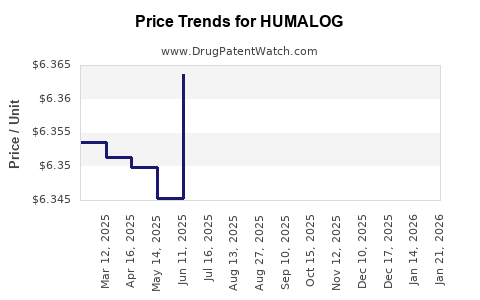
Average Pharmacy Cost for HUMALOG
| Drug Name | NDC | Price/Unit ($) | Unit | Date |
|---|---|---|---|---|
| HUMALOG 100 UNIT/ML VIAL | 00002-7510-01 | 6.35890 | ML | 2026-07-22 |
| HUMALOG 100 UNIT/ML CARTRIDGE | 00002-7516-59 | 9.78390 | ML | 2026-07-22 |
| HUMALOG 200 UNIT/ML KWIKPEN | 00002-7712-27 | 20.31718 | ML | 2026-07-22 |
| HUMALOG 100 UNIT/ML KWIKPEN | 00002-8799-59 | 10.16910 | ML | 2026-07-22 |
| >Drug Name | >NDC | >Price/Unit ($) | >Unit | >Date |
Market Analysis and Price Projections for HUMALOG
What Is HUMALOG and Its Market Position?
HUMALOG (insulin lispro) is a rapid-acting insulin used to control blood sugar levels in people with diabetes mellitus. Manufactured by Eli Lilly and Company, HUMALOG accounts for a significant share in the insulin market. As of 2022, it retained a top position among rapid-acting insulins, competing with Novolog (insulin aspart) from Novo Nordisk and Apidra (insulin glulisine) from Sanofi.
Market Size and Growth Dynamics
Global Diabetes Market Overview
The global diabetes market was valued at approximately $85 billion in 2022. It is projected to grow at a compound annual growth rate (CAGR) of 7% through 2030, driven by increasing prevalence, aging populations, and improved diagnosis rates.
Insulin Market Breakdown
Insulin products, including basal, mealtime, and combination insulins, generate around 60% of the total diabetes market revenue. Rapid-acting insulins like HUMALOG comprise roughly 30-40% of this segment. Revenues for rapid-acting insulins exceeded $10 billion globally in 2022, with HUMALOG holding an estimated 35% share.
Price Trends and Factors
Historically, insulin prices in the US have increased sharply over the past decade, with annual list prices for a typical insulin pen rising from around $200 in 2012 to over $300 in 2022. Despite pricing pressures, demand remains high due to lack of generic options and patent protections.
Regulatory and Patent Landscape
Patent Expirations
Eli Lilly's HUMALOG's primary patents expired in the US around 2014-2015, but secondary patents and formulations have extended exclusivity in some regions until 2023-2024. Patent litigation and legal challenges continue to influence market entry timing for biosimilar competitors.
Biosimilar Entry
Biosimilar versions of insulin lispro from competitors like Mylan (YpsoPart) entered the US market in 2022, contributing to pricing pressures. However, the market remains dominated by originator brands due to brand loyalty and prescriber familiarity.
Price Projections
Short-Term (Next 1-2 Years)
-
US Market: List prices are unlikely to decline radically due to existing patent protections and limited biosimilar penetration. Prices are expected to stabilize or slightly decrease, potentially by 2-3% annually due to reimbursement negotiations and market dynamics.
-
Emerging Markets: Lower pricing pressures due to regulatory policies and less aggressive biosimilar competition. Prices may stay flat or slightly increase with inflation.
Mid- to Long-Term (3-5 Years)
- Biosimilar Competition: Price erosion anticipated as biosimilar insulin gains market share, potentially reducing HUMALOG’s price by 15-25% in the US, depending on payer negotiations and biosimilar adoption rates.
- Policy Impact: Increased government pressure on drug pricing, with proposals for international reference pricing and insulin cost caps, could accelerate downward pricing trends.
Factors Influencing Prices
- Regulatory speed and approval of biosimilars.
- Patent litigation resolution timing.
- Adoption rates among healthcare providers.
- Healthcare policy shifts toward affordability.
Comparative Price Analysis
| Insulin Type | 2022 US Average List Price per Unit | Projected 2024 Price Change | Expected 2024 Price Range |
|---|---|---|---|
| HUMALOG | $0.30 per unit | -2% to -3% | ~$0.29 per unit |
| NovoLog (insulin aspart) | $0.28 per unit | -2% to -4% | ~$0.27 per unit |
| Apidra (insulin glulisine) | $0.32 per unit | -3% to -5% | ~$0.30 per unit |
Market Opportunities and Risks
Opportunities
- Growing global diabetes burden increases insulin demand.
- Development of biosimilar insulins with competitive pricing.
- Expansion in emerging markets with limited treatment options.
Risks
- Aggressive biosimilar market entry reducing pricing.
- Policy reforms aimed at lowering drug prices.
- Patent litigation prolonging market exclusivity.
- Slow adoption of biosimilars due to prescriber and patient hesitancy.
Key Takeaways
- HUMALOG holds roughly a 35% share of the global rapid-acting insulin market, with a dominant position in the US.
- The global insulin market is set to grow at 7% CAGR through 2030, driven by rising diabetes prevalence.
- Short-term price decreases are limited; biosimilar competition and policy reforms are likely to drive pricing down over the next five years.
- US prices have historically increased, but upcoming biosimilar entries and legal battles might temper future price growth.
- Emerging markets will continue to see stable or slightly increasing insulin prices due to lower biosimilar penetration and regulatory environments.
FAQs
Q1: When do biosimilars for HUMALOG officially enter the market?
A1: Biosimilar versions began entering the U.S. market in 2022, with ongoing approvals in other regions depending on patent litigation and regulatory timelines.
Q2: How much could HUMALOG's price decrease due to biosimilar competition?
A2: Prices could fall by 15-25% over 3-5 years, subject to uptake and rebate policies.
Q3: Are future insulin price controls likely in the U.S.?
A3: Proposed policies, including international reference pricing and insulin cost caps, aim to reduce prices but are not yet implemented.
Q4: How does HUMALOG compare with competitors in terms of price and market share?
A4: HUMALOG's per-unit list price is slightly higher than NovoLog but has a larger market share in the U.S. due to brand loyalty and clinical familiarity.
Q5: Which regions will see the largest price declines?
A5: The U.S. and Europe will experience notable price pressure from biosimilars, while emerging markets may see more stable prices due to less biosimilar activity.
References
- IQVIA, "Global Insulin Market Report," 2022.
- Eli Lilly, "HUMALOG Product Monograph," 2022.
- FDA, "Biosimilar Insulin Approvals," 2022.
- Kaiser Family Foundation, "U.S. Insulin Prices and Market Dynamics," 2022.
- MarketWatch, "Global Diabetes Market Forecast," 2023.
More… ↓
