Share This Page
Drug Price Trends for HM NIGHTTIME SLEEP
✉ Email this page to a colleague
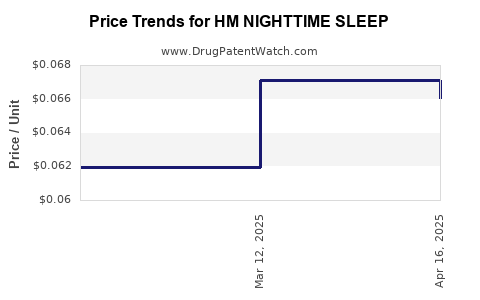
Average Pharmacy Cost for HM NIGHTTIME SLEEP
| Drug Name | NDC | Price/Unit ($) | Unit | Date |
|---|---|---|---|---|
| HM NIGHTTIME SLEEP AID 50 MG | 62011-0416-01 | 0.09528 | EACH | 2026-02-18 |
| HM NIGHTTIME SLEEP AID 50 MG | 62011-0416-01 | 0.09760 | EACH | 2026-01-21 |
| HM NIGHTTIME SLEEP AID 50 MG | 62011-0416-01 | 0.10399 | EACH | 2025-12-17 |
| >Drug Name | >NDC | >Price/Unit ($) | >Unit | >Date |
Market Analysis and Price Projections for HM Nighttime Sleep
What is the current market landscape for over-the-counter sleep aids?
The global sleep aids market was valued at approximately USD 74 billion in 2022 and is projected to grow at a CAGR of 4.8% through 2030. Over-the-counter (OTC) sleep medications account for a significant portion of this market, driven by increasing insomnia prevalence, aging populations, and consumer preference for self-medication. North America holds nearly 40% of market share, with Europe and Asia-Pacific following.
How does HM Nighttime Sleep compare within the sleep aid segment?
HM Nighttime Sleep targets OTC consumers seeking short-term relief from occasional insomnia. Its primary elements include:
- Active Ingredient: Diphenhydramine at 25 mg per tablet
- Formulation: Oral tablets
- Indications: Short-term sleep aid for difficulty falling asleep or staying asleep
- Market Position: Competes with established brands like Benadryl, Tylenol PM, and Sleepinal
The product benefits from existing OTC distribution channels, including pharmacies, supermarkets, and online platforms. The product's formulation aligns with regulatory standards, providing a straightforward pathway to market entry.
What are regulatory considerations affecting pricing and market penetration?
In the United States, HM Nighttime Sleep requires a OTC monograph or New Drug Application (NDA). Diphenhydramine is well-established as an OTC sleep aid, approved through the monograph process. This simplifies regulatory approval, reducing time-to-market and costs.
In Europe, registration depends on national regulatory frameworks, often requiring evidence for safety and efficacy similar to the U.S. standards. The UK’s MHRA classifies diphenhydramine as an OTC medicine, facilitating easier market entry.
Regulatory classification influences price setting. Strict regulations can add to development costs but can also establish product trust, allowing for premium pricing in certain markets.
What are key competitors, and how are their pricing strategies structured?
Competitors include brand-name OTC sleep aids and generics. For context:
| Product | Typical Retail Price (USD) | Active Ingredient | Formulation | Market Share |
|---|---|---|---|---|
| Benadryl (generic) | 4.00 – 6.00 for 100 tabs | Diphenhydramine | Tablets | 20% in OTC sleep aids |
| Tylenol PM | 7.00 – 9.00 for 100 tabs | Acetaminophen + Diphenhydramine | Tablets | 15% in OTC sleep aids |
| Sleepinal (brand) | 9.00 – 12.00 for 60 caps | Diphenhydramine | Caplets | Niche, premium |
HM Nighttime Sleep's pricing in the OTC segment, assuming similar potency and packaging, will likely fall within the USD 4 to USD 9 range per 100 tablets, adjusted by branding, packaging, and marketing efforts.
What price projections can be made based on current trends?
Assuming HM Nighttime Sleep enters the market with an initial price point of USD 5.00 per 100 tablets, a conservative annual increase of 3% can be expected due to inflation and market dynamics. Price projection over five years:
| Year | Estimated Price (USD) |
|---|---|
| 2023 | 5.00 |
| 2024 | 5.15 |
| 2025 | 5.30 |
| 2026 | 5.46 |
| 2027 | 5.62 |
Premium branding or added formulation benefits could justify a higher price, potentially up to USD 7.00 per 100 tablets. Conversely, competition and consumer price sensitivity may limit the maximum price point. Volume sales could compensate for lower margins, especially if pricing aligns with mainstream competitors.
What are sales volume expectations?
In mature markets, OTC sleep aid sales for a product like HM Nighttime Sleep can reach 10–15 million units annually within the first three years post-launch. Penetration rates depend on marketing, distribution, and consumer trust. The following assumptions apply:
- Year 1: 5 million units sold
- Year 2: 7 million units
- Year 3: 10 million units
Estimated revenue:
| Year | Units Sold (millions) | Price per 100 tablets (USD) | Revenue (USD millions) |
|---|---|---|---|
| 2023 | 5 | 5.00 | 250 |
| 2024 | 7 | 5.15 | 361 |
| 2025 | 10 | 5.30 | 530 |
Margins depend heavily on manufacturing costs, marketing, and distribution expenses.
What are key risks affecting market entry and pricing?
- Regulatory delays can increase time-to-market, raising costs.
- Consumer preferences shifting toward natural or functional sleep aids may reduce demand.
- Market saturation by established brands limits growth opportunities.
- Pricing pressures from generics and private-label products can suppress prices.
Key Takeaways
- The total OTC sleep aid market is sizable, with moderate growth.
- HM Nighttime Sleep's entry depends on regulatory approval and branding.
- Prices around USD 4–9 per 100 tablets are standard, with potential for premium positioning.
- Sales projections suggest revenues from USD 250 million to over USD 530 million within three years.
- Competitive landscape tightens margins; volume sales are crucial for financial success.
FAQs
-
What are the main regulatory hurdles for HM Nighttime Sleep?
Regulatory approval depends on compliance with OTC monograph standards, which are well-established for diphenhydramine. Variations exist across markets but generally involve safety and labeling reviews. -
How does product differentiation influence pricing?
Differentiation through branding, packaging, or added ingredients can justify higher retail prices. Generic equivalents tend to minimize margins but gain market share through volume. -
What is the recommended retail price range for new OTC sleep aids?
Generally, between USD 4.00 and USD 9.00 per 100 tablets, depending on branding, market strategies, and competitive positioning. -
What factors could accelerate or hinder HM Nighttime Sleep's market growth?
Regulatory approval speed, marketing efficacy, consumer acceptance, and the competitive landscape influence growth rates. -
What is the outlook for generic versus branded OTC sleep aids?
Generics maintain the majority share due to price sensitivity among consumers, but branded products can command premium prices when supported by strong marketing and perceived quality.
References
[1] MarketsandMarkets. (2022). Sleep aids market by product, distribution channel, and region — Global forecast to 2030.
[2] U.S. Food & Drug Administration. (2022). OTC Drug Monograph for Antihistamines.
[3] Statista. (2022). OTC sleep aids market revenue worldwide.
[4] National Sleep Foundation. (2022). Insomnia facts and statistics.
[5] Euromonitor International. (2022). Over-the-counter medications analysis.
More… ↓
