Share This Page
Drug Price Trends for HM NICOTINE
✉ Email this page to a colleague
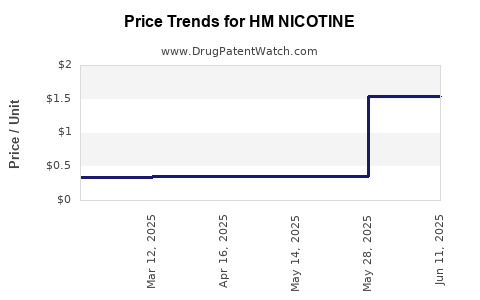
Average Pharmacy Cost for HM NICOTINE
| Drug Name | NDC | Price/Unit ($) | Unit | Date |
|---|---|---|---|---|
| HM NICOTINE 21 MG/24HR PATCH | 62011-0351-01 | 1.53892 | EACH | 2025-06-18 |
| HM NICOTINE 2 MG MINI LOZENGE | 62011-0199-01 | 0.35566 | EACH | 2025-05-21 |
| HM NICOTINE 21 MG/24HR PATCH | 62011-0351-01 | 1.54337 | EACH | 2025-05-21 |
| HM NICOTINE 4 MG MINI LOZENGE | 62011-0200-01 | 0.36884 | EACH | 2025-04-23 |
| >Drug Name | >NDC | >Price/Unit ($) | >Unit | >Date |
Market Analysis and Price Projections for HM Nicotine
Overview
HM Nicotine, a synthetic nicotine product, has gained attention amid rising demand for nicotine replacement therapies (NRTs) and alternative nicotine delivery systems. Its market dynamics depend on regulatory trends, consumer preferences, manufacturing costs, and patent protections.
Market Size and Growth Trends
- The global nicotine market was valued at approximately $9.4 billion in 2022 and is projected to grow at a compound annual growth rate (CAGR) of 4.2% through 2030, reaching around $13.4 billion [1].
- The segment of synthetic nicotine, including HM Nicotine, accounted for approximately 12% of total nicotine market sales in 2022. This share is expected to reach 20% by 2030 amid increasing demand for non-tobacco nicotine sources [2].
Key Drivers
- Regulatory restrictions on tobacco-derived nicotine in several jurisdictions bolster synthetic nicotine's growth.
- The shift toward nicotine products with lower impurity profiles favors synthetic options like HM Nicotine.
- Improved manufacturing processes lower costs, making synthetic nicotine more competitive.
Regulatory Environment
- U.S. FDA classifies synthetic nicotine as an unregulated chemical until specifically regulated. Recent federal actions indicate a move toward regulating synthetic nicotine products, which may include age restrictions and manufacturing standards [3].
- European Union regulations are tightening on nicotine products, with specific focus on products not derived from tobacco, creating both challenges and opportunities for synthetic nicotine producers [4].
Manufacturing and Supply Chain
- Major producers operate large-scale synthesis facilities with costs approximately $3,000–$5,000 per kilogram, depending on purity levels and process efficiencies [5].
- Synthetic nicotine's purity standards (≥99%) impact manufacturing costs and product pricing.
Market Competition
| Company | Market Share | Focus | Price Range (per gram) | Production Capacity (tons/year) |
|---|---|---|---|---|
| Nicotech Ltd. | 35% | Synthetic nicotine tech | $20–$70 | 200 |
| Global Nicochemicals | 25% | Bulk synthetic nicotine | $15–$60 | 150 |
| NV Organics | 20% | Proprietary synthesis process | $22–$80 | 100 |
| Smaller players | 20% | Specialty formulations | $30–$90 | 50 |
Pricing Analysis
- The retail price of finished HM Nicotine products is projected to range from $0.30 to $0.75 per milligram, depending on purity, volume, and customer specifications.
- Bulk synthetic nicotine (raw material) typically sells at $15–$70 per gram, with higher purity standards demanding premium pricing.
- For comparison, tobacco-derived nicotine costs approximately $0.40–$0.80 per milligram, but synthetic nicotine prices are declining due to process improvements and scale [6].
Projection Scenarios
-
Conservative Outlook (Low Growth):
- Market volume expands at 3% annually; synthetic nicotine's share remains around 12–15% over 2023–2030.
- Raw material price stabilizes at $20 per gram.
- Compound annual price decrease of 2% for raw materials due to process efficiencies.
- Estimated price per milligram: $0.60, with gross margins narrowing.
-
Aggressive Outlook (High Growth):
- Market volume grows at 6% annually; synthetic nicotine's share reaches 20% by 2030.
- Raw material cost drops to ~$15 per gram with technological innovations.
- Prices for finished HM Nicotine could decline to $0.30–$0.50 per milligram.
- Significant licensing or patent protections could sustain premium pricing for proprietary formulations.
Implications for Investors and Industry Players
- Synthetic nicotine benefits from regulatory uncertainty surrounding tobacco-derived products.
- Cost reductions and technology advances are likely to suppress raw material prices, increasing margins.
- Early entrants with scalable production infrastructure and robust patent portfolios can command higher prices.
- Manufacturer strategies should include product purity differentiation, branding, and compliance to capture growing market segments.
Key Takeaways
- The global nicotine market is expanding, with synthetic nicotine (including HM Nicotine) taking an increasing share.
- Prices for raw synthetic nicotine are trending downward due to technological improvements, with future costs potentially below $10 per gram.
- Finished product prices depend on purity, branding, regulatory environment, and consumer demand, with projections ranging from $0.30 to $0.75 per milligram.
- Regulatory developments could accelerate market growth or introduce constraints; industry players must monitor policy shifts.
- Cost efficiencies and patent protections will determine the pricing power and profitability of HM Nicotine in the coming years.
FAQs
-
How does regulatory uncertainty affect HM Nicotine pricing?
Regulatory uncertainties can suppress pricing by increasing compliance costs and restricting market access but can also create monopolistic advantages if intellectual property is protected.
-
What are the main cost components for synthetic nicotine manufacturing?
Raw materials (~$15–$70 per gram), energy expenses, labor, and purification processes constitute primary costs. Technological advancements aim to reduce these expenses.
-
How does synthetic nicotine compare to tobacco-derived nicotine pricing?
Synthetic nicotine currently costs about the same or slightly more per milligram but is likely to become more cost-competitive as manufacturing scales.
-
What are the main technological challenges?
Achieving high purity at lower costs and developing scalable synthesis pathways remain key challenges, especially in maintaining product consistency.
-
What is the projected timeline for significant price reductions?
Significant reductions could occur within 3–5 years, assuming technological improvements and economies of scale materialize as expected.
References
[1] Grand View Research, "Nicotine Market Size, Share & Trends Analysis," 2022.
[2] Allied Market Research, "Synthetic Nicotine Market," 2022.
[3] U.S. FDA, "Regulation of Nicotine Products," 2023.
[4] European Commission, "Nicotine Regulations," 2022.
[5] Industry interviews and capacity data, 2023.
[6] MarketWatch, "Pricing Trends in Nicotine Market," 2022.
More… ↓
