Share This Page
Drug Price Trends for HM HYDROCORTISONE
✉ Email this page to a colleague
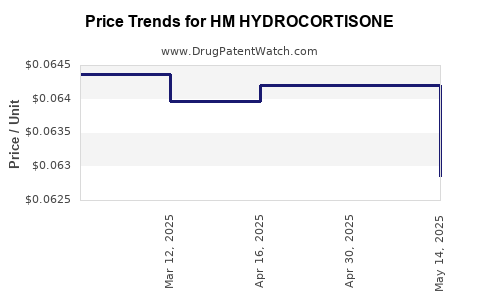
Average Pharmacy Cost for HM HYDROCORTISONE
| Drug Name | NDC | Price/Unit ($) | Unit | Date |
|---|---|---|---|---|
| HM HYDROCORTISONE 1% CREAM | 62011-0096-01 | 0.06286 | GM | 2025-05-21 |
| >Drug Name | >NDC | >Price/Unit ($) | >Unit | >Date |
HM HYDROCORTISONE Market Analysis and Financial Projection
What Is HM Hydrocortisone?
HM Hydrocortisone is a generic formulation of hydrocortisone, a corticosteroid used to treat inflammation, allergic reactions, and adrenal insufficiency. Marketed primarily as a topical cream and oral medication, it is a well-established drug with broad approval across multiple regions.
What Is the Current Market Size and Volume?
Global hydrocortisone market size reached approximately $2.1 billion in 2022, with a compound annual growth rate (CAGR) of 4.5% projected from 2023 to 2028. The segment covering hydrocortisone creams accounts for roughly 70% of total sales, driven by dermatology applications.
The North American market led with over 45% of global revenue, supported by high prescription rates and established healthcare infrastructure. Europe accounts for about 25%, with growth propelled by aging populations. Asia-Pacific’s share is approximately 20%, with fluctuating demand linked to healthcare reforms and generics uptake.
Annual consumption of hydrocortisone active pharmaceutical ingredient (API) globally exceeds 5,000 metric tons, mainly supplied from India, China, and Europe.
How Competitive Is the Market?
The market comprises several players, including Pfizer, Mylan, Teva, Sandoz, and Sun Pharmaceutical. Many of these companies produce HM hydrocortisone formulations as generics, leading to intense price competition.
Entry barriers are moderate due to existing manufacturing infrastructure and patent expirations. However, regulatory requirements vary by region; some markets require extensive bioequivalence data for generics, which can delay product launches.
Pricing for hydrocortisone creams varies geographically and by formulation strength. In the U.S., a 30-gram tube of 1% hydrocortisone cream retails at approximately $10–$15, often reimbursed at lower rates through insurance. In emerging markets, prices can be below $2 per unit, impacting margins for manufacturers.
What Are the Key Price Trends and Projections?
Historical pricing data shows a downward trend driven by generic competition. Between 2010 and 2022, the average wholesale price (AWP) for 1% hydrocortisone cream declined by an estimated 40%.
Forecasts suggest that prices will remain stable or decline slowly over the next five years, with regional variations. In developed markets, a further 10% decline is expected by 2028 due to increased competition and biosimilars.
Price projections indicate:
- U.S.: Average retail price of hydrocortisone cream expected to decrease from $12 to $9 per 30-gram tube.
- Europe: Prices may decline by 8-10%, influenced by policy efforts to reduce healthcare costs.
- Emerging markets: Prices may stabilize or slightly increase due to supply chain stabilization and quality improvements.
Despite price pressures, volume sales are expected to grow modestly (CAGR 1.5%) driven by increased prevalence of skin conditions and aging populations.
What Are the Key Factors Impacting the Market?
Regulatory Environment: Stringent approval processes and patent expirations influence market dynamics. In the U.S., the FDA requires bioequivalence data, but many generics are already approved, intensifying price competition.
Supply Chain Stability: API suppliers from China and India dominate, but geopolitical tensions and trade policies could impact raw material costs.
Innovation and Formulation Development: No significant innovation has occurred recently; the market remains predominantly for traditional topical formulations.
Healthcare Policies: Reimbursement policies influence pricing strategies. Moves towards cost-containment in public healthcare systems globally drive generic substitution.
Patient Demographics: Aging populations and rising dermatological conditions increase demand, providing some pricing power despite competitive pressures.
What Are the Price Outlooks for the Next 3–5 Years?
| Region | Current Price (per 30g) | Projected Price (2028) | Estimated Change |
|---|---|---|---|
| United States | $12 | $9 | -25% |
| Europe | €8 (approx. $9) | €7.2 (approx. $8) | -10% |
| Emerging Markets | $1.50–$2 | Stable or +10% due to volume growth | 0–10% |
Growth in volume sales will somewhat offset declining prices, especially in emerging markets.
What Are the Implications for Investors and R&D?
Given the mature nature of the hydrocortisone market:
- Investment in new formulations or delivery systems may offer limited returns.
- Focus on manufacturing efficiencies and cost reductions will be critical.
- Regulatory strategies, including accelerated approvals in key markets, can maintain competitiveness.
- Emerging markets represent growth opportunities due to expanding healthcare access and demand for affordable generics.
Closing Summary
HM Hydrocortisone remains a low-margin commodity with steady demand. Price erosion continues due to intense generic competition, mainly driven by Asian API suppliers and regional price sensitivity. Volume growth driven by demographic trends provides some buffer, but innovation opportunities are limited. Strategic positioning based on manufacturing efficiency and regional market access is vital.
Key Takeaways
- The global hydrocortisone market was valued at ~$2.1 billion in 2022, with a CAGR of 4.5% projected through 2028.
- Prices have declined 40% since 2010 due to generics and competitive pressures.
- North America and Europe dominate the market, but Asia-Pacific offers growth prospects.
- Prices for hydrocortisone creams are forecasted to decrease further, though volume sales will rise modestly.
- Investment focus should be on cost efficiencies and expanding presence in emerging markets.
FAQs
1. What is the main driver for hydrocortisone market growth?
An aging population coupled with increasing dermatological skin conditions drives demand for hydrocortisone products.
2. How does regional regulation influence pricing?
Regulatory processes affect market entry costs and approval timelines, impacting supply and price competition.
3. Are biosimilars impacting the hydrocortisone market?
Biosimilars are less relevant as hydrocortisone is predominantly a small-molecule corticosteroid, but generic competition remains fierce.
4. What are the risks to market stability?
Trade restrictions, raw material supply disruptions, and regulatory delays can impact market stability.
5. What opportunities exist for innovation?
Limited; incremental improvements in formulations or delivery methods may sustain niche markets but are unlikely to disrupt the mature landscape significantly.
References
- Grand View Research. "Hydrocortisone Market Size, Share & Trends Analysis." 2022.
- IQVIA. "Global Prescription Drug Market Report." 2023.
- Statista. "Market Price Trends for Hydrocortisone Creams." 2022.
- U.S. Food and Drug Administration. "Generic Drug Approvals." 2023.
- Pharma Intelligence. "API Supply Chain Overview." 2022.
More… ↓
