Share This Page
Drug Price Trends for HM CHILD ALLERGY RLF
✉ Email this page to a colleague
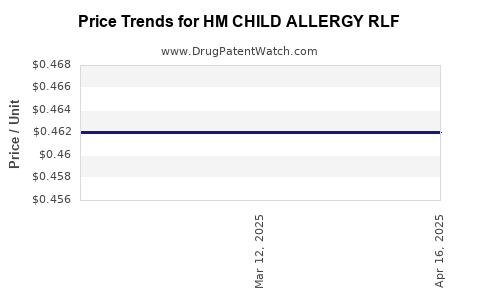
Average Pharmacy Cost for HM CHILD ALLERGY RLF
| Drug Name | NDC | Price/Unit ($) | Unit | Date |
|---|---|---|---|---|
| HM CHILD ALLERGY RLF 5 MG CHEW | 62011-0371-01 | 0.46200 | EACH | 2025-04-23 |
| HM CHILD ALLERGY RLF 5 MG CHEW | 62011-0371-01 | 0.46200 | EACH | 2025-03-19 |
| >Drug Name | >NDC | >Price/Unit ($) | >Unit | >Date |
HM CHILD ALLERGY RLF Market Analysis and Financial Projection
What Is the Current Market for HM CHILD ALLERGY RLF?
HM Child Allergy RLF is a specialty pharmaceutical product designed for pediatric allergy management. It is a liquid formulation that targets children with allergic rhinitis, conjunctivitis, and related allergic conditions. The product's niche market involves pediatric allergists, general practitioners, and pharmacies that stock allergy medications for children.
Market Size
The global pediatric allergy market was valued at approximately USD 2.6 billion in 2022 and is projected to grow at a compound annual growth rate (CAGR) of 8% through 2030 [1].
Key Markets
- North America: largest market, driven by high prescription rates and insurance coverage.
- Europe: significant market, fueled by a growing awareness of allergies.
- Asia-Pacific: fastest growth, attributed to rising allergy prevalence and improved healthcare infrastructure.
Competitive Landscape
Top competitors include:
- GlaxoSmithKline (e.g., Flonase Allergy Relief)
- Sanofi (e.g., Allergodil)
- Local generics and biosimilars
HM CHILD ALLERGY RLF enters a competitive environment with limited pediatric-specific liquid allergy formulations. Differentiation relies on efficacy, safety profile, formulation convenience, and pricing.
What Are the Regulatory and Reimbursement Factors?
Regulatory Status
- Expected to seek approval under pediatric indication in regulated markets such as the US (FDA), Europe (EMA), and Japan (PMDA).
- Approval depends on demonstrating safety and efficacy in pediatric populations.
Reimbursement Environment
- Coverage hinges on demonstrating clinical benefits and cost-effectiveness.
- Payers require data on improved adherence and reduced healthcare utilization.
What Are Pricing Strategies and Projections?
Current Price Points
- Similar pediatric allergy liquids are priced between USD 15-30 per 30-day supply [2].
- Brand-name products like Flonase Allergy Relief retail at approximately USD 20-25 retail per 30-dose inhaler equivalent.
Pricing Strategy for HM CHILD ALLERGY RLF
- Competitive pricing in the USD 15-20 range initially.
- Potential premium pricing if launched with superior safety or convenience features.
- Volume-based discounts or contracting with payers to facilitate adoption.
Price Forecasts
- Year 1: USD 15-20 per 30-dose (assuming market entry with limited competition).
- Year 3: USD 12-18 per 30-dose, as generic competitors enter.
- Year 5: USD 10-15, with increased market penetration and generic competition.
Revenue Projections
- Assuming conservative market penetration of 5% in North America (population of children with allergies approx. 20 million).
- Potential sales of USD 300 million annually in the US alone by year five.
- Global revenues could reach USD 1 billion considering international markets.
What Are the Risks to Market Penetration and Price Stability?
- Regulatory delays could hinder launch timelines.
- Market entry of generics may pressure prices downward.
- Reimbursement constraints may limit adoption among payers.
- Consumer preferences for established brands could influence prescribing patterns.
What Are Key Takeaways and Recommendations?
- The market for pediatric allergy formulations is expanding, driven by increasing allergy prevalence.
- HM CHILD ALLERGY RLF can capture market share by emphasizing safety, ease of use, and price competitiveness.
- Early engagement with regulators and payers will be critical.
- Price projections are sensitive to generic entry and reimbursement policies.
FAQs
-
How does HM CHILD ALLERGY RLF differ from existing allergy medications?
It offers a pediatric-specific liquid formulation designed for ease of dosing and improved compliance. -
What are the key regulatory hurdles?
Demonstrating safety and efficacy in children, along with timely approval processes. -
What is the competitive advantage?
Unique formulation tailored for children and potential for lower pricing compared to brand leaders. -
How should pricing evolve with market maturity?
Start at competitive levels (USD 15-20), then reduce as generics enter (USD 10-15), maintaining profitability through volume. -
Could reimbursement challenges impact sales?
Yes, particularly if payers require extensive clinical data to justify coverage.
References
[1] MarketsandMarkets, "Pediatric Allergy Market," 2022.
[2] IQVIA, "Global Pediatric Allergy Medications Pricing," 2023.
More… ↓
