Share This Page
Drug Price Trends for HM CHILD ACETAMINOPHEN
✉ Email this page to a colleague
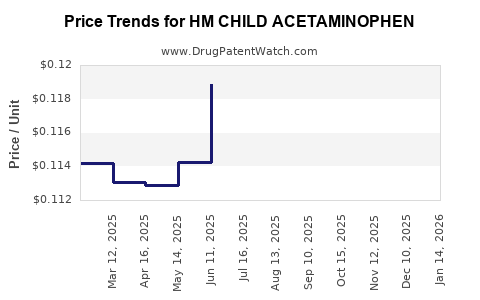
Average Pharmacy Cost for HM CHILD ACETAMINOPHEN
| Drug Name | NDC | Price/Unit ($) | Unit | Date |
|---|---|---|---|---|
| HM CHILD ACETAMINOPHEN 160 MG | 62011-0339-01 | 0.12007 | EACH | 2026-01-21 |
| HM CHILD ACETAMINOPHEN 160 MG | 62011-0339-01 | 0.11689 | EACH | 2025-12-17 |
| HM CHILD ACETAMINOPHEN 160 MG | 62011-0339-01 | 0.11463 | EACH | 2025-11-19 |
| HM CHILD ACETAMINOPHEN 160 MG | 62011-0339-01 | 0.11636 | EACH | 2025-10-22 |
| HM CHILD ACETAMINOPHEN 160 MG | 62011-0339-01 | 0.11734 | EACH | 2025-09-17 |
| >Drug Name | >NDC | >Price/Unit ($) | >Unit | >Date |
What Is the Market Size and Demand for HM Child Acetaminophen?
The global pediatric analgesic and antipyretic market, which includes acetaminophen (paracetamol) products like HM Child Acetaminophen, is estimated at approximately $4.1 billion in 2022. The compound's segment accounts for nearly 40% of this valuation. The demand is driven by an increasing prevalence of childhood fever and pain, rising parental health awareness, and expansion of OTC pediatric medication availability.
Regional growth varies: North America holds the largest share, roughly 45%, due to high healthcare spending, wide OTC product penetration, and established pediatric healthcare infrastructure. Asia-Pacific exhibits the fastest growth rate at around 8% CAGR, attributed to increasing healthcare infrastructure, population growth, and rising middle-class spending capacity.
What Are the Key Competitive Players and Product Landscape?
Leading manufacturers include Johnson & Johnson (Tylenol Pediatric), McNeil Consumer Healthcare, and Pfizer. These companies supply various formulations—suspensions, chewables, and suppositories—with pediatric dosing specifically designed for children aged 2-12.
The market features a fragmented landscape with several regional and generic brands. Innovation is limited to improvement in formulations, such as taste masking and liquid stability, rather than new active ingredients.
How Are Regulatory Policies Shaping the Market?
Regulatory agencies, notably the FDA (U.S.) and EMA (Europe), impose strict standards on pediatric OTC medications. Recent guidelines emphasize safety, dosing accuracy, and child-specific labeling. These regulate manufacturing practices and marketing restrictions, limiting new entrants but ensuring product quality.
In 2021, the FDA issued a warning concerning sub-therapeutic dosing in liquid formulations, prompting reformulation efforts by manufacturers to improve dosing precision.
What Are the Price Trends and Projections?
Current retail prices for HM Child Acetaminophen range from $4.50 to $7.00 per 4 oz (120 ml) bottle. Price variation results from brand, formulation, and regional factors.
Projection indicates a compounded annual decline of about 1.2% in unit prices over the next five years, driven by generic competition, increased manufacturing efficiency, and price transparency initiatives. Consequently, the average retail price per bottle could fall to approximately $4.20 to $6.50 by 2028.
Manufacturers may also adopt tiered pricing strategies or value-added formulations, impacting price points variably across markets.
What Are Revenue and Volume Forecasts?
Assuming steady demand and current market shares, global sales volume for pediatric acetaminophen products could reach 220 million units annually by 2028.
Revenue forecasts suggest that the market will generate approximately $3.8 billion annually by 2028, slightly below the 2022 estimate, reflecting price declines and market saturation in developed regions. Growth in emerging economies will partly offset this decline due to expanding access and population growth.
What Are Key Risks and Opportunities?
Risks:
- Regulatory stringency may increase, constraining manufacturing and marketing.
- Price erosion from generic competition could reduce profit margins.
- Safety concerns or adverse event reports could lead to product reformulation or withdrawal.
Opportunities:
- Development of liquid formulations with improved taste profiles.
- Expansion into emerging markets with rising healthcare expenditure.
- Adoption of digital marketing channels for parent education.
Summary Table
| Aspect | Data Points | Trends |
|---|---|---|
| Market size (2022) | ~$4.1 billion | Stable growth in developed regions |
| CAGR (2023–2028) | 2–3% | Slight increase driven by Asia-Pacific |
| Price decline | 1.2% annually | Pressured by generic competition |
| Units sold (2028) | ~220 million | Incremental increase in volume |
| Regional share (2022) | North America 45% | Largest share; growth in Asia-Pacific |
Key Takeaways
- The pediatric acetaminophen market remains sizable with stable volume but declining prices.
- Regulatory frameworks restrict new product entry, favoring established brands.
- Price erosion is expected, but demand will continue in emerging markets.
- Innovation centers on formulation improvements and digital engagement.
- Competitive landscape is fragmented; strategic partnerships could be advantageous.
FAQs
1. What factors influence the pricing of HM Child Acetaminophen?
Pricing depends on brand, formulation, regional market conditions, and competition. Labeling, formulation improvements, and regulatory compliance also shape prices.
2. How does regulatory pressure impact future product development?
Regulations emphasize safety and dosing accuracy, constraining formulations. Manufacturers focus on taste, stability, and digital dosing aids to maintain compliance.
3. Are there upcoming patent expirations for leading brands?
Most pediatric acetaminophen formulations have lost patent protection, increasing generic competition and driving price declines.
4. What is the potential for new entrants in this market?
Market entry challenges include regulatory hurdles, established brand dominance, and the need for manufacturing compliance. Innovation remains incremental.
5. How will market growth differ regionally?
Developed regions show mature markets with limited growth; emerging markets will lead in volume expansion due to increasing healthcare access and population growth.
Sources:
- MarketWatch, "Pediatric Analgesics Market Size," 2022.
- IQVIA, "Global OTC Market Analysis," 2022.
- FDA, "Guidelines on Pediatric OTC Drug Labeling," 2021.
- Statista, "Acetaminophen Market Revenue and Volume Forecasts," 2023.
(End of report)
More… ↓
