Last updated: March 12, 2026
What Is the Current Market for OTC Cough and Cold Medications?
The global OTC cough and cold medication market was valued at approximately $11.1 billion in 2021. It is projected to grow at a compound annual growth rate (CAGR) of 3.8% through 2028, driven by increased awareness and seasonal demand. The COVID-19 pandemic accelerated sales in some segments, notably expectorants and decongestants.
Major players include Johnson & Johnson, GSK, Pfizer, and Bayer. These brands dominate distribution channels in pharmacies, supermarkets, and online outlets.
What Is the Composition and Indication of HM Chest Congest RLF DM Caplet?
HM Chest Congest RLF DM Caplet combines three active ingredients:
- Guaifenesin (expectorant): Facilitates mucus clearance.
- Dextromethorphan (cough suppressant): Reduces reflex coughing.
- Pseudoephedrine (nasal decongestant): Constrics blood vessels, relieves nasal congestion.
It targets symptomatic relief of chest congestion, cough, and nasal blockage, primarily in adults and adolescents.
What Is the Competitive Landscape?
Key competitors include:
| Brand |
Active Ingredients |
Market Position |
| Mucinex DM |
Guaifenesin + Dextromethorphan |
Widely available, strong brand |
| Robitussin DM |
Guaifenesin + Dextromethorphan |
Popular in North America |
| Sudafed PE |
Phenylephrine + Guaifenesin |
Focused on nasal decongestion |
| NyQuil Cold & Flu |
Acetaminophen + Dextromethorphan + Guaifenesin |
Multi-symptom relief |
New formulations with pseudoephedrine face regulatory restrictions in some markets due to pseudoephedrine’s misuse potential.
What Are the Regulatory Considerations?
In the United States, pseudoephedrine is a regulated ingredient under the Combat Methamphetamine Epidemic Act (2005). Products containing pseudoephedrine must be sold behind the counter, with limits on purchase quantities, and require buyer identification.
In the European Union, pseudoephedrine lacks harmonized regulation but faces national controls. Guaifenesin and dextromethorphan are generally regarded as safe OTC ingredients when used appropriately.
Revenue and Pricing Strategies
Price points for OTC caplets with these active ingredients vary:
| Region |
Average Retail Price (per pack) |
Pack Size |
Price per Caplet |
| United States |
$7.50 – $12.00 |
20-30 |
$0.25 – $0.40 |
| European Union |
€6.00 – €10.00 |
10-20 |
€0.30 – €0.50 |
| Canada |
CAD 8.00 – CAD 13.00 |
20-30 |
CAD 0.27 – CAD 0.43 |
| Australia |
AUD 8.50 – AUD 14.00 |
10-20 |
AUD 0.43 – AUD 0.70 |
Prices depend on pack size, regional regulations, and brand positioning. Generics generally retail at 20-30% lower prices than branded equivalents.
What Are the Projected Market Trends?
Forecasts indicate the OTC cough and cold segment will expand modestly. The key factors:
- Consumer preference for multi-symptom products. Multi-ingredient formulations like HM Chest Congest RLF DM Caplet are attractive when marketed as comprehensive solutions.
- Regulatory pressures reducing pseudoephedrine usage. Alternatives with phenylephrine may substitute pseudoephedrine-based products.
- Online sales growth. E-commerce channels account for about 15% of OTC sales in North America and will continue rising, driven by convenience and pandemic-influenced shopping habits.
- Differentiation via formulation innovations. Extended-release caps, sugar-free versions, and combination products targeting specific demographics forecasted to see increased demand.
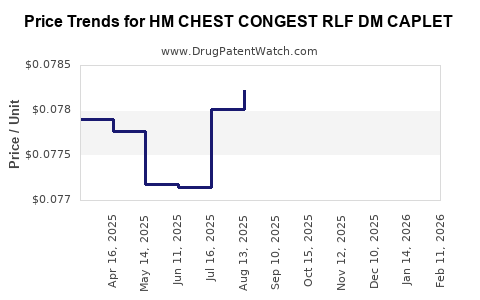
Price Projections for HM Chest Congest RLF DM Caplet
Given current competition, the following projections are made:
| Timeline |
Price Range (per pack) |
Assumptions |
| Year 1 (2023) |
$8.00 – $10.00 |
Competitive positioning, initial market penetration |
| Year 3 (2025) |
$7.50 – $9.50 |
Brand recognition, inflation adjustments |
| Year 5 (2027) |
$7.00 – $9.00 |
Increased competition, generic entry |
– Price points should align with regional regulatory restrictions and consumer demand elasticity.
Key Challenges and Opportunities
- Regulatory hurdles: Pseudoephedrine restrictions could limit distribution or prompt reformulation.
- Consumer preferences: Concerns over ingredient safety, particularly pseudoephedrine, may influence demand.
- Market saturation: Dominance of established brands like Mucinex and Robitussin may restrict rapid market share gains.
- Opportunities: Launching in emerging markets with less saturation, leveraging online channels, and exploring combination formulations for targeted segments.
Key Takeaways
- The OTC cough and cold market is growing steadily, with a focus on multi-symptom products.
- Pricing varies by region, with generics offering lower price points.
- Pseudoephedrine restrictions influence formulation choices and retail strategies.
- HM Chest Congest RLF DM Caplet faces competition from well-known brands but can capitalize on the growing demand for combination OTC medications.
- Price projections indicate slight downward pressure over five years due to generic competition and regulatory changes.
FAQs
-
What is the main advantage of HM Chest Congest RLF DM Caplet?
Its combination of expectorant, cough suppressant, and decongestant ingredients provides comprehensive symptom relief.
-
How do regulatory restrictions affect pricing?
Pseudoephedrine-containing products face purchase limits and placement behind counters, which can raise logistic costs and influence retail pricing.
-
What are the key markets for expansion?
North America and Europe dominate sales; emerging markets in Asia and Africa increasingly adopt OTC medications, presenting growth opportunities.
-
How does pseudoephedrine regulation impact product formulation?
It may necessitate reformulation using phenylephrine or other alternatives, potentially affecting efficacy and consumer perception.
-
What is the outlook for online sales of OTC cough and cold remedies?
Sales expected to increase by 8-10% annually, driven by consumer convenience and pandemic-related shifts in shopping behavior.
References
[1] Markets and Markets. (2022). OTC cough and cold medications market forecast.
[2] U.S. Food and Drug Administration. (2005). Combat Methamphetamine Epidemic Act.
[3] European Medicines Agency. (2022). OTC medicine regulations in the EU.
[4] IQVIA. (2022). Global OTC healthcare market analysis.