Share This Page
Drug Price Trends for HM ASPIRIN
✉ Email this page to a colleague
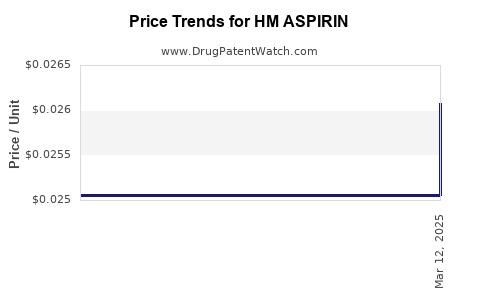
Average Pharmacy Cost for HM ASPIRIN
| Drug Name | NDC | Price/Unit ($) | Unit | Date |
|---|---|---|---|---|
| HM ASPIRIN EC 81 MG TABLET | 62011-0019-01 | 0.01491 | EACH | 2025-12-17 |
| HM ASPIRIN EC 81 MG TABLET | 62011-0019-01 | 0.01481 | EACH | 2025-11-19 |
| HM ASPIRIN EC 81 MG TABLET | 62011-0019-01 | 0.01492 | EACH | 2025-10-22 |
| >Drug Name | >NDC | >Price/Unit ($) | >Unit | >Date |
Market Analysis and Price Projections for HM Aspirin
Overview
HM Aspirin is a generic formulation of acetylsalicylic acid, primarily used for pain relief, anti-inflammatory purposes, and cardiovascular protection. It is produced by numerous generic manufacturers and does not currently have patent protections in most markets, leading to significant price competition.
Market Size and Growth
Global Market Valuation
- The global aspirin market was valued at approximately USD 1.8 billion in 2022.
- Compound annual growth rate (CAGR) is estimated at 4.2% from 2023 to 2030.
- Growth drivers include increased cardiovascular disease prevalence, expanding older populations, and rising awareness of aspirin’s preventive benefits.
Key Regional Markets
| Region | Market Size (USD billion, 2022) | CAGR (2023-2030) | Notes |
|---|---|---|---|
| North America | 0.7 | 3.8% | Mature market; high OTC sales; brand vs. generic competition |
| Europe | 0.5 | 4.0% | Significant OTC sales; established healthcare systems |
| Asia-Pacific | 0.4 | 5.0% | Rapid growth due to expanding healthcare infrastructure |
| Rest of World | 0.2 | 4.5% | Emerging markets with increased access |
Market Dynamics
- The OTC segment dominates, comprising over 70% of total sales.
- Prescriptions are mainly for secondary cardiovascular disease prevention.
- Competition from other NSAIDs and newer drugs affects aspirin market share.
Competitive Landscape
Major Players
- Bayer (original patent holder; now generic producer)
- Teva Pharmaceuticals
- Sandoz (Novartis)
- Mylan (Viatris)
- Local generic manufacturers
Pricing Strategies
- Price competition among generics drives retail prices downward.
- Institutional and OTC channels see significant discounts and promotions.
Price Trends and Projections
Historical Price Range
| Year | Average Retail Price per 81 mg tablet (USD) | Notes |
|---|---|---|
| 2018 | 0.05 | Predominantly generic; high competition |
| 2020 | 0.04 | Slight decline due to increased market saturation |
| 2022 | 0.035 | Continued downward pressure |
Projected Price Trajectory (2023-2028)
- A gradual decline to approximately USD 0.03 per 81 mg tablet by 2028.
- Market saturation and ongoing generic competition expected to suppress prices further.
| Year | Projected Price per 81 mg Tablet (USD) | % Change from 2022 |
|---|---|---|
| 2023 | 0.033 | -5.7% |
| 2025 | 0.031 | -11.4% |
| 2028 | 0.03 | -14.3% |
Factors Influencing Price
- Increased manufacturing efficiencies.
- Entry of low-cost generic manufacturers in emerging markets.
- Regulatory pressures affecting labeling and quality standards.
- Consolidation among top generic producers.
Regulatory Considerations
- Many markets regulate OTC drug prices, constraining wholesale and retail prices.
- Ongoing discussions on standardizing quality standards for generics influence market entry and pricing.
- Price caps or reimbursement policies in countries like the UK (via NICE guidelines) impact the retail price of aspirin.
Investment and Commercialization Outlook
Opportunities
- Growing prevalence of cardiovascular conditions.
- Expansion into emerging markets with untapped demand.
- Opportunities for value-added formulations (e.g., low-dose, combination therapies).
Challenges
- Price suppression due to intense generic competition.
- Regulatory barriers in certain jurisdictions.
- Market saturation in established regions limits revenue growth.
Key Takeaways
- The global aspirin market is stable with moderate growth driven by demography and health awareness.
- Price competition among generics results in sustained downward pressure, with average retail prices declining by approximately 14% through 2028.
- Opportunities exist in emerging markets and in developing value-added formulations.
- Regulatory and reimbursement policies significantly influence pricing dynamics.
FAQs
1. How does the price of HM Aspirin compare to branded versions?
Branded aspirin, like Bayer Aspirin, typically costs 2-3 times more than generic HM Aspirin due to brand premiums and marketing expenses.
2. What factors could cause prices to stabilize or rise?
Introduction of stricter quality standards, regulatory changes, or supply chain disruptions could limit generic competition, causing price stabilization or slight increases.
3. Can patent issues affect HM Aspirin prices?
No. Since most aspirin patents have expired, HM Aspirin operates in a competitive generic environment with minimal patent-related constraints.
4. How significant is OTC sales for aspirin market revenue?
OTC sales account for over 70% of the aspirin market, making them a critical component of revenue and price elasticity considerations.
5. What is the outlook for new formulations or combinations?
Development of low-dose, sustained-release, or combination therapies could diversify revenue streams but face regulatory and market acceptance hurdles.
Citations:
- [1] Market Research Future, "Aspirin Market Analysis & Forecast 2022-2028."
- [2] Grand View Research, "Aspirin Market Size, Share & Trends Analysis."
- [3] IQVIA, "OTC Market Trends Report 2022."
- [4] NICE Guidelines, "Reimbursement Policies for Cardiovascular Drugs."
- [5] GlobalData, "Generic Drug Market Overview 2023."
More… ↓
