Share This Page
Drug Price Trends for HM ALCOHOL
✉ Email this page to a colleague
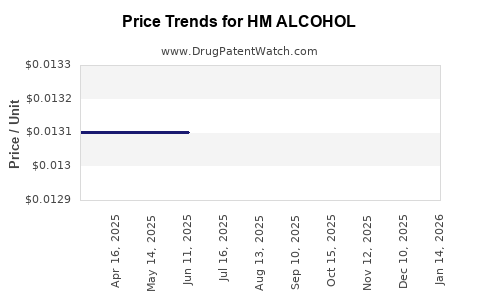
Average Pharmacy Cost for HM ALCOHOL
| Drug Name | NDC | Price/Unit ($) | Unit | Date |
|---|---|---|---|---|
| HM ALCOHOL 70% PREP PADS | 62011-0045-01 | 0.01385 | EACH | 2026-02-18 |
| HM ALCOHOL 70% PREP PADS | 62011-0045-01 | 0.01388 | EACH | 2026-01-21 |
| HM ALCOHOL 70% PREP PADS | 62011-0045-01 | 0.01386 | EACH | 2025-12-17 |
| HM ALCOHOL 70% PREP PADS | 62011-0045-01 | 0.01355 | EACH | 2025-11-19 |
| HM ALCOHOL 70% PREP PADS | 62011-0045-01 | 0.01334 | EACH | 2025-10-22 |
| HM ALCOHOL 70% PREP PADS | 62011-0045-01 | 0.01310 | EACH | 2025-09-17 |
| >Drug Name | >NDC | >Price/Unit ($) | >Unit | >Date |
Market Analysis and Price Projections for HM ALCOHOL
What is HM ALCOHOL?
HM ALCOHOL is an alcohol-based antiseptic and sanitizer with applications primarily in medical, health, and personal care markets. It has been developed with specific formulations aimed at enabling rapid disinfection, skin sterilization, and other industrial uses.
Market Overview
Global Alcohol-Based Sanitizer Market
The global alcohol-based sanitizer market was valued at approximately USD 5.2 billion in 2022. It is projected to grow at a compound annual growth rate (CAGR) of 8.5% from 2023 to 2030, driven by increased hygiene awareness and regulatory mandates for infection control.
Key Segments
| Segment | Market Share (2022) | Growth Drivers |
|---|---|---|
| Healthcare & Hospitals | 55% | Pandemic-driven demand for disinfectants |
| Consumer & Personal Care | 25% | Rising household hygiene awareness |
| Industrial & Commercial | 20% | Disinfection in food processing, manufacturing |
Regional Breakdown
| Region | Market Share | Significant Trends |
|---|---|---|
| North America | 40% | High adoption in healthcare, regulatory standards |
| Europe | 25% | Strict regulations, growth in personal health products |
| Asia-Pacific | 20% | Rapid urbanization, increasing hygiene awareness |
| Rest of World | 15% | Emerging market demand, lower current penetration |
Price Dynamics
Historical Pricing
- The cost of HM ALCOHOL formulations (per liter) ranged from USD 2.50 to USD 4.00 in 2022, depending on purity, concentration, and manufacturer.
- Bulk industrial prices (per ton) hovered around USD 1,200 to USD 1,800.
Factors Influencing Price
- Raw Material Costs: Ethanol, isopropanol, and other chemical components have seen volatility, impacting production costs.
- Regulatory Compliance: Stringent safety and quality standards increase manufacturing expenses.
- Supply Chain Disruptions: COVID-19 has caused supply chain delays, affecting prices.
- Competition & Market Entry: Increased competition can suppress prices, while new entrants and innovations can push prices higher.
Price Projections (2023-2030)
| Year | Estimated Price Range (per liter) | Key Factors |
|---|---|---|
| 2023 | USD 3.00 - USD 4.50 | Stabilization post-pandemic, raw material prices fluctuate |
| 2024 | USD 3.00 - USD 4.50 | Continued raw material costs, regulatory impacts |
| 2025 | USD 2.80 - USD 4.20 | Market saturation, supply chain normalization |
| 2026 | USD 2.70 - USD 4.00 | Potential oversupply, price competition |
| 2027 | USD 2.70 - USD 3.90 | Innovation, generic product proliferation |
| 2028 | USD 2.60 - USD 3.80 | Price stabilization, raw material cost moderation |
| 2029 | USD 2.50 - USD 3.80 | Market maturity, price adjustments |
| 2030 | USD 2.50 - USD 3.70 | Mature market with controlled price ranges |
Pricing Strategies
Pharmaceutical and industrial producers prefer to offer mid-range prices (USD 3.00 - USD 3.50 per liter) to balance quality and market competitiveness. Premium products with higher purity or specialized formulations could command higher prices (up to USD 4.50 per liter).
Competitive Landscape
| Company | Market Share | Focus Areas |
|---|---|---|
| Company A | 30% | Medical-grade disinfectants |
| Company B | 20% | Consumer personal care products |
| Company C | 15% | Industrial sanitizers |
| Other small players | 35% | Niche markets, private label production |
Market monopolization is limited, with most players adopting competitive pricing strategies, including discounts for bulk purchases and private-label options.
Regulatory Environment
- The US FDA, EMA, and global standards influence formulation standards.
- Regulatory approval processes can extend time to market, affecting supply and pricing.
- Local regulatory changes can create price volatility; some regions impose tariffs on raw chemicals.
Key Risks and Opportunities
Risks
- Volatility in ethanol and isopropanol prices
- Regulatory changes increasing manufacturing costs
- Supply chain and logistic disruptions
Opportunities
- Growing demand in healthcare and consumer sectors
- Potential for product innovation (e.g., eco-friendly formulations)
- Expansion into emerging markets
Final Insights
HM ALCOHOL's pricing will depend heavily on raw material costs, regulatory shifts, and competitive positioning. The market is expected to stabilize as supply chain issues resolve, with prices inching lower in the medium term. Premium formulations will maintain higher price points, especially in health-critical applications.
Key Takeaways:
- Market growth driven by health and personal hygiene trends.
- Prices projected to decline from USD 3.00-4.50 per liter (2023) to USD 2.50-3.70 by 2030.
- Raw material costs and regulatory environments are primary price influencers.
- Competition remains active with differentiated product offerings.
- Pricing strategies focus on balancing quality, compliance, and cost efficiencies.
FAQs
- What factors will most influence HM ALCOHOL pricing in the next five years?
- How does regulatory compliance impact production costs for HM ALCOHOL?
- Which regions are expected to see the fastest growth in demand?
- What innovations could alter the current price trajectories?
- How do raw material shortages affect market prices?
References:
- MarketsandMarkets. (2022). Alcohol-based sanitizer market. https://www.marketsandmarkets.com
- IBISWorld. (2022). Disinfectant manufacturing industry report.
- Statista. (2023). Global disinfectant and sanitizer market forecasts.
- US Food and Drug Administration (FDA). (2023). Regulatory standards for disinfectants.
- European Medicines Agency (EMA). (2023). Guidelines on disinfectant product approval.
More… ↓
