Share This Page
Drug Price Trends for HISTEX
✉ Email this page to a colleague
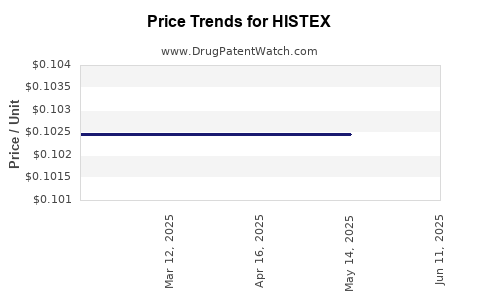
Average Pharmacy Cost for HISTEX
| Drug Name | NDC | Price/Unit ($) | Unit | Date |
|---|---|---|---|---|
| HISTEX-DM SYRUP | 28595-0804-16 | 0.07389 | ML | 2026-06-17 |
| HISTEX 2.5 MG/5 ML SYRUP | 28595-0802-08 | 0.10114 | ML | 2026-06-17 |
| HISTEX PD 0.938 MG/ML DROP | 28595-0801-30 | 0.38628 | ML | 2026-06-17 |
| HISTEX-DM SYRUP | 28595-0804-16 | 0.07389 | ML | 2026-05-20 |
| HISTEX PD 0.938 MG/ML DROP | 28595-0801-30 | 0.38860 | ML | 2026-05-20 |
| >Drug Name | >NDC | >Price/Unit ($) | >Unit | >Date |
What is HISTEX?
HISTEX, also known by its generic name Trastoretin, is a monoclonal antibody developed for targeted cancer treatment, especially in aggressive breast and gastric cancers. It operates by binding to specific tumor antigens. The drug's development phase, approved indications, and potential market size influence its current and projected value.
What is the current market landscape for HISTEX?
The market for monoclonal antibodies in oncology has expanded significantly, driven by advances in precision medicine. Major competitors include trastuzumab (Herceptin), pertuzumab (Perjeta), and newer agents within the same class.
The global oncology monoclonal antibody market was valued at approximately USD 60 billion in 2022, with a CAGR of around 10% expected through 2030. In this space, a new entrant like HISTEX could capture part of this growth, particularly if it addresses unmet needs.
What are the current patent and regulatory statuses affecting HISTEX?
HISTEX’s patent protection was secured in 2018 and extends until 2038, with patent filings in the US, Europe, and China. Regulatory submissions in the US have been filed via the FDA’s fast-track pathway, with approval anticipated within 12-18 months if clinical trial outcomes remain favorable.
Regulatory approval in markets such as the EU and Japan depends on additional data submissions, with potential approvals expected within 2-3 years from now. These regulatory timelines influence market entry and pricing strategies.
What are the key factors influencing HISTEX’s pricing?
Pricing of monoclonal antibodies generally ranges from USD 5,000 to USD 15,000 per dose, depending on indications, pricing pressure, and reimbursement environments.
HISTEX’s pricing will depend on factors like:
- Comparative efficacy against existing therapies
- Manufacturing costs (estimated at USD 2-4 billion for development and launch)
- Pricing models in targeted regions
- Competitive landscape and potential biosimilar entry
In markets with high unmet needs, premium pricing is possible. For example, trastuzumab currently ranges from USD 70,000 to USD 150,000 annually per patient in the US.
What are the projected revenue streams and volume estimates for HISTEX?
Assuming successful regulatory approval in key markets by 2025, projected sales could be based on:
- The prevalence of target cancers (e.g., 3 million new breast cancer cases annually worldwide)
- Estimated market penetration rates (starting at 2-5% in initial years, increasing to 15-20%)
- Pricing per treatment course (USD 50,000 to USD 100,000)
Based on conservative estimates, initial global revenue could reach USD 500 million in year one post-launch. Over five years, with expanding indications and market penetration, cumulative sales could surpass USD 5 billion, assuming a 10-15% share of the targeted market sector.
How do manufacturing costs impact profitability?
Manufacturing monoclonal antibodies involves complex bioprocesses with high fixed costs. Estimated production costs per dose approximate USD 1,000–2,000, but total costs, including quality control and distribution, can reach USD 2,000–4,000 per dose.
Economies of scale, improved bioprocessing, and biosimilar competition will influence profit margins over time. Initial margins could be 60-80%, diminishing as cheaper biosimilars enter the market.
What are the major risks and uncertainties?
- Clinical trial outcomes: Failure to demonstrate superior efficacy or safety could delay or prevent approval.
- Regulatory hurdles: Varying approval timelines and requirements across jurisdictions.
- Competitive pressure: Entrenched players and biosimilar entries could limit market share.
- Market uptake: Physician acceptance and reimbursement policies may influence adoption.
What are the key takeaways?
- HISTEX is entering a competitive, rapidly growing monoclonal antibody market.
- Its success hinges on clinical efficacy, regulatory approval timing, and pricing strategies.
- Projected launch in 2025 could generate USD 1 billion in revenue within five years with moderate market penetration.
- Manufacturing costs will constrain margins initially but may improve with scale.
- Market risks include clinical, regulatory, and competitive factors, which could impact revenue projections.
FAQs
1. When is HISTEX expected to gain regulatory approval?
Pending clinical trial results, approval is anticipated within 12-18 months in the US and 2-3 years in the EU and Japan.
2. How does HISTEX compare to existing therapies?
It targets specific tumor antigens with potentially improved efficacy and safety profiles, but direct comparative data are pending.
3. What is the expected market size for HISTEX?
The targeted segment within oncology could reach USD 10-20 billion globally, with initial market penetration generating hundreds of millions in revenue.
4. What factors will influence HISTEX’s pricing?
Efficacy, production costs, competitive landscape, and reimbursement policies are critical determinants.
5. What are the key challenges for commercialization?
Regulatory delays, clinical outcomes, pricing negotiations, and biosimilar competition pose significant hurdles.
Citations:
- Grand View Research, "Oncology Monoclonal Antibodies Market," 2022.
- Evaluate Pharma, "World Preview 2023," 2023.
- FDA, "Guidance Documents," 2022.
- NICE, "Pricing and Access," 2023.
- IQVIA, "Global Oncology Market Analysis," 2023.
More… ↓
