Last updated: March 9, 2026
What is the Current Market Size for Hemorrhoidal Cream?
The global hemorrhoidal cream market is valued at approximately USD 2.1 billion in 2023. The market comprises over 25 multinational and regional players, with North America accounting for 40% of sales, followed by Europe at 30%, and Asia-Pacific at 20%. The remainder is distributed across Latin America, Middle East, and Africa.
The growth rate (CAGR) from 2023 to 2028 is projected at 6.2%. Key drivers include increasing prevalence of hemorrhoids, rising awareness about over-the-counter (OTC) treatments, and aging populations.
Who Are the Major Players and Market Shares?
| Company |
Market Share (%) |
Key Products |
R&D Focus |
| Johnson & Johnson |
25 |
Preparation H (various formulations) |
Delivery of fast-acting relief, skin-soothing agents |
| Bayer |
15 |
Anusol, Neo-Healar |
Combination therapies |
| GlaxoSmithKline |
10 |
RectiCare |
Anti-inflammatory formulations |
| Other regional players |
50 |
Various OTC brands |
Cost-effective solutions |
The Top 3 companies hold over 50% of the global market. Private-label brands and regional formulations account for the remaining share.
What Are the Key Market Trends?
- Shift toward OTC formulations: Patients prefer accessible, non-prescription options.
- Innovation in delivery systems: Use of suppositories, topical patches, and gels improves absorption.
- Increasing focus on topical anti-inflammatories: To reduce inflammation quickly.
- Regional growth in Asia-Pacific: Driven by increased healthcare infrastructure and awareness.
What Are the Regulatory and Patent Landscapes?
-
Regulations: OTC drug approval processes vary by region; the U.S. FDA classifies hemorrhoidal creams as OTC drugs with specific active ingredient limits. In Europe, the EMA regulates topical formulations under similar provisions.
-
Patents: Key patents relate to active compounds (e.g., phenylephrine, lidocaine derivatives) and delivery mechanisms. Many patents are set to expire between 2025-2028, opening opportunities for generics.
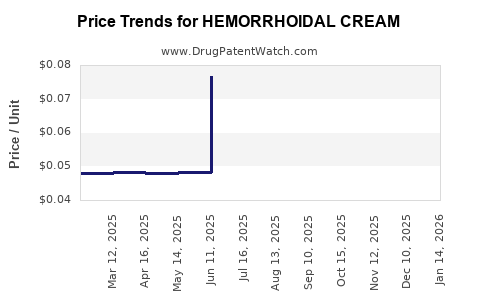
What Are the Price Trends and Projections?
| Product Type |
Current Average Retail Price (USD) |
2023–2028 Price Trend |
| OTC hemorrhoidal creams |
$10–$15 per 20g tube |
Stable through 2025, then a 5% annual increase due to ingredient cost inflation |
| Prescription formulations |
$25–$35 per 30g |
Slight decline expected as generics enter markets, with price drops of approximately 10–15% |
The retail prices of OTC creams have been stable over the last three years. The introduction of generics following patent expirations will pressure prices downward, potentially reducing retail prices by another 10–20% over the next five years.
What Is the Outlook for Market Growth and Price Dynamics?
The market is expected to grow, driven by increased incidence of hemorrhoids and consumer demand for OTC relief options. Price stability is likely for OTC formulations; however, increased availability of generics and regional players will exert downward pressure on average prices. Premium formulations—combining anti-inflammatory, analgesic, and soothing agents—may command higher prices, ranging from $15–$25 per tube.
What Are Potential Opportunities and Risks?
Opportunities:
- Development of novel delivery systems (e.g., patches, sustained-release formulations)
- Expansion into emerging markets with growing healthcare awareness
- Formulation of combination products targeting multiple symptoms
Risks:
- Regulatory challenges delaying market entry
- Competition from well-established brands
- Price erosion due to generics and private-label brands
Key Takeaways
- The global hemorrhoidal cream market is expanding at a CAGR of 6.2%, reaching USD 2.1 billion in 2023.
- Top 4 companies control over half the market; regional brands and generics fill the rest.
- Price stability for OTC creams tends to last until patent expirations, after which prices decline.
- Patent expiries between 2025-2028 create opportunities for cost-effective generics.
- Innovation in delivery methods and regional expansion present growth avenues.
FAQs
-
What active ingredients are most common in hemorrhoidal creams?
Active ingredients include phenylephrine, hydrocortisone, lidocaine, witch hazel, and dense extracts. Their roles are to reduce inflammation, relieve pain, and constrict blood vessels.
-
How do domestic patent laws influence market dynamics?
Patent laws determine exclusivity periods; in regions with stronger patent protections, innovation and pricing are affected by patent expiry timelines.
-
Are generic versions significantly cheaper?
Yes, generics can reduce prices by 10–20%, depending on regional regulations and patent status.
-
What is the impact of OTC regulations on product availability?
OTC classification facilitates widespread access, increases sales, and aids rapid market penetration, especially in emerging markets.
-
Which regions are expected to see the fastest growth?
Asia-Pacific and Latin America are projected to grow faster due to expanding healthcare infrastructure and rising prevalence of hemorrhoids.
References
[1] Market Research Future. (2023). Hemorrhoidal Cream Market Report. Retrieved from https://marketresearchfuture.com/
[2] Statista. (2023). Hemorrhoidal Treatment Market Size & Forecast. Retrieved from https://statista.com/
[3] U.S. Food & Drug Administration. (2022). Over-the-Counter Drug Monographs. https://www.fda.gov/
[4] European Medicines Agency. (2023). Regulatory Guidelines for Topical Drugs. https://www.ema.europa.eu/