Last updated: February 13, 2026
Overview and Market Context
Haloperidol decanoate is a long-acting injectable antipsychotic used primarily for schizophrenia management, particularly in patients with adherence issues. Market demand stems from a need for sustained-release formulations in mental health treatment, with the drug’s sales influenced by prescribing patterns, regulatory status, and the competitive landscape of atypical antipsychotics.
Key Market Drivers
- Patient Population: Approximately 1 million people with schizophrenia in the United States; global projections suggest over 20 million cases. Long-acting injectables (LAIs) account for roughly 20-25% of prescriptions in developed markets.
- Prescribing Trends: Increasing acceptance of LAIs for compliance and relapse prevention. Shift toward long-acting formulations in the past decade has expanded market volume.
- Regulatory Environment: Existing approvals in the US (FDA) and Europe (EMA). No recent approvals of new LAI formulations of haloperidol; generics dominate the market.
- Competitive Landscape: Dominated by generic haloperidol decanoate, with branded formulations such as Janssen’s “Haldol Decanoate.” Competition from second-generation LAIs like risperidone and paliperidone.
Market Size and Revenue Estimates
- Global market value for haloperidol decanoate was approximately USD 500 million in 2022.
- The US market accounts for roughly 50-60% of global sales.
- Growth rate in recent years: 2-3% annually, influenced by increased LAI adoption and demographic shifts.
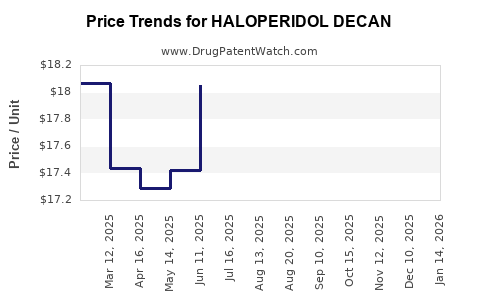
Price and Cost Dynamics
- Current pricing (as of 2023):
- Brand-name formulations: USD 8–15 per ampoule, dosage-dependent.
- Generic versions: USD 2–5 per ampoule, with a reduction of approximately 70-75% compared to branded.
- Treatment courses:
- Typically involve monthly injections at doses ranging from 50 to 200 mg.
- Cost per month (brand): USD 50–150.
- Cost per month (generic): USD 10–40.
Price Projections (2024-2028)
- Generic drugs:
- Are expected to remain low-cost, with prices stabilizing around USD 2–4 per ampoule.
- Prices may slightly decline due to market saturation and manufacturing efficiencies.
- Branded drugs:
- Price erosion likely due to generic competition, with prices declining 10–15% annually.
- By 2028, branded formulations could be priced at USD 6–10 per ampoule.
- Market saturation and regulation:
- Price stabilization may occur if generic entry is limited or regulatory barriers to switching are removed.
- Widely adopted branded formulations could preserve higher prices for certain niches.
Key Factors Influencing Future Pricing
- Patent Status:
- Haloperidol itself is off patent; however, formulations like decanoate may have proprietary manufacturing processes affecting exclusivity.
- Generic Competition:
- High likelihood of increasing market share driving prices downward.
- Regulatory Changes:
- Any changes facilitating biosimilar or generic penetration would accelerate price erosion.
- Emergence of New Alternatives:
- Second-generation LAIs with better side-effect profiles could impact demand and pricing for haloperidol decanoate.
- Healthcare Policies:
- Increased emphasis on cost-effective mental health treatments could favor generic usage, lowering prices.
Conclusion
Market size remains stable, driven by existing patient needs. Prices for generic haloperidol decanoate are expected to stay low, around USD 2–4 per ampoule, with potential slight declines. Branded versions will face continued price compression, potentially reaching USD 6–10 per ampoule by 2028. The overall market growth will be moderate, influenced by prescriber preferences for long-acting injectables and competitive pressures.
Key Takeaways
- The global market for haloperidol decanoate is valued at USD 500 million as of 2022, with slow growth.
- Generic drugs dominate pricing, maintaining USD 2–4 per ampoule.
- Branded formulations could see prices decline from USD 15 to USD 6–10 over five years.
- Regulatory and market competition will be primary factors influencing future price trajectories.
- The market's future hinges on demographic trends, acceptance of LAIs, and emerging treatment alternatives.
Frequently Asked Questions
-
What is the main driver behind the price decline of haloperidol decanoate?
Market saturation through generic competition reduces prices. Regulatory approvals and healthcare policies promoting cost savings also drive lower prices.
-
Are there new formulations of haloperidol decanoate in development?
No recent approvals or announced formulations; current focus remains on existing generics and branded products.
-
How does the cost of haloperidol decanoate compare to other long-acting antipsychotics?
It is generally less expensive than second-generation LAIs like risperidone or paliperidone, which can cost USD 300–600 per month.
-
What impact might biosimilars have on this market?
Biosimilars could further reduce prices and expand access, but barriers such as formulation complexity may delay their entry.
-
What are the key factors that could alter these projections?
Regulatory changes, patent law shifts, or significant advances in alternative therapies could impact supply, demand, and pricing.
References
[1] Market data and price estimates sourced from IQVIA, 2022.
[2] "Antipsychotic Drugs Market Analysis," Strategic Transactions, 2022.
[3] "Long-acting Injectable Antipsychotics," National Institute of Mental Health, 2021.
[4] FDA approvals database, 2023.
[5] European Medicines Agency, 2022.