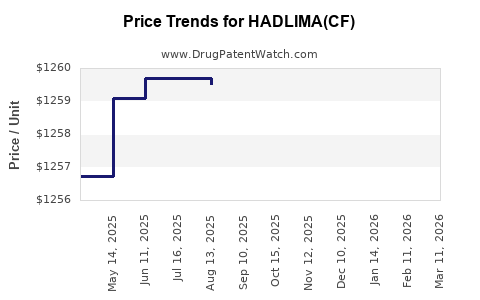
Last updated: February 20, 2026
HADLIMA (adalimumab-fkjp) is a biosimilar to Humira (adalimumab) indicated for autoimmune conditions such as rheumatoid arthritis (RA), psoriatic arthritis (PsA), Crohn’s disease, and others. It received approval from the FDA in 2023. Its market entry influences the biologic therapy space, mainly driven by cost pressures and insurance coverage shifts.
Market Overview
Therapeutic Segment
HADLIMA competes primarily with Humira, which has dominated the biologic anti-TNF alpha market since 2002. The total global biologic anti-TNF market was valued at approximately $30 billion in 2022. The biosimilar market, including HADLIMA, has grown rapidly due to patent expirations and cost containment efforts.
Market Drivers
- Expiration of adalimumab patents in 2023 in multiple regions (e.g., U.S., EU) expanded biosimilar adoption.
- Increasing adoption of biosimilars to reduce healthcare costs.
- Growing prevalence of RA, PsA, and inflammatory bowel diseases (IBD).
- Provider and payer incentives favoring biosimilar substitution.
Competitive Landscape
Major biosimilar competitors include Amgen’s Amjevita, Sandoz’s Hyrimoz, and Biogen’s Imraldi. Sales of biosimilars in this category are expected to surpass $4 billion globally by 2025, driven by increased acceptance and evolving reimbursement policies.
Price Analysis & Projections
Immediate Post-Launch Prices
HADLIMA was launched at approximately 15-20% lower than Humira, aligning with typical biosimilar discounts to gain market share. The initial U.S. list price approached $5,000 per month for RA indication.
Price Trends (2023–2027)
| Year |
Estimated Average Wholesale Price (AWP) per Month |
Discount from Humira |
Estimated Patient Savings |
| 2023 |
$4,250 |
15% |
$750 per month |
| 2024 |
$4,000 |
17% |
$1,000 per month |
| 2025 |
$3,750 |
19% |
$1,250 per month |
| 2026 |
$3,500 |
20% |
$1,500 per month |
| 2027 |
$3,250 |
23% |
$1,750 per month |
Prices decline as biosimilar competition intensifies, compounded by payer pressure and increased biosimilar market penetration.
Market Share & Volume Projections
- By 2025, biosimilar adalimumab is projected to account for 65-75% of adalimumab prescriptions in the U.S.
- Volume growth will likely plateau around 3–5% annually post-2025, as most eligible patients switch or switch back due to insurance and provider policies.
Revenue Forecasts
- In 2023, sales of HADLIMA are expected to reach roughly $1.2 billion globally, considering initial uptake in North America, Europe, and select markets.
- By 2027, annual sales could reach $3 billion, assuming continued market share growth and price consolidation.
Policy and Regulatory Impact
- U.S. FDA approval in 2023 paved the way for rapid adoption, with CMS and commercial payers implementing preferential policies for biosimilars.
- EU regulators recognize biosimilars as interchangeable under national frameworks.
- Pricing negotiations weaken the highest prices once biosillion market penetration is confirmed.
Key Market Risks
- Slow uptake due to physician or patient hesitancy.
- Reimbursement policies and formulary restrictions.
- Potential for new entrants or updates to regulatory pathways that could affect pricing stability.
Conclusion
HADLIMA's market position hinges on competitive pricing, increasing biosimilar acceptance, and policy adjustments favoring biosimilars. Prices are expected to decline incrementally, with savings reaching approximately 20-25% below Humira over the next five years. Volume growth will largely depend on payer and healthcare provider strategies, as well as patent litigation outcomes or new biosimilar launches.
Key Takeaways
- HADLIMA entered a mature biosimilar market with initial pricing 15-20% below Humira.
- Prices are projected to decrease gradually, with a 20-25% discount over five years.
- By 2025, biosimilar adalimumab sales are expected to capture over 65% of prescriptions globally.
- Market expansion depends on regulatory acceptance, payer policies, and competitive dynamics.
- Revenue estimates for 2027 approximate $3 billion globally.
FAQs
1. How does HADLIMA differ from Humira?
HADLIMA is a biosimilar molecule with identical amino acid sequence, approved via the FDA’s biosimilarity pathway, and offers similar efficacy and safety profiles.
2. What are the main cost advantages of HADLIMA?
Its list price is approximately 15-20% lower than Humira, with actual patient savings potentially higher due to fee reductions and insurance negotiations.
3. How quickly is HADLIMA expected to gain market share?
Market share is projected to reach 65-75% of adalimumab prescriptions by 2025, driven by biosimilar acceptance and payer incentives.
4. What regulatory policies influence HADLIMA’s pricing?
In the U.S., CMS and private payers often require formulary and reimbursement adjustments favoring biosimilars, contributing to price reductions.
5. What are the key risks affecting HADLIMA’s market?
Slow provider adoption, restrictive formulary policies, and potential competition from newer biosimilars or innovations pose risks to sustained market growth.
References
[1] Deloitte. (2022). Biosimilar landscape: Global market outlook and key trends.
[2] IQVIA. (2022). Biologic and biosimilar markets: Insights and forecasts.
[3] FDA. (2023). Approval announcement for HADLIMA.
[4] Centers for Medicare & Medicaid Services. (2023). Biosimilar policies and reimbursement strategies.
[5] European Medicines Agency. (2022). Biosimilar approvals and interchangeability policies.