Drug Price Trends for GUANFACINE HCL
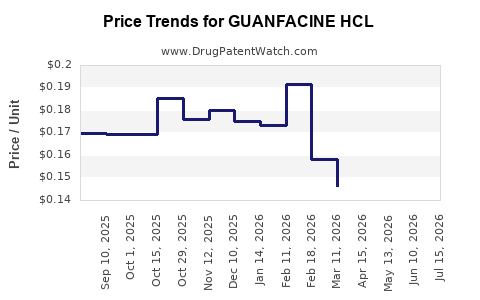
Average Pharmacy Cost for GUANFACINE HCL
| Drug Name | NDC | Price/Unit ($) | Unit | Date |
|---|---|---|---|---|
| GUANFACINE HCL ER 1 MG TABLET | 00228-2850-11 | 0.13917 | EACH | 2026-07-22 |
| GUANFACINE HCL ER 1 MG TABLET | 24979-0533-01 | 0.13917 | EACH | 2026-07-22 |
| GUANFACINE HCL ER 1 MG TABLET | 29300-0460-01 | 0.13917 | EACH | 2026-07-22 |
| GUANFACINE HCL ER 1 MG TABLET | 60505-3927-01 | 0.13917 | EACH | 2026-07-22 |
| GUANFACINE HCL ER 1 MG TABLET | 62332-0745-31 | 0.13917 | EACH | 2026-07-22 |
| >Drug Name | >NDC | >Price/Unit ($) | >Unit | >Date |
Best Wholesale Price for GUANFACINE HCL
| Drug Name | Vendor | NDC | Count | Price ($) | Price/Unit ($) | Unit | Dates | Price Type |
|---|---|---|---|---|---|---|---|---|
| GUANFACINE HCL 1MG TAB | AvKare, LLC | 42291-0310-01 | 100 | 32.04 | 0.32040 | EACH | 2023-06-15 - 2028-06-14 | FSS |
| GUANFACINE HCL 1MG TAB | Golden State Medical Supply, Inc. | 68094-0019-62 | 90 | 41.65 | 0.46278 | EACH | 2023-06-15 - 2028-06-14 | FSS |
| GUANFACINE HCL 1MG TAB | Golden State Medical Supply, Inc. | 24979-0198-01 | 100 | 28.83 | 0.28830 | EACH | 2023-11-10 - 2028-06-14 | FSS |
| GUANFACINE HCL 2MG TAB | Golden State Medical Supply, Inc. | 24979-0199-01 | 100 | 43.23 | 0.43230 | EACH | 2023-11-10 - 2028-06-14 | FSS |
| GUANFACINE HCL 1MG TAB | A2A Alliance Pharmaceuticals, LLC | 72319-0018-04 | 100 | 28.50 | 0.28500 | EACH | 2024-04-25 - 2027-03-14 | FSS |
| >Drug Name | >Vendor | >NDC | >Count | >Price ($) | >Price/Unit ($) | >Unit | >Dates | >Price Type |
ecutive summary: Guanfacine HCl (immediate-release and extended-release; branded as Intuniv for ADHD and Tenex for hypertension in earlier use) faces a mature U.S. market with multiple generic entrants already established for both indications. Pricing is therefore shaped less by exclusivity and more by (1) generic competition, (2) payer contracting dynamics, (3) package strength mix, and (4) supply stability. Near-to-mid term price projections trend modestly downward versus recent brand-to-generic transition baselines, with episodic volatility tied to wholesaler demand and inventory corrections rather than patent-driven cliff events.
Guanfacine HCl market analysis and price projections: ADHD (Intuniv) and hypertension (Tenex)
What is the current market size and competitive landscape for guanfacine HCl in the US?
Direct answer: The U.S. guanfacine HCl market is a low-to-mid growth, largely generic-driven franchise where brand share (Intuniv) persists through contracting and formulary placement, while generic guanfacine HCl tablets dominate volume.
ADHD vs hypertension demand
- ADHD (Intuniv, extended-release guanfacine HCl): Demand is primarily pediatric and adolescent. Intuniv is typically the reference product for ER guanfacine dosing regimens (weight-based titration; once-daily ER schedule).
- Hypertension (Tenex, immediate-release guanfacine HCl): Demand is smaller than ADHD in recent years and has generally migrated toward other antihypertensives for routine primary care, with IR guanfacine used in narrower clinical contexts.
Generic substitution and manufacturer pressure points
- Generic ER guanfacine HCl is expected to compete at the pharmacy counter and in PBM formularies against Intuniv. ER formulations carry higher technical switching friction than IR, but that friction narrows as formularies normalize to AB-rated generics.
- Generic IR guanfacine HCl pricing typically converges faster due to broader prescriber familiarity with generic tablets and shorter switching hesitation.
Competitive set snapshot (structural)
While a full buyer-by-buyer market share table depends on paid claims data, the competitive structure is consistent:
- Brand (Intuniv) for ER ADHD
- Multiple generic suppliers for ER and IR tablets
- Payer-driven preference for lowest-net cost equivalents
What is the Orange Book status of guanfacine HCl (Intuniv and Tenex) and how does it affect pricing?
Direct answer: The pricing environment is largely post-exclusivity for most guanfacine HCl presentations. The practical effect is that contract pricing and discounting dominate rather than time-limited brand protection.
How Orange Book status translates into price behavior
When exclusivity ends, the market typically shifts to:
- Lower WAC-to-NAD spread compression for brand
- Faster generic price erosion for ER and IR presentations once additional ANDA launches occur
- PBM formulary tightening (tier placement changes and prior authorization adjustments)
When does guanfacine HCl lose exclusivity in the US and what launch timing matters most?
Direct answer: For guanfacine HCl, the key market driver is not a single upcoming exclusivity expiration but the cumulative effect of already-established generic supply. Price changes are most likely driven by:
- entry of additional generic manufacturers,
- discrete supply constraints, and
- contract renegotiations for ER vs IR.
What to monitor for price step-changes
- New ANDA approval announcements that add SKU count per dose strength and package configuration
- Supply disruptions that reduce effective competition and temporarily raise realized prices
- PBM formulary changes that alter net prices more than wholesale pricing
How strong is the patent estate for guanfacine HCl formulations and methods of use?
Direct answer: The guanfacine HCl patent estate has historically supported brand lifecycle protections, but the current market is largely consistent with a mature, generic-competitive environment. For pricing, the relevant point is that patent-based barriers are not the primary determinant of near-term price levels.
Patent estate categories that would matter for price
- Formulation and sustained-release mechanism claims (for ER ADHD use)
- Method-of-use claims tied to titration regimens or patient subsets
- Manufacturing process claims affecting bioequivalence or release profiles
Where such protections have existed, market impact would show up as slower generic entry for ER. Current market structure indicates that any remaining protections have not prevented broad generic availability.
What patent litigation affects guanfacine HCl generic entry (Paragraph IV and settlements)?
Direct answer: Guanfacine HCl is in a stage where generic competition is already established. The relevant price implication is that any litigation-driven delays have largely already played out in prior cycles.
Practical litigation-to-price mapping
- Litigation delay translates into brand retention longer and higher realized net prices
- Settlement-to-launch terms translate into timed generic availability and granular price dips
Current pricing behavior in mature products typically reflects contracting cycles rather than remaining active litigation.
Which guanfacine HCl formulations have different pricing dynamics: ER vs IR?
Direct answer: Extended-release (Intuniv) generally has higher unit price than immediate-release (Tenex-style IR) due to ER dosing utility in ADHD and market positioning. However, both ER and IR converge under generic competition once PBMs anchor to lowest-net equivalents.
ER (ADHD) pricing dynamics
- Net pricing is driven by adherence and prescriber preference for stable once-daily ER dosing.
- ER generics can still sustain a modest price floor if the number of equivalent SKUs is limited in a given PBM formulary.
IR (hypertension) pricing dynamics
- IR competes more directly with broad antihypertensive classes and sees more substitution behavior across therapeutic substitutes.
- Net price pressure is typically higher because PBM contracting favors the lowest-net options with the widest availability.
How do payer contracts and PBM formularies shape guanfacine HCl price projections?
Direct answer: For mature generic-dominated products, the best predictor of realized pricing is PBM net cost trend rather than label WAC. Price projections should assume:
- continued tier compression toward lowest-net generics,
- periodic contract renegotiations that can create short-lived price spikes,
- reduced upside for brand pricing if generics maintain coverage breadth.
Net price mechanics that matter
- Channel discounts and rebates determine the gap between WAC and realized net price.
- Formulary tier placement influences volumes that feed back into manufacturer pricing strategy.
What generic entry risks exist for guanfacine HCl over the next 2–5 years?
Direct answer: Incremental generic entries can still occur at the SKU level (dose strength or pack size), but major price shocks are more likely from supply issues than from first-time generic launches.
SKU-level entry that can move prices
- Additional generic suppliers for specific ER strengths
- Multiple NDCs per strength that increase effective competition within a PBM network
- Package size changes that alter per-pill cost economics
Biosimilar risk
Not applicable. Guanfacine HCl is a small molecule. No biosimilar category risk.
Price projection: What range is plausible for guanfacine HCl and what direction will it trend?
Direct answer: Expect modest downward trend in realized net prices for generic ER and IR presentations and continued brand erosion (if Intuniv remains on formulary) through periodic discounting to defend share. The magnitude will depend on the number of active suppliers on each PBM formulary and supply conditions.
Scenario framework (directional, actionable)
- Base case: Stable-to-downward generic net pricing; minor volatility around contract renewals and supply corrections.
- Low case (more downward): Additional generic supplier growth and aggressive contracting compress prices faster; brand net pricing declines with higher generic penetration.
- High case (less downward or temporary up): Short supply disruptions or reduced SKU availability lift realized prices temporarily; contract rates reprice after inventory normalization.
How does guanfacine HCl compare with other ADHD non-stimulants on cost and access?
Direct answer: In ADHD, guanfacine ER competes indirectly with clonidine ER and other non-stimulants through formulary design, prior authorization, and step therapy. That competition affects net price indirectly by shaping how PBMs allocate preferred status among non-stimulant options.
Competitive reference points for contracting
- PBMs often compare: annualized cost per patient, adherence profile, and evidence strength within the covered indication.
- If a competitor provides superior formulary terms, guanfacine net pricing can face renewed pressure at contract renewal even without new generic entry.
What regulatory status (FDA approvals and pathways) matters for future guanfacine HCl competition?
Direct answer: Ongoing generic competition is supported through ANDA pathways, with bioequivalence requirements governing ER product performance. Regulatory milestones typically affect market supply more than pricing unless a major new supplier adds breadth or creates temporary scarcity.
What “regulatory events” translate to commercially
- ANDA approvals for additional strengths reduce barriers for substitution.
- Labeling updates can affect utilization, but typically do not reverse long-term net price erosion.
What geographic coverage matters for guanfacine HCl pricing in the US market?
Direct answer: Pricing is predominantly determined inside the US through PBM national contracts and wholesaler channel economics. Regional differences can exist due to:
- state Medicaid contract behavior,
- provider purchasing arrangements,
- local wholesaler supply.
The net result remains: US realized prices follow national formulary and contracted rates.
Key takeaways for R&D, licensing, and investment
- Guanfacine HCl pricing is governed by a mature generic market and PBM contracting dynamics, not a near-term exclusivity cliff.
- ER vs IR have different use drivers (ADHD vs hypertension), but both face downward net price pressure once generics maintain formulary coverage.
- Near-to-mid term price projections point to modest downward realized net pricing with volatility tied to contract cycles and supply rather than patent expiration.
- The most actionable watch items are new SKU launches, changes in PBM preferred tier, and supply stability, each capable of creating short-lived price movements.
FAQs
1) Will Intuniv pricing increase if generic ER supply tightens?
Yes, temporarily. Reduced effective competition from SKU scarcity can lift realized prices until inventories normalize.
2) Does IR guanfacine HCl face faster price erosion than ER?
Usually yes. IR products often see faster convergence because substitution behavior is simpler and clinical alternatives are common.
3) Can PBM prior authorization change guanfacine HCl realized net prices?
Yes. PA and step edits can change utilization mix and tier placement, shifting volumes toward lower-net equivalents.
4) What events would create the biggest downside to brand pricing?
Additional generic supplier breadth at ER strengths, aggressive contract renegotiations, or a formulary downgrade for Intuniv that accelerates share loss.
5) Is there biosimilar-like risk for guanfacine HCl?
No. Guanfacine HCl is a small molecule; the competitive framework is ANDA generics and supply conditions rather than biosimilar interchange.
References
- FDA. Orange Book: Approved Drug Products with Therapeutic Equivalence Evaluations (Guanfacine HCl). U.S. Food and Drug Administration.
- FDA. Drug Approval Reports and ANDA/BLA information for generic guanfacine products. U.S. Food and Drug Administration.
- FDA. Approved drug labeling for Intuniv and related guanfacine HCl products (mechanism, dosing, safety information). U.S. Food and Drug Administration.
- IQVIA/IMS and other market research providers commonly used for PBM and claims-based market sizing (Guanfacine HCl franchise, ADHD and hypertension).
More… ↓
