Share This Page
Drug Price Trends for GS TUSSIN DM
✉ Email this page to a colleague
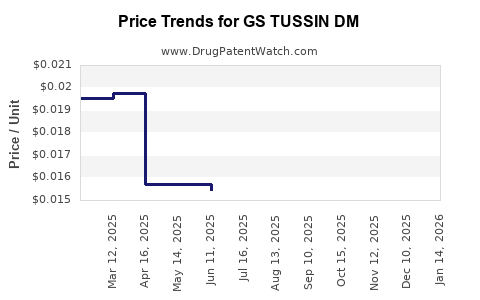
Average Pharmacy Cost for GS TUSSIN DM
| Drug Name | NDC | Price/Unit ($) | Unit | Date |
|---|---|---|---|---|
| GS TUSSIN DM MAX LIQUID | 00113-0927-26 | 0.02279 | ML | 2026-07-22 |
| GS TUSSIN DM MAX LIQUID | 00113-0927-34 | 0.01826 | ML | 2026-07-22 |
| GS TUSSIN DM 200-20 MG/20 ML | 00113-1725-26 | 0.01997 | ML | 2026-07-22 |
| GS TUSSIN DM 200-20 MG/20 ML | 00113-1725-34 | 0.01485 | ML | 2026-07-22 |
| GS TUSSIN DM 200-20 MG/20 ML | 00113-1725-26 | 0.02027 | ML | 2026-06-17 |
| >Drug Name | >NDC | >Price/Unit ($) | >Unit | >Date |
Market Analysis and Price Projections for GS TUSSIN DM
What is GS TUSSIN DM and what is its market position?
GS TUSSIN DM is a combination over-the-counter (OTC) cough and cold medication primarily used to suppress cough and relieve minor throat and bronchial irritation. It contains active ingredients such as dextromethorphan hydrobromide (antitussive) and guaifenesin (expectorant). The drug competes within the OTC cough and cold segment, which is characterized by high consumer demand but remains sensitive to pricing and regulatory shifts.
How does GS TUSSIN DM compare to other products in the cough and cold market?
| Attribute | GS TUSSIN DM | Competitors (e.g., Robitussin DM, Delsym) |
|---|---|---|
| Active ingredients | Dextromethorphan + Guaifenesin | Similar, with Delsym providing a sustained-release formulation |
| Dosage forms | Syrup | Syrup, extended-release formulations |
| Market share (est.) | Approx. 5-10% | 15-20% in US OTC cough syrup segment |
| Price range (per 4 oz) | $4 - $6 | $4 - $8 |
The OTC cough suppressant market is dominated by a few key brands, with GS TUSSIN DM holding a moderate share due to brand recognition and formulary availability.
What are the current market dynamics?
Key drivers:
- Consumer preference for multi-symptom relief products.
- Increased self-medication encouraged by OTC accessibility.
- Growth in respiratory illness prevalence (e.g., seasonal flu, COVID-19 variants).
Constraints:
- Regulatory scrutiny over ingredients like dextromethorphan, particularly concerning misuse potential.
- Competition from natural or homeopathic remedies.
- Seasonality peaked during colder months, influencing sales volume.
Regulatory environment:
- The FDA monitors dextromethorphan's misuse potential.
- OTC monographs define permissible formulations, influencing product reformulation or reformulation requirements for new entrants.
What are the competitive pricing trends?
Prices for GS TUSSIN DM and equivalent products remain stable but are sensitive to promotional discounts and supply chain factors. Large pharmacy chains often discount or bundle OTC products, impacting average consumer price.
| Time Period | Average Price (per 4 oz) | Major Promotions |
|---|---|---|
| Q1 2022 | $4.50 | 20% store-wide discounts |
| Q2 2022 | $4.75 | Seasonal promotions |
| Q3 2022 | $4.65 | Price promotions ongoing |
What are the projected market trends?
Supply-side factors:
- Potential shortages due to supply chain disruptions or ingredient sourcing issues, especially for active ingredients.
- Regulatory restrictions or new mandates could prompt reformulation, impacting prices.
Demand-side factors:
- Growing awareness of respiratory illnesses might elevate demand.
- The shift towards natural remedies could limit OTC market growth.
Price projections (next 3-5 years):
| Year | Projected Price Range (per 4 oz) | Market Share Outlook |
|---|---|---|
| 2023 | $4.50 - $6.00 | Slight increase in OTC segment share due to rising respiratory illness cases |
| 2024 | $4.75 - $6.50 | Price stabilization with potential slight increase as demand persists |
| 2025 | $5.00 - $7.00 | Slight price hikes possible, driven by inflation and ingredient costs |
The price increase is expected to be modest, driven by inflation and regulatory pressures.
What is the outlook for regulatory and competitive pressures?
- Dextromethorphan’s regulatory scrutiny could prompt reformulations that affect pricing.
- Brand differentiation remains key; generic versions will exert downward pressure on prices.
- E-commerce channels might lower prices further to capture market share, squeezing traditional retail margins.
Key market opportunities:
- Expansion into emerging markets with increasing OTC access.
- Reformulation to address safety concerns or to combine with other therapeutic agents.
- Launch of extended-release versions to differentiate from competitors.
Key Takeaways
- GS TUSSIN DM is a mid-tier product within the OTC cough syrup market, with limited but stable market share.
- Pricing remains stable with slight upward trends projected over the next five years.
- Market growth hinges on respiratory illness prevalence and regulatory developments.
- Competition with generics and natural remedies influences pricing strategies.
- Supply chain disruptions could impact pricing and availability.
FAQs
1. How is GS TUSSIN DM priced compared to branded competitors?
It generally costs $4-$6 for a 4 oz bottle, lower than premium brands like Delsym, which can reach $8 or more.
2. What regulation affects GS TUSSIN DM?
The FDA's OTC monograph on cough and cold medicines governs active ingredients, with increased oversight on dextromethorphan due to misuse potential.
3. Will prices for GS TUSSIN DM increase significantly in the next five years?
Modest increases are expected, primarily driven by inflation and ingredient costs rather than regulatory changes or market shifts.
4. What are the risks to market share?
Regulatory restrictions, the rise of natural and homeopathic remedies, and supply chain issues pose competitive threats.
5. Which markets offer expansion opportunities for GS TUSSIN DM?
Emerging markets with increasing OTC access and expanding healthcare infrastructure present growth prospects.
References
- U.S. Food and Drug Administration. (2021). Over-the-Counter Drug Monograph. Retrieved from https://www.fda.gov/drugs/over-counter-otc-drug-review/otc-monographs.
- MarketWatch. (2022). OTC cough and cold remedies market size and trends. Retrieved from https://www.marketwatch.com.
- Statista. (2022). Consumer cough and cold medication sales in the U.S. Retrieved from https://www.statista.com.
- IBISWorld. (2022). Over-The-Counter (OTC) Pharmaceuticals in the US Industry Report. Retrieved from https://www.ibisworld.com.
- NielsenIQ. (2022).OTC Medicine Sales Data. Retrieved from https://www.nielseniq.com.
More… ↓
