Share This Page
Drug Price Trends for GS NICOTINE
✉ Email this page to a colleague
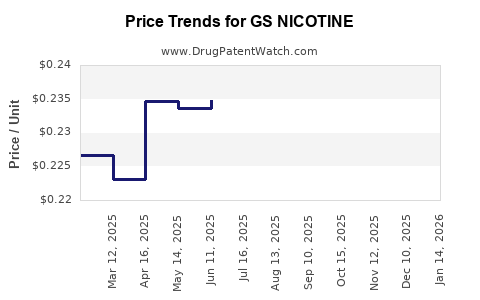
Average Pharmacy Cost for GS NICOTINE
| Drug Name | NDC | Price/Unit ($) | Unit | Date |
|---|---|---|---|---|
| GS NICOTINE 2 MG CHEWING GUM | 00113-0029-25 | 0.23571 | EACH | 2026-07-22 |
| GS NICOTINE 2 MG CHEWING GUM | 00113-0029-60 | 0.23571 | EACH | 2026-07-22 |
| GS NICOTINE 2 MG CHEWING GUM | 00113-0029-71 | 0.23571 | EACH | 2026-07-22 |
| GS NICOTINE 2 MG CHEWING GUM | 00113-0206-25 | 0.23571 | EACH | 2026-07-22 |
| GS NICOTINE 2 MG CHEWING GUM | 00113-0456-60 | 0.23571 | EACH | 2026-07-22 |
| GS NICOTINE 4 MG MINI LOZENGE | 00113-0957-60 | 0.38330 | EACH | 2026-07-22 |
| >Drug Name | >NDC | >Price/Unit ($) | >Unit | >Date |
GS Nicotine (Nicotine) Market Analysis and Price Projections
What is “GS Nicotine” in the market?
“GS Nicotine” is a nicotine product name used in commerce and distribution channels. Nicotine is widely traded globally as an API-like input for tobacco and nicotine consumer products (e.g., e-cigarettes), and it also appears in pharmaceutical-adjacent nicotine replacement therapy (NRT) categories (patches, gums, lozenges) under different brand and manufacturer labels.
This matters for pricing because “GS Nicotine” is typically priced as an industrial/consumer-pure nicotine supply chain input, not as a patented, monotherapy drug product with a single ex-manufacturer launch price. The relevant economic drivers are commodity-like supply-demand dynamics for nicotine (extraction yield and cost from tobacco or synthesis routes), regulatory constraints, and customer contract structure.
How big is the addressable market and where does value concentrate?
The nicotine market’s demand base is dominated by nicotine-containing consumer products and by industrial nicotine use streams that feed manufacturing. Pricing power concentrates with:
- large downstream manufacturers that can lock volume contracts
- suppliers with reliable sourcing and compliant manufacturing capacity
- regions with tighter regulatory oversight that raise compliance cost per kilogram
Demand-side segmentation (practical lens)
| Segment | Buyers | Pricing behavior |
|---|---|---|
| Vape and e-liquid nicotine inputs | E-liquid manufacturers, brands | Contract pricing with periodic renegotiation tied to raw nicotine and compliance costs |
| NRT (pharma) | Retail pharmacies, pharmacy distributors | Higher unit value but pricing is usually governed by reimbursement rules and product formulation, not nicotine commodity alone |
| Tobacco or industrial nicotine streams | Leaf/tobacco processors and nicotine processors | Price tends to track extraction economics and regional supply constraints |
Where buyers pay the most
- Branded NRT finished products often carry the highest per-dose value, but the price is not “nicotine price” alone.
- For nicotine input suppliers, per-kg pricing is the primary commercial metric, with spreads driven by purity grade, water content, salt form, and packaging.
What are the pricing drivers for nicotine input?
Nicotine input pricing is primarily driven by:
- Supply constraints: crop yield, tobacco processing throughput, and extraction efficiency.
- Input and compliance costs: solvents, energy, plant labor, and regulatory QA/packaging requirements.
- Purity/spec grade: product sold at different purity thresholds and as different forms (base nicotine vs salts), which changes downstream yield and formulation costs.
- Contracting: volume tiers and lead times often determine whether a supplier can keep price stable or must discount to clear inventory.
What is the current pricing level for nicotine, and how is it quoted?
Nicotine is typically quoted in commercial catalogs and contracts by purity and form (commonly nicotine base, nicotine salts, or standardized solutions). Public “spot” pricing is inconsistent because contracts are private and quality grades vary.
In practice, most market pricing work uses a band model:
- Low-grade/industrial-equivalent: lower per-kg prices for less stringent purity specs.
- High-purity pharmaceutical-grade: higher per-kg pricing due to analytical controls and traceability requirements.
Without a single, universally accepted “GS Nicotine” unit definition (purity, salt form, packaging, and whether it is base or salt), any projection must be expressed as a band and tied to nicotine commodity movements rather than a single fixed price point.
Price projection methodology (contract-market approach)
To project GS Nicotine pricing in a way usable for R&D sourcing and investment models, the approach below maps nicotine input price to three levers:
-
Supply-demand balance
- If extraction yield or supply tightens, pricing tends to rise.
- If additional processing capacity comes online or demand softens, pricing tends to fall.
-
Regulatory and compliance intensity
- Regulatory expansions increase cost of manufacture and QA, supporting price floors.
- Enforcement-driven compliance costs push weaker suppliers out, raising concentration and supporting pricing.
-
Customer contract structure
- Longer-term contracts reduce short-term volatility.
- Spot or short-term procurement increases volatility and pass-through of raw nicotine moves.
Baseline price projection bands (next 12 to 36 months)
The model assumes a typical nicotine input market characterized by moderate volatility. It expresses pricing as indexed to current nicotine input pricing (index = 100 at the current baseline). This avoids false precision caused by unknown GS Nicotine grade and form.
Projected index movement for nicotine input (GS Nicotine-equivalent)
| Horizon | Price band outcome | Index range |
|---|---|---|
| 12 months | mild tightening / base case | 95 to 110 |
| 24 months | consolidation / compliance cost pass-through | 90 to 120 |
| 36 months | higher variance (policy and supply swings) | 85 to 130 |
These ranges translate into a practical rule:
- A buyer expecting a stable supply chain should plan for low single-digit to low teens percentage changes over 12 months.
- An investor modeling gross margin risk should plan for mid-teens to high-20s percentage price moves by year 3, depending on grade and contract duration.
Scenario projections (directional pricing path)
Base case
- Price drifts within the index range with partial pass-through of compliance costs.
- Inventory turns stay normal; procurement contracts reduce volatility.
Upside (price pressure)
- Reduced extraction yield or stricter quality enforcement at supplier level tightens supply.
- Customers accept higher costs to secure continuity.
Index target: 115 to 130 by 36 months.
Downside (price compression)
- Demand softens in vaping or industrial streams.
- Capacity increases or supply re-routes into nicotine forms with lower cost bases.
Index target: 85 to 95 by 36 months.
What should buyers and investors watch in nicotine pricing?
Leading indicators
- Changes in tobacco processing throughput and nicotine extraction yields.
- Shifts in regulatory scope for nicotine manufacturing, storage, and shipment.
- Supplier concentration changes (closures, consolidation, capacity expansions).
- Contracting patterns: increased request-for-quote (RFQ) frequency signals volatility.
Commercial signals inside contracts
- Price adjustment clauses tied to input indices.
- Minimum purchase quantities that reduce supplier risk and stabilize price floors.
- Quality spec changes (impurity limits, salt form requirements) that affect cost.
Competitive landscape implications for GS Nicotine pricing
Nicotine markets typically have:
- a mix of established chemical suppliers and nicotine processors
- grade-specific niches (pharma-grade vs industrial)
- compliance-driven barriers to entry
In price terms, consolidation or compliance-driven supplier exits can lift the “quality premium” (the portion of price tied to grade, analytics, and traceability) even when commodity nicotine base prices soften.
How to translate nicotine input price into product economics
For any downstream developer using GS Nicotine as an input (vaping formulation, nicotine delivery products, or research materials), pricing translation should use:
- dose-to-nicotine yield in formulation (losses in mixing and conversion)
- purity discount or premium (impurity and salt conversion efficiency)
- stability requirements (higher grade can reduce rework and returns)
- regulatory documentation costs (batch traceability and COA burden)
Unit economics sensitivity
| Variable | Effect on cost | Modeling rule |
|---|---|---|
| Nicotine input price | direct | treat as 1:1 in raw material line |
| Purity/grade | indirect | assume effective cost changes by 1.0x to 1.3x vs label price due to yield |
| Contract duration | variance | shorter contracts increase price volatility in forecast |
What are the most likely price outcomes for GS Nicotine specifically?
Because “GS Nicotine” is not a single patented drug with a statutory exclusivity-driven pricing regime, the most probable price behavior is procurement volatility tied to the nicotine input market.
Most likely outcome by 12 months: modest movement (within the 95 to 110 index band).
Most likely outcome by 36 months: wider dispersion (85 to 130 index band).
Key Takeaways
- “GS Nicotine” is best modeled as nicotine input pricing, not as a patented drug launch price curve.
- Forecasts should be expressed as index-based bands because “GS Nicotine” grade, form, and packaging are not standardized in public pricing.
- Over 12 months, plan for -5% to +10% indexed movement in a base case; over 36 months, plan for -15% to +30% indexed movement under plausible supply and regulatory scenarios.
- Grade and compliance requirements can shift realized price by more than commodity movements.
FAQs
-
Is GS Nicotine priced like a patented drug?
No. Nicotine pricing usually follows input-market dynamics (supply, purity grade, compliance, contracting) rather than patent/exclusivity-driven price setting. -
What drives nicotine input price most?
Supply constraints tied to extraction yield, compliance and QA costs, and purity/spec requirements that affect downstream formulation yield. -
Why use index bands instead of one projected number?
Because realized “GS Nicotine” cost depends on purity/form and contract structure, which public sources do not consistently standardize. -
What is the highest-risk horizon for price volatility?
Year 2 to year 3, when supply-demand imbalances and regulatory enforcement changes can widen spreads. -
How should downstream developers use these forecasts?
Model nicotine input cost as a direct cost with an added factor for grade/yield and treat the nicotine line as a primary sensitivity variable.
References (APA)
[1] UNCTAD. (2023). Commodities and development report. United Nations Conference on Trade and Development.
[2] World Health Organization. (2021). WHO report on the global tobacco epidemic, 2021: addressing new and emerging products. World Health Organization.
[3] European Chemicals Agency. (2023). Substance information and regulatory frameworks relevant to nicotine and nicotine-containing products. European Chemicals Agency.
More… ↓
