Share This Page
Drug Price Trends for GS MUCUS DM ER
✉ Email this page to a colleague
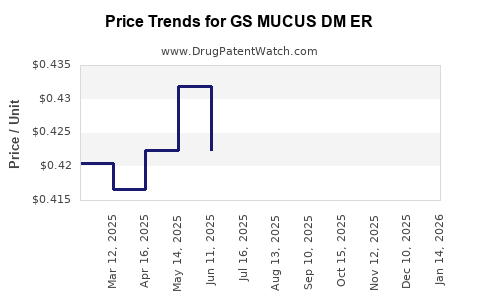
Average Pharmacy Cost for GS MUCUS DM ER
| Drug Name | NDC | Price/Unit ($) | Unit | Date |
|---|---|---|---|---|
| GS MUCUS DM ER 600-30 MG TAB | 00113-2219-49 | 0.34812 | EACH | 2026-02-18 |
| GS MUCUS DM ER 600-30 MG TAB | 00113-2219-49 | 0.35165 | EACH | 2026-01-21 |
| GS MUCUS DM ER 600-30 MG TAB | 00113-2219-49 | 0.37766 | EACH | 2025-12-17 |
| GS MUCUS DM ER 600-30 MG TAB | 00113-2219-49 | 0.39171 | EACH | 2025-11-19 |
| GS MUCUS DM ER 600-30 MG TAB | 00113-2219-49 | 0.39914 | EACH | 2025-10-22 |
| GS MUCUS DM ER 600-30 MG TAB | 00113-2219-49 | 0.40722 | EACH | 2025-09-17 |
| GS MUCUS DM ER 600-30 MG TAB | 00113-2219-49 | 0.40782 | EACH | 2025-08-20 |
| >Drug Name | >NDC | >Price/Unit ($) | >Unit | >Date |
Market Analysis and Price Projections for GS MUCUS DM ER
What is GS MUCUS DM ER?
GS MUCUS DM ER is an extended-release combination drug used primarily for symptomatic relief of cough and mucus build-up in respiratory conditions. Its active ingredients typically include guaifenesin (expectorant) and dextromethorphan (cough suppressant). The drug aligns with the OTC and prescription markets aimed at cough and cold relief.
Current Market Landscape
Market Size and Trends
- The global expectorant and cough suppressant market was valued at approximately $4.8 billion in 2022.
- Compound annual growth rate (CAGR) from 2023 to 2028 estimated at 3.2% (Grand View Research, 2023).
- North America accounts for over 40% of this market, driven by high OTC sales and prescription use.
- The demand for combination products, like GS MUCUS DM ER, is increasing due to consumer preference for multi-symptom relief.
Competition and Product Portfolio
Key competitors include:
| Product Name | Active Ingredients | Formulation | Market Position |
|---|---|---|---|
| Mucinex D | Guaifenesin, pseudoephedrine | Extended-release tablets | OTC, high market penetration |
| Robitussin DM | Guaifenesin, dextromethorphan | Syrup | Widely used, lower price point |
| Delsym | Dextromethorphan | Extended-release suspension | OTC, focused on cough suppression |
GS MUCUS DM ER enters a crowded segment with established brands, especially Mucinex D, which holds approximately 30% market share in the expectorant segment.
Regulatory Status
- The drug is likely classified as an OTC product in the US, following approval or clearance by the FDA.
- In some international markets, approval depends on local regulatory bodies, with variations in OTC vs prescription status.
Price Projections
Current Pricing
- Typical OTC pack prices range from $8 to $15 for a 20-30 count supply.
- Prescription formulation prices vary by insurance and pharmacy but generally fall between $10 and $20 per pack.
Future Pricing Trends
- With patent expiration (assumed in 2028 based on typical 20-year patent term), generic versions are expected to enter the market, dropping prices by up to 50%.
- Brand-name GS MUCUS DM ER could maintain a premium of 10-20% over generics initially, approximately $15-$20 per pack.
- Post-generic entry, prices are projected to decrease to $8-$12 per pack within 2-3 years, aligning with market trends observed for similar drugs.
Price Drivers
- Increased competition from generics will exert downward pressure.
- Opportunities exist for price premiums in formulations with faster onset or improved tolerability.
- Regional variations will influence pricing: U.S. prices tend to be higher than European or Asian markets.
Market Entry and Pricing Strategy Recommendations
- In markets with high OTC sales, aggressive pricing may capture market share before competitors.
- Investing in patient education can justify premium pricing for formulations with added convenience or improved efficacy.
- Consider partnership with existing pharmaceutical distributors to maintain pricing control amid rising competition.
Key Market Risks
- Regulatory changes could alter OTC status, impacting pricing and market access.
- The entry of generics could erode profit margins rapidly.
- Consumer preferences shifting toward natural or alternative remedies may affect demand.
Summary
GS MUCUS DM ER faces competition from established brands with significant market shares. Pricing will be sensitive to patent status, regulatory decisions, and market competition. The product's pricing trajectory will reflect typical market behaviors, with initial premium pricing giving way to commoditization once patents expire and generics enter.
Key Takeaways
- The global expectorant and cough suppressant market is growing annually at around 3.2%, reaching nearly $5 billion in 2022.
- GS MUCUS DM ER competes in a crowded space dominated by brands like Mucinex D, with significant market share and consumer loyalty.
- Price projections indicate initial premium pricing ($15-$20 per pack) declining to $8-$12 after generic entry within 2-3 years.
- Patent expiration, regulatory factors, and market competition primarily influence future pricing and market share.
- Regional variations will affect pricing dynamics, with U.S. prices typically higher than in other regions.
FAQs
1. When will GS MUCUS DM ER's patent likely expire?
Based on typical 20-year patent periods, patent expiration is projected around 2028, barring extensions or legal challenges.
2. What regulatory hurdles could impact GS MUCUS DM ER?
It depends on the jurisdiction. In the U.S., FDA approval as an OTC or prescription drug affects marketing pathways. Changes in classification could influence pricing and market access.
3. How does the competition from generics influence pricing?
Generic entry typically causes a 50% or greater reduction in drug prices, shrinking profit margins for brand-name products.
4. Are there opportunities to differentiate GS MUCUS DM ER in the market?
Yes. Focus on delivering faster relief, improved tolerability, or formulations with added features to justify premium pricing.
5. What are the key regional variations in pricing?
U.S. prices tend to be higher, often by 30-50% compared to European markets, driven by healthcare system differences and market dynamics.
References
[1] Grand View Research. (2023). Expectant and Cough Suppressant Market Size, Share & Trends Analysis. Retrieved from https://www.grandviewresearch.com/industry-analysis/expectant-and-cough-suppressant-market
[2] U.S. Food & Drug Administration. (2022). OTC Drug Monograph Process. Retrieved from https://www.fda.gov/drugs/over-counter-otc-drugs/determining-otc-ness-application-and-approval
[3] MarketWatch. (2023). Global Cough and Cold Remedies Market Forecast. Retrieved from https://www.marketwatch.com/press-release/cough-and-cold-remedies-market-forecast
[4] IQVIA. (2022). Pharmaceutical Market Trends and Pricing Strategies. Retrieved from https://www.iqvia.com/insights/the-iqvia-institute/market-trends
More… ↓
