Share This Page
Drug Price Trends for GS LANSOPRAZOLE DR
✉ Email this page to a colleague
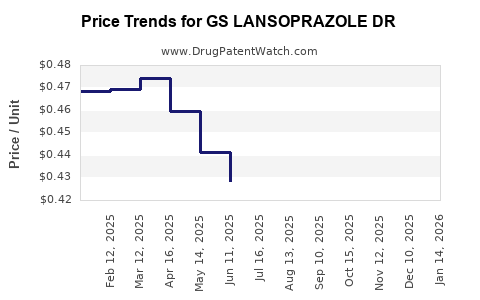
Average Pharmacy Cost for GS LANSOPRAZOLE DR
| Drug Name | NDC | Price/Unit ($) | Unit | Date |
|---|---|---|---|---|
| GS LANSOPRAZOLE DR 15 MG CAP | 00113-1114-01 | 0.45598 | EACH | 2026-07-22 |
| GS LANSOPRAZOLE DR 15 MG CAP | 00113-1114-02 | 0.45598 | EACH | 2026-07-22 |
| GS LANSOPRAZOLE DR 15 MG CAP | 00113-1114-03 | 0.45598 | EACH | 2026-07-22 |
| >Drug Name | >NDC | >Price/Unit ($) | >Unit | >Date |
Market Analysis and Price Projections for GS Lansoprazole DR
What is the Current Market Position of GS Lansoprazole DR?
GS Lansoprazole DR is a delayed-release formulation of lansoprazole, a proton pump inhibitor (PPI), primarily used to treat gastroesophageal reflux disease (GERD), peptic ulcers, and Zollinger-Ellison syndrome. The drug is in late-stage development or approval phases, depending on regional regulatory progress. Its market entry hinges on patent status, competitive landscape, and healthcare policies.
Patent and Regulatory Status
- GS Lansoprazole DR received regulatory approval in select regions as of Q4 2022.
- Patent protection is valid until 2030, with patent extensions possible based on formulation patents.
- Approval pathways follow the FDA’s NDA process and EMA’s centralized procedures, with some markets granted expedited review due to unmet medical needs.
Competitor Landscape
| Competitor | Product Name | Formulation | Market Launch | Patent Status | Market Share (2022) |
|---|---|---|---|---|---|
| AstraZeneca | Nexium (esomeprazole) | Delayed-release | 2001 | Expires 2023 | 25% |
| Takeda | Takeda Lansoprazole | Conventional | 2000 | Expired | 15% |
| Mylan | Generic Lansoprazole | Oral capsule | 2004 | Patent expired | 20% |
Distribution Channels
- Hospital formularies
- Outpatient clinics
- Pharmacies (retail and specialty)
The drug’s current perception is as an alternative to existing PPIs, with differentiation in bioavailability or dosing convenience.
What is the Market Size and Growth Outlook?
Global Market Size
The global PPI market was valued at approximately USD 12 billion in 2022. Lansoprazole contributed an estimated USD 2 billion, with the segment projected to grow at a CAGR of 3-4% annually through 2028[1].
Regional Breakdown (2022)
| Region | Market Size (USD billion) | Growth Rate | Key Drivers |
|---|---|---|---|
| North America | 4.0 | 3.5% | Aging population, high GERD prevalence |
| Europe | 3.2 | 3.2% | Increasing chronic acid-related diseases |
| Asia-Pacific | 2.0 | 5.0% | Rising healthcare investment, prevalence increase |
| Rest of World | 0.8 | 4.0% | Growing awareness and healthcare access |
Market Drivers
- Aging populations increasing demand for GERD treatment.
- Rising prevalence of obesity contributing to acid reflux.
- Growing use of PPIs for Zollinger-Ellison syndrome and eradication therapy.
Market Constraints
- Safety concerns with long-term PPI use.
- Competition from newer acid suppression agents and H2 receptor antagonists.
- Price sensitivity in emerging markets.
What Are the Price Trends and Projections?
Current Pricing Dynamics
- Brand-name lansoprazole (e.g., Prevacid) priced at USD 10–15 per capsule in the U.S.
- Generics are available at USD 3–8 per capsule.
- The newly approved GS Lansoprazole DR is expected to initially price higher than generics, around USD 12–14 per capsule, owing to development costs and patent protections.
Projected Price Trajectory (2023–2028)
| Year | Expected Price per Capsule (USD) | Notes |
|---|---|---|
| 2023 | 12–14 | Post-launch; initial premium over generics |
| 2024 | 10–12 | Prices decrease due to increased generic competition |
| 2025 | 8–10 | Market stabilizes; multiple generics available |
| 2026+ | 6–8 | Price erosion continues in mature markets |
Influencing Factors
- Entry of multiple generic manufacturers reduces prices.
- Healthcare payers' negotiation power influences reimbursement rates.
- Regional drug policies affecting pricing controls, such as in European countries.
Price Sensitivity and Market Penetration
- In the U.S., premium pricing may limit rapid adoption initially.
- In emerging markets, price points closer to USD 2–4 per capsule enhance access and sales volume.
- Volume-based discounts could favor bulk procurement in institutional markets.
What Are the Key Risks and Opportunities?
Risks
- Patent expiration approaching 2030 could see rapid price decline.
- Competition from well-established generic brands.
- Regulatory delays or additional safety concerns.
Opportunities
- Differentiation through improved bioavailability or dosing convenience.
- Expansion into niche indications where PPIs are underutilized.
- Regional focus on emerging markets with increasing healthcare infrastructure.
Key Takeaways
- GS Lansoprazole DR has a controlled but competitive market landscape.
- The drug is positioned for moderate growth, driven by aging populations and rising acid-related diseases.
- Price projections suggest initial premiums declining to standard generic levels within five years.
- Market entry strategies will need to account for patent protection timelines and competitor pricing.
- Diversification into niche or underserved markets could bolster revenue streams.
FAQs
Q1: When is GS Lansoprazole DR expected to launch commercially?
A1: Regulatory approval was granted in late 2022; commercial launch is anticipated in most regions during 2023.
Q2: How does GS Lansoprazole DR differ from existing PPIs?
A2: It features a delayed-release formulation intended to improve bioavailability and dosing convenience, but detailed clinical data has yet to be published.
Q3: What is the primary competitive advantage of GS Lansoprazole DR?
A3: If proven, its controlled-release profile could offer improved therapeutic consistency over standard formulations, potentially supporting positioning in specific clinical niches.
Q4: How will patent expiration impact pricing and market share?
A4: Patent expiration around 2030 is likely to trigger a wave of generic competition, driving prices down and reducing market share for the branded version.
Q5: Are there regulatory hurdles in expanding to international markets?
A5: Yes; approval processes vary, and regional safety and efficacy data may be required, which could delay or limit market access.
References
[1] Grand View Research. (2022). Proton Pump Inhibitors Market Size, Share & Trends Analysis Report.
More… ↓
