Share This Page
Drug Price Trends for GS FIRST AID ANTIBIOTIC OINT
✉ Email this page to a colleague
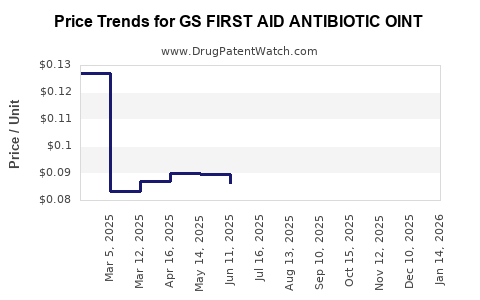
Average Pharmacy Cost for GS FIRST AID ANTIBIOTIC OINT
| Drug Name | NDC | Price/Unit ($) | Unit | Date |
|---|---|---|---|---|
| GS FIRST AID ANTIBIOTIC OINT | 00113-0084-64 | 0.08559 | GM | 2026-07-22 |
| GS FIRST AID ANTIBIOTIC OINT | 00113-0084-64 | 0.08670 | GM | 2026-06-17 |
| GS FIRST AID ANTIBIOTIC OINT | 00113-0084-64 | 0.08956 | GM | 2026-05-20 |
| GS FIRST AID ANTIBIOTIC OINT | 00113-0084-64 | 0.08998 | GM | 2026-04-22 |
| GS FIRST AID ANTIBIOTIC OINT | 00113-0084-64 | 0.08906 | GM | 2026-03-18 |
| GS FIRST AID ANTIBIOTIC OINT | 00113-0084-64 | 0.08800 | GM | 2026-02-18 |
| GS FIRST AID ANTIBIOTIC OINT | 00113-0084-64 | 0.08854 | GM | 2026-01-21 |
| >Drug Name | >NDC | >Price/Unit ($) | >Unit | >Date |
Analysis of GS First Aid Antibiotic Ointment Market and Pricing
This report analyzes the market landscape and projects pricing trends for GS First Aid Antibiotic Ointment. The market is characterized by established competition, consumer reliance on over-the-counter (OTC) accessibility, and consistent demand driven by minor wound care. Pricing is influenced by raw material costs, manufacturing scale, competitor pricing strategies, and retail channel markups.
What is the Current Market Size and Segmentation for GS First Aid Antibiotic Ointment?
The global market for OTC antibiotic ointments, including products like GS First Aid Antibiotic Ointment, is substantial and exhibits steady growth. This segment is primarily driven by household usage for treating minor cuts, scrapes, burns, and abrasions.
-
Market Size: While precise figures for "GS First Aid Antibiotic Ointment" specifically are not publicly granular, the broader OTC topical antibiotic market is estimated to be in the hundreds of millions of U.S. dollars globally, with projected compound annual growth rates (CAGR) typically between 3% and 5% [1]. This growth is attributed to an aging population, increased participation in outdoor activities, and a general consumer preference for self-treatment of minor injuries.
-
Key Segments:
- Product Type: This segment is largely homogenous, with most products containing similar active pharmaceutical ingredients (APIs) like Neosporin (bacitracin, neomycin, polymyxin B) or alternatives. The differentiation lies in branding, excipients, and ancillary benefits (e.g., pain relief, skin conditioning).
- Distribution Channel:
- Retail Pharmacies: Dominate sales, accounting for over 60% of the market share. Major chains and independent pharmacies are key outlets.
- Supermarkets/Mass Merchandisers: Significant volume providers, offering convenience and competitive pricing.
- Online Retail: Growing segment, driven by convenience and price comparison. E-commerce platforms represent approximately 20-25% of sales and are projected to increase [2].
- Specialty Stores: Smaller contribution, focusing on natural or niche wound care products.
- End-User:
- Households: Primary consumers for immediate home use.
- First Aid Providers/Organizations: Bulk purchases for kits and emergency preparedness.
- Healthcare Professionals (Minor Use): Limited use in clinics for initial dressing of minor wounds.
Who are the Primary Competitors in the OTC Antibiotic Ointment Space?
The competitive landscape for GS First Aid Antibiotic Ointment is mature, featuring well-established brands with significant market presence and consumer recognition.
-
Major Brands:
- Neosporin (Johnson & Johnson): The dominant market leader with a wide range of formulations and strong brand loyalty. Their products are often considered the benchmark for efficacy and trust in the category.
- Polysporin (Johnson & Johnson): Another key product from J&J, often distinguished by its primary active ingredient (polymyxin B sulfate).
- Generic Brands: Numerous private label and store-brand antibiotic ointments are available from major retailers (e.g., CVS, Walgreens, Walmart). These offer a lower price point and capture a significant portion of the market share based on price sensitivity.
- Specialty Brands: Smaller companies may offer formulations with different API combinations, natural ingredients, or specific marketing claims (e.g., "organic," "hypoallergenic"). Examples include brands found in natural health stores or online marketplaces.
-
Competitive Advantages:
- Brand Recognition & Trust: Established brands like Neosporin benefit from decades of consumer exposure and perceived efficacy.
- Distribution Network: Broad availability across retail channels is critical for market penetration.
- Pricing Strategy: Competitors utilize a range of pricing, from premium for branded products to value-oriented for generics.
- Product Formulation: While API combinations are similar, minor variations in inactive ingredients or delivery mechanisms can be a point of differentiation.
What are the Key Raw Material Costs and Supply Chain Considerations?
The cost and availability of active pharmaceutical ingredients (APIs) and excipients are primary drivers of manufacturing costs for GS First Aid Antibiotic Ointment.
-
Key Active Pharmaceutical Ingredients (APIs):
- Bacitracin Zinc: A polypeptide antibiotic effective against Gram-positive bacteria.
- Neomycin Sulfate: An aminoglycoside antibiotic effective against Gram-negative bacteria.
- Polymyxin B Sulfate: Another aminoglycoside effective against Gram-negative bacteria, particularly Pseudomonas aeruginosa.
- White Petrolatum/Mineral Oil: Common base ingredients providing an occlusive barrier.
- Lanolin, Beeswax, other emollients: Used for texture and skin conditioning.
-
Supply Chain Dynamics:
- API Sourcing: APIs are typically sourced from global manufacturers, primarily in China and India. Fluctuations in these markets, geopolitical events, regulatory changes, or production issues can impact supply and price [3].
- Excipient Availability: Base ingredients like petrolatum and mineral oil are derived from petroleum, making their costs subject to oil price volatility.
- Manufacturing Capacity: Dedicated pharmaceutical manufacturing facilities are required, with adherence to Good Manufacturing Practices (GMP). Capacity constraints or shifts in production focus by contract manufacturers can affect lead times and costs.
- Packaging Materials: Tubes, boxes, and labels are sourced from various suppliers. Material costs (e.g., plastic for tubes) are influenced by commodity prices.
-
Cost Drivers:
- API Prices: Can fluctuate based on global demand, production yields, and regulatory compliance costs.
- Energy Costs: Impact manufacturing and transportation expenses.
- Labor Costs: Vary significantly by manufacturing location.
- Regulatory Compliance: Costs associated with FDA, EMA, or other national health authority approvals and ongoing compliance.
What is the Regulatory Landscape for OTC Antibiotic Ointments?
The regulatory framework for over-the-counter (OTC) antibiotic ointments is stringent, focusing on safety, efficacy, and labeling.
-
U.S. Food and Drug Administration (FDA):
- Drug Facts Labeling: Requires specific information, including active ingredients, their quantities, uses, warnings, directions, and inactive ingredients [4].
- Monograph System: Many OTC drug products, including topical antibiotics, are regulated under the FDA's OTC drug monograph system. This system establishes conditions under which certain drugs are generally recognized as safe and effective (GRASE). Products aligning with established monographs do not require premarket approval for their approved indications. However, any deviation requires a New Drug Application (NDA).
- Inactive Ingredient Limitations: The FDA lists maximum potency levels for certain inactive ingredients to prevent safety issues.
- Advertising Claims: Must be substantiated and not misleading.
-
European Medicines Agency (EMA) & National Competent Authorities:
- Marketing Authorization: Products require a marketing authorization before they can be sold in EU member states. This can be national, decentralized, or centralized.
- Product Information: Similar to FDA, requires detailed labeling and patient information leaflets.
- Pharmacovigilance: Ongoing monitoring of adverse events is mandatory.
-
Key Regulatory Considerations:
- API Purity & Quality: Must meet pharmacopeial standards (e.g., USP, EP).
- Stability Testing: Products must demonstrate shelf-life stability under specified storage conditions.
- Child-Resistant Packaging: May be required for certain product sizes or formulations.
- Counterfeit Prevention: Manufacturers must implement measures to prevent counterfeiting and ensure product integrity throughout the supply chain.
What are the Historical and Projected Price Trends for GS First Aid Antibiotic Ointment?
Pricing for GS First Aid Antibiotic Ointment is influenced by a combination of cost-push and market-pull factors.
-
Historical Pricing Factors:
- API Cost Fluctuations: Significant price swings in key APIs have historically impacted manufacturing costs.
- Branding & Marketing Investment: Premium pricing for established brands reflects their extensive marketing efforts and perceived value.
- Retailer Margin: Pharmacy and supermarket chains apply significant markups, often ranging from 30% to 50% of the wholesale price [5].
- Generic Competition: The introduction of lower-cost generic versions has consistently exerted downward pressure on prices for branded products.
-
Current Pricing Benchmarks (USD, approximate retail for standard tubes, e.g., 0.5 oz / 15g):
- Leading Branded Products (e.g., Neosporin): $6.00 - $10.00
- Generic/Store Brands: $3.00 - $6.00
- Value Packs/Larger Sizes: Offer a lower per-unit cost.
-
Projected Price Trends:
- Upward Pressure (Moderate):
- Rising API & Raw Material Costs: Continued volatility in global supply chains and commodity prices is expected to increase input costs.
- Increased Regulatory Scrutiny: Stricter compliance requirements can add to manufacturing expenses.
- Inflationary Environment: General economic inflation can drive up all aspects of production and distribution costs.
- Downward Pressure (Persistent):
- Intensifying Generic Competition: As patents expire on any novel formulations (though less common in this mature OTC space), and manufacturing processes become more commoditized, generic competition will remain a primary price moderator.
- E-commerce Price Transparency: Online platforms facilitate easy price comparison, forcing retailers and manufacturers to remain competitive.
- Private Label Expansion: Retailers continue to invest in their own private label offerings, often priced aggressively.
- Overall Projection: Over the next 3-5 years, expect modest price increases for branded products driven by cost pressures, potentially in the range of 2-4% annually. Generic and store-brand prices are likely to remain relatively stable or increase at a lower rate, continuing to offer a value alternative. Significant price jumps would likely only occur due to major supply disruptions or a breakthrough in formulation efficacy that garners strong consumer demand and pricing power.
- Upward Pressure (Moderate):
What are the Key Factors Driving Demand for GS First Aid Antibiotic Ointment?
Demand for GS First Aid Antibiotic Ointment is primarily driven by its role in preventive wound care and the consumer preference for self-treatment.
- Minor Wound Incidence: The constant occurrence of minor injuries (cuts, scrapes, burns) in households, workplaces, and during recreational activities is the foundational demand driver.
- Preventive Health Behavior: Consumers use antibiotic ointments to prevent infection, a primary concern for even minor wounds. This is a habitual purchase for many households.
- OTC Accessibility: The availability of these products without a prescription makes them immediately accessible for self-care, aligning with consumer desire for convenience.
- Perceived Efficacy and Trust: Established brands, particularly Neosporin, have cultivated long-term consumer trust in their ability to prevent infection and promote healing.
- First Aid Kit Essentials: Inclusion in standard first aid kits for home, automotive, and travel preparedness ensures consistent, albeit less frequent, demand.
- Seasonal Trends: While not a primary driver, increased outdoor activities during warmer months can lead to a marginal increase in minor injuries and thus, product demand.
- Demographic Factors: An aging population may experience slower wound healing and a greater concern for infection prevention.
What are the Potential Risks and Opportunities for GS First Aid Antibiotic Ointment?
The market for GS First Aid Antibiotic Ointment presents both inherent risks and opportunities for manufacturers and marketers.
-
Risks:
- Antibiotic Resistance: Growing concerns about antibiotic resistance, though primarily focused on systemic antibiotics, can create consumer hesitancy or regulatory scrutiny regarding topical applications.
- Allergic Reactions & Sensitivity: While rare, some individuals may experience allergic reactions to specific APIs or excipients. This can lead to product recalls or reputational damage.
- Intensifying Competition: The market is saturated with branded and generic options, making market share gains challenging and price competition fierce.
- Regulatory Changes: Potential for new regulations on API usage, labeling requirements, or environmental impact of manufacturing could increase compliance costs or restrict product formulations.
- Supply Chain Disruptions: Geopolitical instability, natural disasters, or pandemics can disrupt the supply of key raw materials.
-
Opportunities:
- Emerging Markets: Growth in developing economies with increasing disposable income and greater access to healthcare products presents untapped markets.
- Product Line Extensions: Developing specialized formulations (e.g., for sensitive skin, improved moisturizing, or specific types of wounds) could capture niche segments.
- Combination Products: Exploring the inclusion of mild analgesics or skin protectants alongside antibiotics could offer added value.
- E-commerce Optimization: Strengthening online presence, utilizing direct-to-consumer models, and leveraging digital marketing can capture a growing online consumer base.
- Sustainable Sourcing & Manufacturing: Increasing consumer awareness of environmental issues may favor products manufactured with sustainable practices or eco-friendly packaging.
- Education & Awareness Campaigns: Highlighting the importance of proper wound care and the role of topical antibiotics in preventing infection can reinforce demand.
Key Takeaways
- The OTC antibiotic ointment market is mature and dominated by established brands, with significant competition from generics and private labels.
- Pricing is largely dictated by raw material costs, manufacturing scale, and retail markups, with modest annual price increases projected, offset by intense generic competition.
- Demand is consistent, driven by the high incidence of minor wounds and consumer preference for self-treatment and infection prevention.
- Regulatory compliance with bodies like the FDA and EMA is critical, with the monograph system simplifying market entry for products meeting established standards.
- Key risks include antibiotic resistance concerns and supply chain volatility, while opportunities lie in emerging markets, product innovation, and e-commerce expansion.
Frequently Asked Questions
-
What is the primary differentiator between GS First Aid Antibiotic Ointment and major brands like Neosporin? Differentiation typically lies in brand recognition, marketing, and potentially minor variations in inactive ingredients affecting texture or absorption. Active ingredients in most standard OTC antibiotic ointments are highly standardized.
-
How susceptible is the pricing of GS First Aid Antibiotic Ointment to fluctuations in oil prices? Pricing is moderately susceptible as key excipients like petrolatum and mineral oil are petroleum derivatives. Significant spikes in oil prices can increase the cost of these base ingredients.
-
What regulatory hurdles must GS First Aid Antibiotic Ointment overcome if it deviates from existing FDA monographs? Any deviation requires a New Drug Application (NDA) to the FDA, involving extensive clinical trials to prove safety and efficacy for the new claims or formulations, a significantly more costly and time-consuming process.
-
Is there a significant risk of antibiotic resistance emerging from the use of OTC topical antibiotics? While the risk is generally considered lower than with systemic antibiotics, prolonged or inappropriate use of topical antibiotics can contribute to resistance. This is a growing area of scientific and public health discussion.
-
What are the most significant drivers of profit margins for manufacturers of GS First Aid Antibiotic Ointment? Profit margins are driven by efficient manufacturing, economies of scale in API and excipient procurement, brand equity that allows for premium pricing, and effective supply chain management to minimize waste and overhead.
Citations
[1] Grand View Research. (2023). Topical Antibiotics Market Size, Share & Trends Analysis Report. [2] Statista. (2023). Online Sales of Pharmaceuticals - Worldwide. [3] IQVIA. (2023). Global Pharmaceutical Market Trends Report. [4] U.S. Food and Drug Administration. (2020). Labeling Requirements for Over-the-Counter (OTC) Drugs. [5] American Pharmacists Association. (2022). Pharmacy Practice and Policy.
More… ↓
