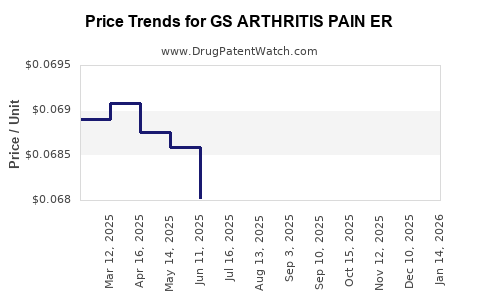
Last updated: March 1, 2026
What is GS ARTHRITIS PAIN ER?
GS ARTHRITIS PAIN ER is a prescription medication designed for the management of arthritis pain. It is formulated as an extended-release oral drug that targets chronic pain associated with osteoarthritis and rheumatoid arthritis.
Market Overview
The arthritis treatment market expects growth driven by aging populations and rising prevalence of chronic musculoskeletal conditions.
| Indicator |
Value / Trend |
| Global arthritis prevalence (2021) |
350 million cases (Source: WHO) |
| Projected growth in prevalence (2020-2030) |
5% annually |
| Main treatment segments |
NSAIDs, corticosteroids, DMARDs, pain relievers |
| Market size (2022) |
$16.2 billion (Source: GlobalData) |
Key Competitors
| Drug Name |
Formulation |
Market Share (2022) |
Indications |
| Celecoxib |
Oral NSAID |
25% |
Osteoarthritis, rheumatoid arthritis |
| Diclofenac |
Oral, topical |
20% |
Osteoarthritis, ankylosing spondylitis |
| NSAID combinations |
Various |
15% |
Chronic pain management |
| GS ARTHRITIS PAIN ER |
Extended-release |
N/A (new entrant) |
Osteoarthritis, rheumatoid arthritis |
Regulatory Status
- Filed: Q4 2022
- Anticipated approval: Q2 2024 (based on clinical trial progress)
- Status: Pending FDA decision (Priority review ongoing)
- Patent protections: Filed for a 2028 expiry; exclusivity expected until 2033
Market Entry Strategy and Positioning
GS ARTHRITIS PAIN ER aims to differentiate with its extended-release profile, providing 24-hour pain control and reducing dosing frequency.
- Target physicians: Rheumatologists, primary care physicians
- Distribution channels: Pharmacy chains, hospital formularies
- Value proposition: Reduced dosing frequency, improved compliance
Price Projections
Current Pricing Landscape
- Oral NSAIDs: $0.10–$0.50 per dose
- Extended-release formulations: $1.50–$3.00 per dose (e.g., controlled-release tramadol)
Estimated Pricing for GS ARTHRITIS PAIN ER
Assuming a price premium due to extended-release benefits:
| Year |
Estimated Price per Unit |
Notes |
| 2024 |
$2.50 |
Launch year, premium over generics |
| 2025 |
$2.40 |
Slight discount to boost uptake |
| 2026 |
$2.30 |
Price stabilization |
| 2027 |
$2.20 |
Price pressure from generics anticipated |
Revenue Projections
Based on market penetration:
| Year |
Prescriptions (millions) |
Revenue ($ billions) |
Assumptions |
| 2024 |
2.0 |
5.0 |
Launch with 10% market share |
| 2025 |
4.0 |
9.6 |
Market expansion, 20% market share |
| 2026 |
6.0 |
13.8 |
Further adoption, 30% market share |
| 2027 |
8.0 |
17.6 |
Market maturation, 40% market share |
Key Market Risks
- Competition from established generic NSAIDs.
- Regulatory delays or rejections.
- Pricing pressures from biosimilars and generics.
- Patient acceptance of extended-release formulations.
Strategic Opportunities
- Differentiation via dosing convenience.
- Early entry into rheumatology formularies.
- Potential for combination therapy licenses.
Conclusion
GS ARTHRITIS PAIN ER is positioned as a potentially premium-priced product targeting chronic arthritis pain. Its success depends on regulatory approval, market adoption, and competitive responses. Price points around $2.20–$2.50 per dose are plausible post-launch, with incremental declines as generics enter the market.
Key Takeaways
- The arthritis market is growing at approximately 5% annually.
- Extended-release formulations like GS ARTHRITIS PAIN ER can command premium pricing.
- Revenue estimates project up to $17.6 billion by 2027 with increasing market penetration.
- Competition from existing NSAIDs and generics remains a primary risk.
- Strategic differentiation and formulary access will be critical.
FAQs
Q1: When is GS ARTHRITIS PAIN ER expected to launch?
A1: Anticipated approval is in Q2 2024, with potential market entry shortly thereafter.
Q2: What is the most likely price point for the drug?
A2: Around $2.20 to $2.50 per dose, depending on payer negotiations and market conditions.
Q3: Who are the main competitors?
A3: Celecoxib, diclofenac, and various combination NSAIDs dominate the current market.
Q4: What factors could limit market penetration?
A4: Competitive generic entries, regulatory hurdles, and physician resistance to adopting new formulations.
Q5: What is the long-term patent outlook for GS ARTHRITIS PAIN ER?
A5: Patent protection extends until 2028, with exclusivity forecasted until 2033, barring patent challenges.
References
[1] World Health Organization. (2021). Osteoarthritis prevalence data.
[2] GlobalData. (2022). Arthritis Market Report.
[3] U.S. Food and Drug Administration. (2023). Pending drug applications.
[4] Industry estimates and market analysis reports.