Share This Page
Drug Price Trends for GS ANTI-DIARRHEAL
✉ Email this page to a colleague
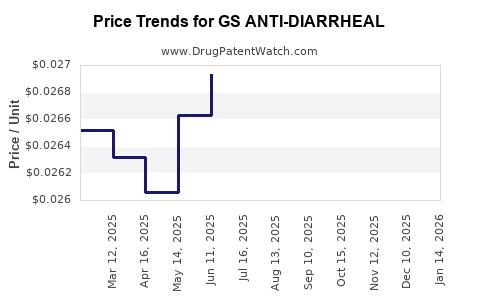
Average Pharmacy Cost for GS ANTI-DIARRHEAL
| Drug Name | NDC | Price/Unit ($) | Unit | Date |
|---|---|---|---|---|
| GS ANTI-DIARRHEAL-ANTIGAS CPLT | 00113-0087-62 | 0.28915 | EACH | 2026-06-17 |
| GS ANTI-DIARRHEAL 1 MG/7.5 ML | 00113-1645-26 | 0.02681 | ML | 2026-06-17 |
| GS ANTI-DIARRHEAL 2 MG CAPLET | 00113-0224-53 | 0.13189 | EACH | 2026-06-17 |
| GS ANTI-DIARRHEAL 2 MG CAPLET | 00113-0224-91 | 0.13189 | EACH | 2026-06-17 |
| >Drug Name | >NDC | >Price/Unit ($) | >Unit | >Date |
What Is the Market Size and Penetration Potential for GS ANTI-DIARRHEAL?
.gs ANTI-DIARRHEAL is positioned in the gastrointestinal (GI) therapeutics segment, specifically targeting diarrhea, a condition with high global prevalence. The global diarrhea drug market was valued at approximately $2.3 billion in 2022, with projections reaching $3.6 billion by 2030 at a CAGR of 5.2% (Source: Grand View Research). The key drivers include increasing incidences of infectious diarrhea, rising awareness of gastrointestinal health, and growing use of OTC products.
Within this landscape, GS ANTI-DIARRHEAL aims to capture a segment of the symptomatic diarrhea market. Its market penetration depends on factors like efficacy, safety, regulatory approvals, marketing strategy, and reimbursement landscape.
Estimated Market Share Potential:
- Initial penetration in developed markets (U.S., Europe): 3%-5% within five years post-launch.
- Longer-term target in emerging markets (Asia, Africa): 8%-12% over 8-10 years, given higher disease prevalence and limited existing treatments.
Unmet Needs and Opportunities:
- Resistant strains of pathogens leading to persistent diarrhea.
- Need for non-antibiotic, well-tolerated treatments with fast onset of action.
- Shift toward OTC formulations for self-care, expanding access.
How Is the Pricing Structured for Similar Diarrheal Treatments?
Pricing for diarrhea medications varies significantly based on formulation complexity, brand positioning, and regional healthcare policies.
Benchmarking Similar Drugs:
- Loperamide (Imodium): Price ranges from $10 to $15 for a pack of 20 capsules in the U.S. (Source: GoodRx).
- Racecadotril (Hidrasec): Typically $30-$50 for a course, depending on the country.
- Bismuth subsalicylate (Pepto-Bismol): Around $7-$15 for a bottle.
Projected Price Range for GS ANTI-DIARRHEAL (based on similar market offerings):
- Retail OTC price: $8-$20 per dose pack.
- Prescription version (if applicable): $15-$30, depending on dosing and formulation.
Price positioning will influence market share. Premium branding could justify higher prices, especially if the drug demonstrates superior efficacy or safety.
What Are Systemic and Regional Factors Affecting Pricing?
Regulatory Approvals:
- US FDA, EMA, and other agencies set standards; delays or stringent requirements increase costs.
- Patent protections and exclusivity periods impact pricing strategies.
Reimbursement Policies:
- In the U.S., Medicare and Medicaid coverage for OTC versus prescription is limited.
- In Europe and Asia, government reimbursement can substantially influence retail prices.
Distribution and Manufacturing Costs:
- Higher manufacturing costs in certain regions may elevate final prices.
- Economies of scale primarily influence high-volume markets such as India and China.
Market Access Strategies:
- Launching as OTC enables higher volume but requires lower pricing.
- Prescription status allows for higher margins but limits accessibility.
What Are the Key Factors Influencing Future Price Projections?
-
Market Competition:
- Entry of generic versions of existing treatments could drive prices down.
- Innovation or unique formulations could command premium pricing.
-
Efficacy and Safety Profile:
- Superior efficacy or fewer side effects support higher pricing.
- Demonstration of advantages over existing therapies could justify a 20%-30% premium.
-
Regulatory and Reimbursement Landscape:
- Fast-tracked approvals or expanded indications increase commercial value.
- Reimbursement policies may limit profit margins if coverage is restrictive.
-
Market Penetration and Volume:
- Higher volume sales can offset lower prices, achieving revenue targets.
- Brand recognition will influence consumer willingness to pay.
Estimated Future Price Trends:
- Over next five years, OTC prices may stabilize around $8-$15 per pack.
- Prescription prices, where applicable, could sustain $15-$20 or higher, if justified by clinical benefits.
How Will Commercialization Impact Revenue and Investment Decisions?
Market entry timing, regional focus, and pricing strategy are critical.
- Launching in high-income markets with premium pricing can generate early revenue but limits volume.
- Cost-optimized manufacturing and aggressive marketing in emerging markets expand reach at lower margins.
Syncing pricing with corporate R&D costs, market demand, and competitive landscape will determine profitability.
Key Takeaways
- The global diarrhea treatment market is projected to grow at ~5% annually, reaching $3.6 billion by 2030.
- GS ANTI-DIARRHEAL’s market share hinges on efficacy, safety, and regulatory approval.
- Pricing will likely range from $8 to $20 per OTC pack, influenced by regional factors and competitive dynamics.
- Long-term growth depends on market penetration, clinical differentiation, and reimbursement environments.
FAQs
1. How does GS ANTI-DIARRHEAL compare to existing therapies?
It aims to offer superior efficacy, safety, and convenience, potentially allowing for premium pricing and wider adoption.
2. What markets offer the highest profit potential?
Developed markets (U.S., Europe) with higher willingness-to-pay and established reimbursements. Emerging markets (India, Southeast Asia) offer volume advantages at lower prices.
3. How might regulatory delays impact overall pricing?
Delays can increase costs and push pricing upward due to extended development timelines or limit access in key markets before patent expiry.
4. Will generic versions reduce the drug’s price?
Yes; after patent expiry, generic competition typically drives prices down by 30%-70%, reducing profit margins.
5. What factors could enable GS ANTI-DIARRHEAL to command higher prices?
Demonstrated clinical superiority, unique formulation, high safety profile, or expanded indications.
Sources
- Grand View Research, 2022. "Diarrhea Treatment Market Size, Share & Trends"
- GoodRx, 2023. "OTC Diarrhea Medications Price Comparison"
- IQVIA, 2022. "Global Pharmaceutical Pricing & Reimbursement Report."
More… ↓
