Share This Page
Drug Price Trends for GNP ZINC OXIDE
✉ Email this page to a colleague
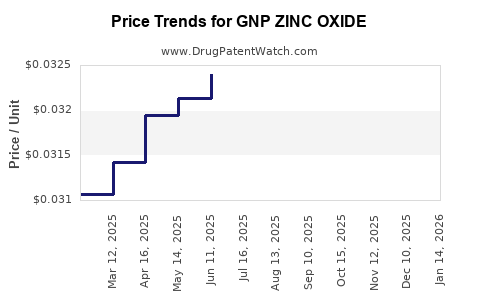
Average Pharmacy Cost for GNP ZINC OXIDE
| Drug Name | NDC | Price/Unit ($) | Unit | Date |
|---|---|---|---|---|
| GNP ZINC OXIDE 20% OINTMENT | 46122-0676-46 | 0.03583 | GM | 2026-06-17 |
| GNP ZINC OXIDE 20% OINTMENT | 46122-0676-46 | 0.03487 | GM | 2026-05-20 |
| GNP ZINC OXIDE 20% OINTMENT | 46122-0676-46 | 0.03329 | GM | 2026-04-22 |
| GNP ZINC OXIDE 20% OINTMENT | 46122-0676-46 | 0.03220 | GM | 2026-03-18 |
| GNP ZINC OXIDE 20% OINTMENT | 46122-0676-46 | 0.03158 | GM | 2026-02-18 |
| GNP ZINC OXIDE 20% OINTMENT | 46122-0676-46 | 0.03153 | GM | 2026-01-21 |
| >Drug Name | >NDC | >Price/Unit ($) | >Unit | >Date |
Market Analysis and Price Projections for GNP Zinc Oxide
Overview
GNP Zinc Oxide is a zinc oxide variant marketed primarily for pharmaceutical, cosmetic, and industrial applications. As a specialty grade product, it differentiates through purity standards and functional properties, influencing its market behavior. The global zinc oxide market size was valued at approximately $2.8 billion in 2022, with anticipated compound annual growth rate (CAGR) of 4.5% from 2023 to 2030 (Grand View Research). GNP's specific positioning may influence tailored pricing strategies due to its quality standards and supply chain.
Market Size and Trends
Global Market Value and Segmentation
- Pharmaceutical sector: Accounts for roughly 25% of total zinc oxide demand, driven by use in topical formulations and skin protection products.
- Cosmetic industry: Represents 45%, notably in sunscreens and skin care products.
- Industrial applications: Comprise 30%, including rubber manufacturing, ceramics, and paints.
Regional Distribution
- Asia-Pacific: 60%, led by China, India, and Southeast Asian nations, driven by low-cost manufacturing and expanding cosmetic markets.
- North America: 20%, with growth fueled by pharmaceutical innovations and regulatory approvals.
- Europe: 15%, characterized by high-quality standards and sustainable sourcing initiatives.
Demand Drivers
- Increasing adoption of zinc oxide in topical pharmaceuticals for skin conditions and UV protection.
- Growth in cosmetic products featuring zinc oxide as a mineral-based sunscreen.
- Expansion of zinc oxide use in rubber and ceramics industries, especially in emerging markets.
Pricing Dynamics
Historical Pricing Trends
- The average price of GNP Zinc Oxide in 2022 ranged between $4.50 and $6.00 per kilogram, fluctuating with raw material costs, supply chain factors, and quality certifications.
- Premium quality variants, like GNP, command premiums of 10-20% over standard zinc oxide grades.
Key Cost Factors
- Raw material costs (zinc metal and oxygen): Price volatility directly impacts final product pricing.
- Manufacturing quality standards: Higher purity levels (≥99.99%) increase production costs.
- Regulatory compliance: Certifications (e.g., USP, EP standards) add costs but enable premium pricing.
Price Projections (2023–2030)
| Year | Price Range (USD per kg) | Notes |
|---|---|---|
| 2023 | $5.00 – $6.00 | Market stabilization; raw material costs influence range. |
| 2025 | $5.75 – $7.00 | Slight upward trend; demand growth in cosmetics and pharma. |
| 2027 | $6.50 – $8.00 | Increasing adoption in emerging markets—price premiums expand. |
| 2030 | $7.50 – $9.00 | Market maturity; sustained demand supports steady pricing. |
Factors Influencing Prices
- Raw material supply disruptions or zinc metal shortages can prompt spikes in pricing.
- Stringent regulations for pharmaceutical-grade zinc oxide may sustain premium pricing.
- Trade policies, tariffs, and geopolitical tensions could impact costs and import-export dynamics.
Competitive Landscape
Leading producers include Zhujiang Zinc Industry, US Zinc, and Raw Material suppliers in China and India. GNP's market position depends on quality assurance, supply reliability, and capacity to meet regulatory standards. Premium brands can command 20% higher prices in focused niche markets.
Risks and Opportunities
- Risks: Raw material price fluctuations, regulatory hurdles, market saturation in mature regions.
- Opportunities: Expanding in skin health and UV protection products, developing sustainable sourcing, and leveraging technological innovations for higher purity grades.
Key Takeaways
- The global zinc oxide market is growing steadily at around 4.5% CAGR through 2030, with GNP Zinc Oxide positioned as a premium product.
- Prices are expected to rise gradually, reaching up to $9.00 per kilogram by 2030, driven by demand in pharmaceuticals and cosmetics.
- Raw material costs and regulatory standards remain primary price influencers.
- Regional demand asymmetries favor Asia-Pacific growth, with premium pricing possible in markets demanding higher purity standards.
- Market entry or expansion strategies should consider raw material sourcing stability, certification requirements, and regional regulatory landscapes.
FAQs
1. What factors primarily affect the price of GNP Zinc Oxide?
Raw material costs, product purity levels, certification standards, and regional demand influence pricing.
2. How does GNP Zinc Oxide compare to standard zinc oxide products?
GNP Zinc Oxide is a high-purity, specialty grade product, commanding higher prices due to its quality and compliance with stringent standards.
3. What is the potential for price increases in the next five years?
Prices could rise by approximately 20-30%, reaching around $9.00 per kilogram, contingent on raw material costs and demand growth.
4. Which regions offer the most growth opportunities for GNP Zinc Oxide?
Asia-Pacific, due to manufacturing hubs and consumer markets, and North America, with pharmaceutical and cosmetic sector expansion.
5. What are the biggest risks facing GNP Zinc Oxide market stability?
Supply chain disruptions, zinc metal price volatility, and tighter regulatory requirements across markets.
References
[1] Grand View Research. Zinc Oxide Market Size, Share & Trends Analysis Report, 2022–2030.
More… ↓
