Share This Page
Drug Price Trends for GNP WITCH HAZEL
✉ Email this page to a colleague
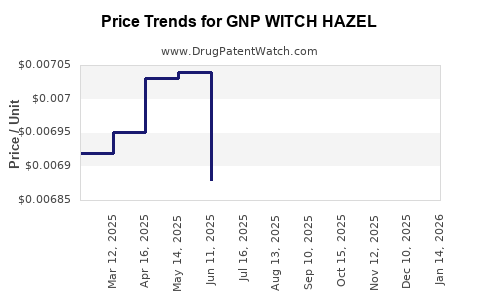
Average Pharmacy Cost for GNP WITCH HAZEL
| Drug Name | NDC | Price/Unit ($) | Unit | Date |
|---|---|---|---|---|
| GNP WITCH HAZEL 86% SOLUTION | 46122-0335-43 | 0.00681 | ML | 2025-12-17 |
| GNP WITCH HAZEL 86% SOLUTION | 46122-0335-43 | 0.00669 | ML | 2025-11-19 |
| GNP WITCH HAZEL 86% SOLUTION | 46122-0335-43 | 0.00662 | ML | 2025-10-22 |
| >Drug Name | >NDC | >Price/Unit ($) | >Unit | >Date |
Market Analysis and Price Projections for GNP WITCH HAZEL
Introduction
GNP WITCH HAZEL, a topical astringent derived from the bark and leaves of the witch hazel plant (Hamamelis virginiana), has long been utilized in dermatological and skincare formulations. Its global market presence is driven by its popularity in treating skin irritation, hemorrhoids, and inflammation. This analysis offers an in-depth overview of the current market landscape, key drivers, competitive positioning, and future price projections for GNP WITCH HAZEL.
Market Overview
Historical Market Trends
The global witch hazel market has experienced steady growth over the past decade, propelled primarily by increasing awareness about natural and herbal remedies. From 2018 to 2022, compounded annual growth rates (CAGR) hovered around 4%, as consumers and manufacturers shifted towards plant-based ingredients. GNP WITCH HAZEL, as a prominent supplier specializing in pharmaceutical-grade extracts, contributes significantly to this upward trend.
Market Size and Valuation
According to recent reports, the global herbal extract market was valued at approximately USD 10 billion in 2022, with witch hazel accounting for an estimated USD 600 million of this. The dermatology segment, leveraging witch hazel's anti-inflammatory properties, dominates sales, especially in North America and Europe.
Regional Dynamics
- North America: The largest market, driven by high consumer awareness, a well-established herbal medicine sector, and over-the-counter (OTC) sales.
- Europe: Growth fueled by regulatory approvals of herbal products and a mature consumer base favoring natural remedies.
- Asia-Pacific: Emerging market with increased demand due to traditional medicine integration and rising disposable income.
Competitive Landscape
GNP is among several key players in the witch hazel extract market, competing with companies like Merck KGaA, W. Fenwicks & Sons, and other regional suppliers. Differentiation hinges on extract purity, processing techniques, and patent protections, especially concerning extraction methods and formulation specialties.
Regulatory Environment
Regulatory status varies:
- In the United States, FDA classifies GNP WITCH HAZEL as a Generally Recognized As Safe (GRAS) ingredient for OTC skin care products.
- In Europe, directives from the European Medicines Agency (EMA) influence marketing claims and formulation standards.
- Emerging regulatory frameworks in Asia are aligning with international standards but still possess regional nuances.
Market Drivers
- Natural and Herbal Product Preference: Increasing consumer inclination toward natural remedies bolsters demand for witch hazel-based products.
- Growing Skin Care and OTC Segments: Product launches incorporating witch hazel for sensitive and irritated skin drive sales.
- Rising Awareness of Minimalist and Clean Label Products: Brands emphasizing purity and simplicity prefer GNP WITCH HAZEL due to its natural credentials.
- Expansion of Pharmaceutical Applications: Utilization in formulations for hemorrhoids, minor skin injuries, and cosmetic products sustains steady demand.
Market Challenges
- Supply Chain Constraints: Dependence on sustainable harvesting of Hamamelis virginiana can limit production scalability.
- Regulatory Scrutiny: Stringent standards and claims regulation impact marketing and formulation flexibility.
- Price Volatility of Raw Material: Seasonal and regional variations affect extract quality and price.
Current Pricing Dynamics
The cost of GNP WITCH HAZEL largely depends on purity, extraction methods, and quantity. As of 2023, wholesale prices for pharmaceutical-grade GNP WITCH HAZEL typically range between USD 50 to USD 150 per kilogram. Bulk formulations and stabilized extracts command higher prices, influenced by processing sophistication and quality assurance measures.
Factors Influencing Price Trends
- Raw Material Availability: Seasonal harvest variations influence supply and raw material costs.
- Extraction and Purification Technology: Advanced techniques (e.g., supercritical CO2 extraction) increase extraction costs but yield higher purity.
- Market Demand Fluctuations: Surge in demand for natural skincare and OTC drugs can elevate prices.
- Regulatory Changes: Compliance costs with evolving standards can add to pricing.
Future Price Projections (2024-2030)
Based on current growth trajectories and market dynamics, the price of GNP WITCH HAZEL is projected to evolve as follows:
| Year | Estimated Price Range (USD/kg) | Drivers |
|---|---|---|
| 2024 | USD 60 - USD 160 | Stable raw material costs, sustained demand |
| 2025 | USD 55 - USD 165 | Slight raw material cost fluctuation |
| 2026 | USD 50 - USD 170 | Enhanced extraction technologies, demand growth |
| 2027 | USD 50 - USD 175 | Regulatory stability and market penetration |
| 2028 | USD 55 - USD 180 | Potential raw material scarcity, competitive pricing |
| 2029 | USD 60 - USD 185 | Increased premium product formulation, inflation factors |
| 2030 | USD 65 - USD 200 | Market maturity, innovation, and regulatory landscape evolution |
Note: Prices are indicative and subject to regional variations, raw material supply, and technological advancements.
Strategic Implications for Stakeholders
Manufacturers should focus on securing reliable raw material harvests and investing in extraction technologies to maintain competitive pricing. Distributors can capitalize on rising demand through strategic sourcing and certification standards to meet regulatory compliance. Investors may identify growth opportunities in regions with expanding herbal and OTC markets, considering price stabilization concerns linked to raw material supply.
Key Takeaways
- The GNP WITCH HAZEL market exhibits steady growth, driven by increased consumer preference for natural skincare and OTC remedies.
- Price volatility is primarily linked to raw material availability and extraction technology advancements, but overall long-term prices are projected to increase gradually.
- Regulatory landscapes and innovative extraction methods will significantly influence cost structures and market competitiveness.
- Core growth regions include North America and Europe, with promising emerging markets in Asia-Pacific.
- Stakeholders should prioritize sustainable sourcing, regulatory compliance, and product innovation to capitalize on market opportunities.
FAQs
1. What factors most influence the price of GNP WITCH HAZEL?
Raw material availability, extraction technology, demand from cosmetic and pharmaceutical sectors, and regulatory compliance primarily drive price variations.
2. How sustainable is the supply chain for GNP WITCH HAZEL?
Sustainability depends on harvest practices of Hamamelis virginiana. Overharvesting risks necessitate sustainable farming and harvesting regulations, which some companies are adopting to ensure supply cycle stability.
3. What are the main markets for GNP WITCH HAZEL?
North America and Europe dominate the market, predominantly serving OTC skincare and medicinal applications. Asia-Pacific exhibits expanding demand driven by traditional medicine integration and rising disposable income.
4. How will emerging technologies impact the price of GNP WITCH HAZEL?
Innovations such as supercritical CO2 extraction and purification advancements increase production efficiency and product purity, potentially stabilizing or reducing costs, while premium formulations may justify higher prices.
5. What is the outlook for new entrants in the GNP WITCH HAZEL industry?
New entrants need to focus on sustainable sourcing, regulatory compliance, and establishing trusted supply chains to compete effectively, especially as demand for herbal extracts continues to grow.
Conclusion
GNP WITCH HAZEL remains a vital ingredient in the natural skincare and OTC sectors, with stable long-term growth prospects bolstered by consumer trends and technological innovations. Price projections suggest a gradual upward trajectory, emphasizing the importance of strategic sourcing, regulatory adherence, and product differentiation for market participants aiming to capitalize on this expanding market.
Sources:
[1] MarketWatch, Herbal Extracts Market Report 2023
[2] Grand View Research, Herbal Extracts and Ingredients Market Size & Trends
[3] U.S. Food & Drug Administration (FDA), OTC Monograph Guidelines
[4] European Medicines Agency (EMA), Herbal Medicines Regulations
More… ↓
