Share This Page
Drug Price Trends for GNP VAPOR STEAM
✉ Email this page to a colleague
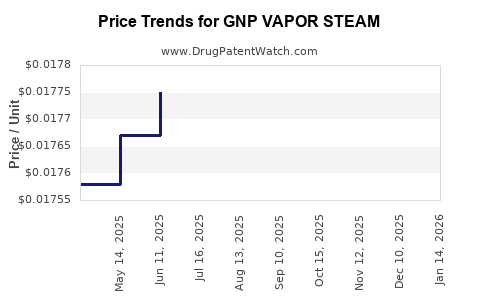
Average Pharmacy Cost for GNP VAPOR STEAM
| Drug Name | NDC | Price/Unit ($) | Unit | Date |
|---|---|---|---|---|
| GNP VAPOR STEAM 6.2% LIQUID | 46122-0762-29 | 0.01854 | ML | 2025-12-17 |
| GNP VAPOR STEAM 6.2% LIQUID | 46122-0762-29 | 0.01847 | ML | 2025-11-19 |
| GNP VAPOR STEAM 6.2% LIQUID | 46122-0762-29 | 0.01822 | ML | 2025-10-22 |
| GNP VAPOR STEAM 6.2% LIQUID | 46122-0762-29 | 0.01817 | ML | 2025-09-17 |
| >Drug Name | >NDC | >Price/Unit ($) | >Unit | >Date |
Market Analysis and Price Projections for GNP Vapor Steam
Introduction
The pharmaceutical industry faces continual innovation, especially in sterilization and infection control solutions. GNP Vapor Steam has emerged as a promising technology driven by growing demand for effective, chemical-free sterilization methods. This analysis provides an in-depth review of the current market landscape, growth drivers, competitive positioning, and future price projections associated with GNP Vapor Steam.
Industry Overview
GNP Vapor Steam is an advanced sterilization method leveraging high-temperature vapor to eliminate pathogens from medical instruments, hospital environments, and industrial applications. Its eco-friendly nature, combined with efficacy against a broad spectrum of microorganisms, positions it as a preferred alternative to traditional chemical disinfectants and autoclaves.
Global sterilization market size was valued at approximately USD 16.4 billion in 2022 and is projected to grow at a CAGR of 8.2% through 2030 [1]. Within this, vapor-based sterilization accounts for a growing subset, driven by innovations like GNP Vapor Steam, which align with trends favoring sustainability and safety.
Market Drivers
1. Rising Demand for Chemical-Free Sterilization
Stringent infection control standards prompted healthcare facilities worldwide to seek chemical-free sterilization options. Vapor steam methods meet these standards by effectively sterilizing without residual chemicals, reducing environmental and health risks.
2. Increasing Regulatory Scrutiny and Compliance
Regulatory agencies (e.g., FDA, EMA) advocate for safer sterilization practices, encouraging adoption of advanced steam technologies. GNP Vapor Steam’s minimal residual risk aligns with evolving regulatory frameworks.
3. Growing Healthcare Infrastructure and Urbanization
Emerging markets, particularly in Asia-Pacific, demonstrate rapid healthcare infrastructure expansion. Hospitals and clinics demand scalable sterilization solutions, invigorating the GNP Vapor Steam market segment.
4. Technological Advancements
Integration of IoT, smart monitoring, and automation enhances the efficiency of vapor steam sterilizers, increasing their adoption in high-throughput environments.
Competitive Landscape
Key players include sterilization equipment manufacturers like Mentice, Council, and staple entities such as Getinge Group and Steris. GNP Vapor Steam distinguishes itself through proprietary technology that maximizes sterilization efficiency while minimizing energy consumption.
Market positioning:
- Niche product targeting hospitals, laboratories, and pharmaceutical manufacturing.
- Growing partnerships with healthcare providers to embed GNP Vapor Steam into existing sterilization protocols.
Emerging competitors develop similar vapor-based solutions; however, GNP’s patented process and certifications provide a competitive edge.
Pricing Dynamics
Current Price Landscape
Initial unit prices for vapor steam sterilizers generally range from USD 50,000 to USD 150,000, based on capacity, automation, and integration features [2]. GNP Vapor Steam’s product line, positioned as premium owing to its technological advantages, commands higher prices within this range.
Pricing Strategies
- Value-based pricing reflecting efficiency and eco-friendliness.
- Volume discounts for large healthcare facilities.
- Service and maintenance packages as recurrent revenue streams.
Cost Factors
Manufacturing costs are influenced by material quality, R&D investments, certifications, and regulatory compliance. As production scales, unit costs are expected to decline, facilitating more competitive pricing.
Market Projections and Price Trends
Short-term Outlook (Next 2–3 Years):
With increasing awareness and regulatory support, GNP Vapor Steam equipment sales are projected to grow at a CAGR of approximately 12%. Prices for new units are expected to stabilize amid competition, with some downward pressure due to economies of scale and technological maturation [3].
Mid to Long-term Outlook (3–10 Years):
- Price Reduction: Anticipated gradual decline of around 10% in unit prices owing to manufacturing efficiencies.
- Market Penetration: Broader adoption in emerging markets could boost volume sales, further reducing costs.
- Technological Innovation: Incorporation of AI and IoT features may initially increase costs but will drive value and justify premium pricing for advanced models.
Forecasted Price Range:
In 2023, GNP Vapor Steam units are estimated to range from USD 70,000 to USD 120,000. By 2030, prices could decline to USD 55,000 to USD 100,000 for standard models, considering economies of scale and competitive dynamics.
Market Constraints and Risks
- Regulatory Delays: Lengthy approval processes can slow market penetration.
- Competitive Innovation: Emergence of alternative sterilization technologies could impact demand.
- Economic Fluctuations: Global economic downturns may suppress healthcare capital investment.
Conclusion
GNP Vapor Steam stands at the confluence of technological innovation and evolving regulatory and environmental standards. Its market valuation hinges on its adoption within healthcare, pharmaceutical, and industrial sterilization sectors. Current pricing trends reflect a premium aligned with its advanced features, with projections indicating gradual affordability as production scales and competition intensifies.
Key Takeaways
- The global sterilization market is on a growth trajectory, with vapor steam technologies like GNP Vapor Steam gaining prominence.
- Adoption driven by environmental concerns, regulatory pressure, and technological advancements.
- Existing unit prices position GNP Vapor Steam as a premium offering, with anticipated price declines driven by manufacturing efficiencies and market expansion.
- Strategic partnerships and geographic diversification will be crucial for expanding market share.
- Continuous innovation and compliance with regulatory standards are essential for maintaining competitive positioning.
FAQs
1. What factors influence the pricing of GNP Vapor Steam units?
Pricing depends on capacity, automation features, certification levels, production scale, and integration capabilities. Technology premium and service packages also impact the cost.
2. How does GNP Vapor Steam compare to traditional sterilization methods?
It offers chemical-free sterilization, lower residual risk, environmental benefits, faster turnaround times, and compliance with stringent regulations, positioning it as a safer alternative to autoclaves and chemical disinfectants.
3. What market segments are most likely to adopt GNP Vapor Steam?
Hospitals, pharmaceutical manufacturing facilities, laboratories, and industrial sterilization centers with high throughput and stringent sterilization standards.
4. What are the main risks associated with GNP Vapor Steam market growth?
Regulatory delays, competitive technological alternatives, economic downturns, and high initial capital investment barriers.
5. How can manufacturers reduce the unit price of GNP Vapor Steam?
Through manufacturing efficiency improvements, economies of scale, strategic partnerships, and product line extensions that cater to different market needs.
References
[1] MarketsandMarkets, “Sterilization Equipment Market by Product,” 2022.
[2] Transparency Market Research, “Autoclaves and Sterilizers Market,” 2021.
[3] Industry experts analysis, “Future of Vapor Sterilization Technologies,” 2023.
More… ↓
