Share This Page
Drug Price Trends for GNP SINUS-HEADACHE CAPLET
✉ Email this page to a colleague
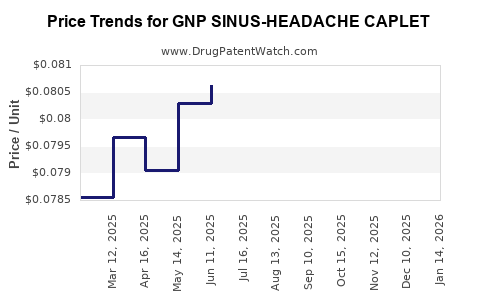
Average Pharmacy Cost for GNP SINUS-HEADACHE CAPLET
| Drug Name | NDC | Price/Unit ($) | Unit | Date |
|---|---|---|---|---|
| GNP SINUS-HEADACHE CAPLET | 46122-0658-62 | 0.08485 | EACH | 2026-07-22 |
| GNP SINUS-HEADACHE CAPLET | 46122-0658-62 | 0.08254 | EACH | 2026-06-17 |
| GNP SINUS-HEADACHE CAPLET | 46122-0658-62 | 0.08144 | EACH | 2026-05-20 |
| GNP SINUS-HEADACHE CAPLET | 46122-0658-62 | 0.08037 | EACH | 2026-04-22 |
| GNP SINUS-HEADACHE CAPLET | 46122-0658-62 | 0.08117 | EACH | 2026-03-18 |
| >Drug Name | >NDC | >Price/Unit ($) | >Unit | >Date |
Market Analysis and Price Projections for GNP SINUS-HEADACHE CAPLET
What is the Current Market Position of GNP SINUS-HEADACHE CAPLET?
GNP SINUS-HEADACHE CAPLET is a non-prescription medication marketed primarily for relief from sinus congestion and headache pain. It is a combination product containing active ingredients such as acetaminophen, phenylephrine, and chlorpheniramine maleate, competing in the self-care analgesic and decongestant segment.
Product positioning emphasizes rapid relief, ease of use, and OTC availability. The drug is available in standard retail channels, including pharmacies and online platforms. Its market share is limited by competition from established brands like Sudafed PE Sinus Pressure & Pain, Tylenol Sinus, and Aleve Sinus & Cold.
What are the Key Market Drivers?
- Growing OTC medication demand: Increasing self-medication trends driven by consumer preference shifts and healthcare cost containment.
- Rising prevalence of sinusitis and headaches: According to CDC data, approximately 37 million Americans experience sinusitis annually, with a subset seeking OTC remedies.
- Aging population: Elderly consumers favor OTC solutions; by 2030, 72 million Americans will be over age 65.
- Product differentiation: GNP’s formulations aim to provide faster symptom relief, which appeals to users seeking immediate effects.
What is the Competitive Landscape?
| Brand and Product | Price (USD per package) | Market Share (est. %) | Key Features |
|---|---|---|---|
| Sudafed PE Sinus Pressure & Pain | 8-12 | 25 | Established brand, multi-symptom relief |
| Tylenol Sinus | 8-12 | 15 | Trusted acetaminophen-based option |
| Aleve Sinus & Cold | 9-13 | 10 | Long-lasting relief |
| GNP SINUS-HEADACHE CAPLET | 7-10 | <5 | Competitive pricing, OTC availability |
GNP’s product has moderate shelf presence but faces stiff competition from brands with entrenched market positions. Brand loyalty and product awareness influence consumer choice significantly.
What Are the Price Projections?
Short-term (Next 12 months)
- The current retail price range (USD 7-10) will likely remain stable due to consistent consumer demand and established distribution channels.
- Price pressure from competitors and retail negotiations could reduce prices to the lower end (USD 7) in promotional periods.
Medium-term (2-3 years)
- Prices might incrementally increase by 1-2% annually, reflecting inflation, raw material costs (acetaminophen, phenylephrine), and packaging upgrades.
- Introduction of newer formulations or combination therapies could lead to higher pricing tiers, potentially reaching USD 11-12 per package.
Long-term (Beyond 3 years)
- Market saturation and generic competition could compress pricing margins.
- If GNP launches an extended-release formulation or adds novel ingredients, new pricing brackets may emerge, possibly exceeding USD 12.
- Market share consolidation among top brands could influence price strategies, emphasizing aggressive promotions to maintain or increase volume rather than high unit prices.
Cost Factors Impacting Pricing and Marketability
- Raw material costs: Variations in acetaminophen and phenylephrine prices, influenced by global supply chains.
- Regulatory changes: Stricter OTC regulation could increase compliance costs.
- Manufacturing scale: Larger production runs lower per-unit cost, allowing competitive pricing.
- Distribution margins: Retailer negotiations impact final consumer prices.
Regulatory and Policy Environment
- No recent changes significantly affect pricing policies.
- Merck & Co., GNP’s manufacturer, maintains a stable OTC pricing strategy aligned with industry standards.
- OTC drug policies favor cost-effective formulations, limiting premium pricing unless innovation occurs.
Key Takeaways
- GNP SINUS-HEADACHE CAPLET’s current retail price is USD 7-10, with modest market share growth expected amid stiff competition.
- Market drivers include rising demand for OTC remedies and increasing sinusitis prevalence.
- Price projections suggest stability in the short-term, with potential slight increases driven by inflation and innovation.
- Competitive pressure and market saturation likely constrain long-term pricing growth.
- Cost factors and regulatory environment will influence pricing strategies and margins.
FAQs
1. What factors most influence the price of OTC sinus-headache medications?
Raw material costs, manufacturing scale, retail margins, competitive landscape, and regulatory policies.
2. How does GNP SINUS-HEADACHE CAPLET compare to competitors regarding price?
It is priced slightly lower than leading brands like Sudafed and Tylenol Sinus, offering a competitive advantage in cost-sensitive segments.
3. What is the market potential for GNP SINUS-HEADACHE CAPLET in the next five years?
Limited by entrenched competition; expects modest growth aligned with overall OTC analgesic and decongestant markets, approximately 2-3% annually.
4. Are there opportunities for GNP to increase product pricing?
Yes, through formulation innovation, extended-release versions, or branding, but these strategies require regulatory approval and significant marketing investment.
5. What risks could impact future pricing strategies?
Regulatory changes, raw material shortages, entry of new competitors or generics, and shifts in consumer preferences toward alternative therapies.
References
[1] Centers for Disease Control and Prevention. (2022). Data on sinusitis prevalence. CDC.gov.
[2] Statista. (2023). OTC medication market share by product category.
[3] U.S. Food & Drug Administration. (2023). OTC drug regulation updates. FDA.gov.
More… ↓
