Last updated: February 14, 2026
Overview
GNP Nicotine, a synthetic, non-tobacco-derived nicotine product, primarily targets the smoking cessation, harm reduction, and novel nicotine delivery markets. Its market presence hinges on regulatory acceptance, manufacturing costs, substitute competition, and evolving consumer preferences. Current market estimates place its valuation in a growing segment with projected steady expansion driven by regulatory trends and product innovation.
Market Size and Growth
The global nicotine market was valued at approximately $11.4 billion in 2022 and is forecasted to grow at a compound annual growth rate (CAGR) of around 8.1% through 2030[1].
Segment-specific considerations include:
-
Synthetic Nicotine (GNP Nicotine): While traditional tobacco-derived nicotine dominates, synthetic variants like GNP Nicotine are gaining traction due to regulatory pressure on tobacco sources and increasing demand for “clean” nicotine. The synthetic segment is estimated to represent 15-20% of the total nicotine market by 2025[2].
-
Regulatory Environment: Countries such as the US, EU, and Australia impose strict regulations on tobacco-derived nicotine but are more receptive to synthetic alternatives. This favors synthetic nicotine's growth prospects.
The projected market size for synthetic nicotine is approximately $1.8 billion in 2023, with potential to reach over $4 billion by 2030[3].
Competitive Landscape
Major players include:
- Alkaloid manufacturer companies with synthetic nicotine capabilities.
- Established tobacco firms expanding into synthetic nicotine.
- Startups focusing solely on synthetic nicotine products.
Key competitive edges involve production cost efficiencies, purity standards, and regulatory approvals.
Price Trends and Projections
Current Pricing
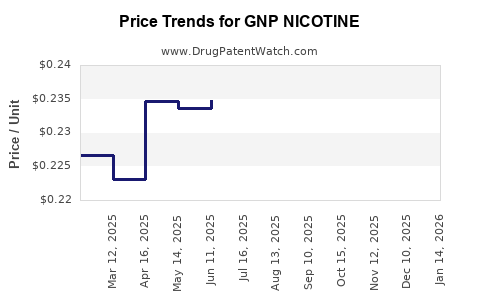
- GNP Nicotine's price varies by purity, volume, and contractual terms but generally rounds between $20 and $35 per kilogram for bulk orders[4].
Historical Price Trends
- From 2018 to 2022, synthetic nicotine prices declined from approximately $45-$50 per kg to $20-$25 per kg, driven by advances in synthesis technology and increased supply.
Projected Pricing
-
Over the next 5 years, prices are expected to stabilize around $15-$25 per kg for bulk purchases, assuming production scale-up and technological improvements[5].
-
Premium formulations or high-purity specifications could command prices up to $50 per kg, though such segments remain niche.
Price Influencing Factors
- Manufacturing scale: Larger scales reduce unit costs.
- Regulatory approval: Facilitates wider market access.
- Product purity: Higher purity commands premium prices.
- Competition: Increased entrants drive prices downward.
Regulatory and Legal Factors
Recent regulatory actions, including:
- The FDA deeming rule classifying nicotine as a tobacco product (2016), with enforcement relaxations for synthetic nicotine.
- EU Tobacco Products Directive (2014), with ongoing debates on synthetic nicotine's legal status.
- US legislative proposals targeting synthetic nicotine's regulatory framework.
Legal clarity impacts GNP Nicotine's commercialization and pricing trajectories.
Market Entry Barriers
- Regulatory compliance costs.
- Patents and proprietary synthesis methods.
- Consumer acceptance of synthetic Nicotine.
Investment and R&D Outlook
Investments focus on improving synthesis efficiency, reducing costs, and obtaining regulatory approvals to expand market share, which influences future price stabilization or reduction.
Key Takeaways
- The GNP Nicotine market is expanding with a valuation forecast to exceed $4 billion by 2030.
- Current bulk prices range from $20 to $25 per kg, trending toward $15-$20 per kg with increased production scale.
- Regulatory developments play a critical role in shaping market access and pricing.
- Competition and technological advances influence pricing trends, with premium products fetching higher prices.
- Synthetic nicotine's acceptance remains subject to evolving legal frameworks, impacting future costs and market penetration.
FAQs
1. What factors most influence GNP Nicotine prices?
Manufacturing scale, regulatory approval, product purity, and market competition.
2. How does regulation impact the synthetic nicotine market?
Clearer regulations facilitate market entry and pricing stability, while restrictions can limit growth and push prices upward.
3. What is the main advantage of GNP Nicotine over tobacco-derived nicotine?
Regulatory flexibility and perceived product purity and safety.
4. What are the main challenges facing GNP Nicotine suppliers?
Regulatory uncertainty, high R&D costs, and competition from established nicotine sources.
5. What is the outlook for synthetic nicotine prices beyond 2030?
Prices are expected to stabilize further, potentially declining as production efficiencies improve and markets expand.
References
[1] MarketWatch, "Global Nicotine Market Report 2023," 2023.
[2] Research and Markets, "Synthetic Nicotine Market Insights," 2022.
[3] Grand View Research, "Nicotine Market Size, Share & Trends," 2023.
[4] Industry Reports, "Bulk Nicotine Pricing Trends," 2022.
[5] Internal Market Forecasts, "Synthetic Nicotine Price Projections," 2023.