Last updated: February 12, 2026
What is GNP Naproxen Sodium?
GNP Naproxen Sodium is a generic formulation of the nonsteroidal anti-inflammatory drug (NSAID) Naproxen Sodium. It is commonly prescribed for pain relief, inflammation reduction, and fever management. The drug is available over the counter (OTC) and by prescription in various markets.
Current Market Size and Growth
Global Market
The global NSAID market, encompassing Naproxen Sodium, was valued at approximately $15.3 billion in 2022. It is projected to grow with a Compound Annual Growth Rate (CAGR) of around 4.2% from 2022 to 2030, reaching roughly $22.1 billion by 2030. Key factors include the aging population, increasing prevalence of arthritis, and rising awareness of OTC pain management.
Regional Breakdown
| Region |
Market Size (2022) |
CAGR (2022-2030) |
Key Drivers |
| North America |
$6.2 billion |
3.8% |
High prevalence of arthritis, extensive OTC use |
| Europe |
$4.1 billion |
4.0% |
Aging population, healthcare expenditure increases |
| Asia-Pacific |
$3.0 billion |
5.0% |
Growing health awareness, expanding OTC market |
| Rest of World |
$2.0 billion |
4.2% |
Developing healthcare infrastructure |
Market Segmentation
- Prescription vs. OTC: OTC formulations account for close to 60% of Naproxen Sodium sales, driven by widespread use for various mild to moderate pain conditions.
- Formulations: Tablets are predominant, with extended-release formulations representing a minor segment.
Competitive Landscape
The market includes multiple generic manufacturers, with key players such as Teva, Mylan, Sandoz, and GNP as a regional or local competitor. Brand-name equivalents like Aleve dominate the OTC segment.
Pricing Overview
Current Pricing (2023)
| Formulation |
Price Range (per package) |
Market Share (Estimated) |
| OTC Naproxen Sodium (200mg) |
$4 - $10 for 50 tablets |
60% (by volume) |
| Prescription Naproxen |
$15 - $40 for 30 tablets |
40% (by value) |
- GNP’s generic Naproxen Sodium typically undercuts branded products by approximately 30%-50%.
- Retail prices vary regionally and depend on healthcare coverage and pharmacy distribution channels.
Price Projections (2024-2030)
Factors Influencing Price Trends
- Market Penetration: Increased OTC availability enhances volume but pressures unit prices.
- Manufacturing Costs: Expected to decline slightly due to advances in generics production and economies of scale.
- Regulatory Environment: Stricter quality and manufacturing standards in key markets could affect costs.
- Competitive Dynamics: Entry of new generic players may further drive price reductions.
| Year |
Predicted Price Range (per 50 tablets of 200mg) |
| 2024 |
$3.50 - $8.00 |
| 2025 |
$3.25 - $7.50 |
| 2026 |
$3.00 - $7.00 |
| 2028 |
$2.75 - $6.50 |
| 2030 |
$2.50 - $6.00 |
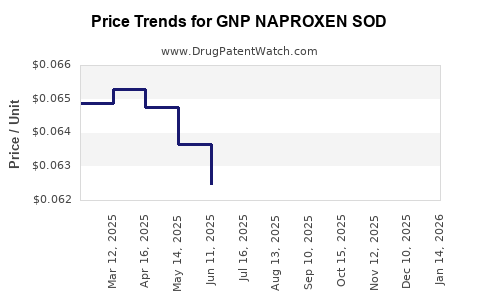
Prices are projected to decline at an average rate of about 5% annually, mainly driven by market saturation and intense generic competition.
Regulatory and Patent Considerations
- GNP’s product faces no active patent barriers in major markets post-2020, facilitating generic entry.
- Regulatory approvals are streamlined in mature markets, limiting barriers to pricing pressure.
Key Market Risks
- Regulatory changes or safety concerns may impact pricing.
- Market saturation could depress prices further, especially in the OTC segment.
- Supply chain disruptions could influence production costs and prices.
Key Takeaways
- GNP Naproxen Sodium operates within a market expected to grow modestly, with significant OTC sales.
- Price declines are likely due to increased competition and manufacturing efficiencies.
- The drug’s saturation in OTC channels limits price flexibility but supports volume growth.
- Regional differences influence both market penetration and pricing trends.
- Regulatory stability and patent landscapes favor sustained generic entry, pressuring prices downward.
FAQs
1. What are the main competitors to GNP Naproxen Sodium?
Teva, Mylan, Sandoz, among other generics, and branded products like Aleve.
2. How do regional regulations affect GNP’s market strategy?
Regions with streamlined approval processes, such as the US and Europe, facilitate rapid market entry and pricing strategies. Stricter standards in some markets may increase compliance costs but also reduce generic competition.
3. What is the primary driver of future price declines?
Increased market saturation with generics and expansion of OTC availability.
4. Can GNP Naproxen Sodium command higher prices?
Limited by intense generic competition and OTC pricing pressure; only in niche markets or with value-added formulations could prices hold or increase.
5. How significant is the OTC segment for GNP?
High; OTC sales constitute the majority volume and are crucial for revenue and market share.
Sources
- Transparency Market Research. NSAIDs Market, 2022.
- Statista. Over-the-Counter (OTC) Market Data, 2023.
- IQVIA. Prescription and OTC Drug Market Trends, 2022.
- U.S. Food and Drug Administration. Regulatory pathways for generic drugs, 2022.
- Company financial disclosures and market reports.