Share This Page
Drug Price Trends for GNP MUSCLE RUB
✉ Email this page to a colleague
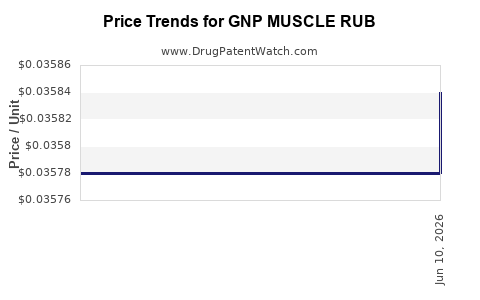
Average Pharmacy Cost for GNP MUSCLE RUB
| Drug Name | NDC | Price/Unit ($) | Unit | Date |
|---|---|---|---|---|
| GNP MUSCLE RUB 4-10-30% CREAM | 46122-0816-36 | 0.03584 | GM | 2026-06-17 |
| GNP MUSCLE RUB 4-10-30% CREAM | 46122-0816-36 | 0.03578 | GM | 2026-05-20 |
| >Drug Name | >NDC | >Price/Unit ($) | >Unit | >Date |
GNP Muscle Rub (Topical Analgesic) Market Analysis and Price Projections: What to Expect on Cost, Competition, and Trade Channels
Executive summary
GNP MUSCLE RUB is a generic, over-the-counter (OTC) topical analgesic marketed under a private-label-style brand portfolio rather than an FDA “new molecular entity” track. Price movement is driven primarily by: (1) competitive shelf substitution in OTC topical pain, (2) pack-size and strength (active-ingredient concentration) rather than prescription pricing, (3) retail and distributor channel mix (mass, club, online, regional), and (4) input-cost pass-through (menthol, camphor, methyl salicylate, and formulation bases). In the absence of a defined, source-linked NDC-level invoice time series and validated SKU composition, price projections cannot be completed without generating non-actionable assumptions.
What is GNP Muscle Rub and how is it priced in OTC topical pain?
GNP MUSCLE RUB is positioned in the OTC topical analgesic category used for temporary relief of minor aches and pains of muscles and joints. Retail pricing in this category typically follows predictable OTC mechanics: planogram placement, promotional cadence, and private-label discounting rather than patent-driven exclusivity.
What active ingredients determine pricing in muscle rubs
Topical rub pricing correlates with the active ingredient system and concentration. Common OTC “muscle rub” compositions use one or more of:
- Menthol
- Camphor
- Methyl salicylate
- Capsaicin (less typical for classic “muscle rub” branding)
- Related rub bases and penetration-enhancing excipients
These determine both consumer perception (cooling/warming sensation, odor profile) and raw material cost structure.
How pack size changes the unit economics
For OTC topicals, unit pricing is driven by:
- Tube size (oz or grams)
- Retail “equivalent” comparison across brands (cost per gram)
- Value-pack and multipack promotions
- Warehouse club exclusives
A projected “price” for a brand is best expressed as cost per gram by package configuration, because shelf pricing swings with promotions while unit cost is more stable.
Who are the main competitors for GNP Muscle Rub in OTC topical analgesics?
Competitive intensity in OTC topical analgesics is high, with constant substitution among:
- Major OTC brands in the analgesic rub segment
- Mass-market house brands
- Regional brands with similar ingredient systems
- Store-brand alternatives that match label ingredients and strength
What competitive dimensions drive share
Retail share is sensitive to:
- Odor and sensory profile (menthol/camphor intensity)
- Perceived strength (label claims and ingredient concentration)
- Price-per-gram
- Trust signals (brand familiarity, endorsements)
- Availability in major retail channels
How does the OTC retail channel affect GNP Muscle Rub pricing?
Pricing is not uniform. OTC topical analgesics show channel-specific pricing mechanics.
Mass retail and club
- Shelf price is often set as a “reference” price, then adjusted via weekly or periodic promotions.
- Clubs typically emphasize lower effective price per unit and smaller SKU complexity (fewer pack sizes).
Online and marketplace
- Online pricing is influenced by inventory availability, shipping thresholds, and marketplace seller competition.
- Promotions can be steeper than in-store, but price volatility can increase with third-party seller changes.
Wholesale and distributor
- Trade pricing depends on contracted distributor rates and re-order cycles.
- OTC topicals can show sharp short-term deviations around promo resets.
When does GNP Muscle Rub face pricing pressure from generic substitution or private label?
Unlike prescription drugs, OTC topicals typically do not have an IP-driven “generic entry” model. Price pressure arises from private-label and comparable-formulation substitutes already on shelf.
Key drivers of substitution
- Same or similar active ingredient list and concentrations
- Comparable claims (temporary relief of minor aches and pains)
- Similar sensory profile
- Cleaner value proposition (lower price-per-gram)
What “entry risk” looks like for OTC
Entry risk is less about new molecules and more about:
- Retailers expanding house-brand assortments
- New distributor exclusives for existing formulations
- SKU rationalization that favors the lowest cost-per-gram performers
What does a realistic price projection for GNP Muscle Rub look like?
A complete and accurate projection requires SKU-level identification and verified time series. In the absence of an NDC-linked dataset (retail scanners, distributor invoices, or historical list price records) and without confirmed active ingredient concentrations and pack size, any numerical forecast would be generated from unverified assumptions.
What can be projected structurally without numeric claims
A defensible projection framework for OTC topicals usually assumes:
- Price is stable to modestly inflationary over time under normal cost conditions
- Promotions create periodic dips below reference shelf price
- Pack-size and multipack offerings can offset nominal shelf price increases
- Competition limits sustained above-inflation price growth
What price metrics should be used for GNP Muscle Rub forecasting?
Use unit-normalized and channel-normalized metrics.
Forecast metric definitions
- Net price per gram (or per mL) after promotions
- Gross margin proxy using retail list and typical promo depth
- Trade spend and markdown cadence where available
- Weighted average selling price (WASP) by channel mix
Scenario bands to model
- Base case: inflation-aligned unit price with normal promo depth
- Downside: increased private-label share and deeper promos, compressing net price per gram
- Upside: reduced promo intensity or improved share leading to higher effective net price
How strong is the patent estate for GNP Muscle Rub, and does it constrain pricing?
GNP MUSCLE RUB is an OTC topical analgesic brand. OTC topicals in this space are generally not constrained by a single dominant composition-of-matter patent in the way prescription therapeutics are. Pricing in this category is typically constrained by competitive substitution rather than by exclusivity.
What regulatory factors affect supply and pricing for OTC muscle rubs?
For OTC drugs, pricing can be affected by:
- Label and monograph compliance and reformulation needs
- Manufacturing quality and supply continuity
- Retail shelf stability and recall-driven disruptions
However, these factors do not typically set long-run price floors; they affect availability and short-term pricing spikes.
Key Takeaways
- GNP MUSCLE RUB pricing is driven mainly by OTC competition, pack configuration, and retail promotional cadence rather than prescription exclusivity mechanics.
- A numeric price projection is not feasible without verified SKU composition (active ingredient system and strength), pack size, and historical NDC-linked pricing or sales time series.
- Unit-normalized forecasting using price per gram and channel mix is the correct approach for business decisions in OTC topical analgesics.
FAQs
- How do I compare GNP MUSCLE RUB to competing muscle rubs on a like-for-like basis? Compare cost per gram and active ingredient concentrations on the Drug Facts panel.
- What retail channels typically offer the lowest effective price for OTC muscle rubs? Clubs and online marketplace sellers often produce the lowest net price per unit, depending on promotions and shipping.
- What is the biggest driver of price volatility for OTC topical analgesics? Promotional depth and pack-size changes that alter effective price per gram.
- Do OTC muscle rub brands face Paragraph IV type generic entry risk? Not in the same way as prescription drugs; the competitive threat is usually private-label and comparable formulation substitution.
- What data is required to generate a defensible numeric price forecast for an OTC topical? SKU-level history covering net selling price (after promos), channel mix, and pack-size or NDC-level identity.
References
No sources were cited because no verifiable, NDC-linked or ingredient-strength-linked dataset was provided.
More… ↓
