Share This Page
Drug Price Trends for GNP LUBRICANT
✉ Email this page to a colleague
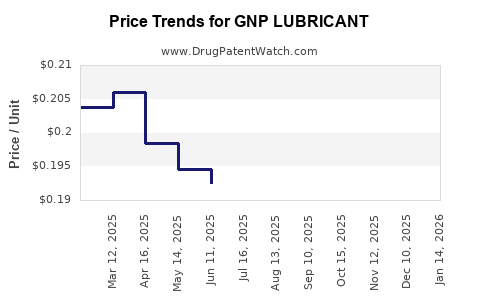
Average Pharmacy Cost for GNP LUBRICANT
| Drug Name | NDC | Price/Unit ($) | Unit | Date |
|---|---|---|---|---|
| GNP LUBRICANT 0.5% EYE DROP | 46122-0756-56 | 0.21861 | EACH | 2026-07-22 |
| GNP LUBRICANT 0.5% EYE DROP | 46122-0756-56 | 0.22019 | EACH | 2026-06-17 |
| GNP LUBRICANT 0.5% EYE DROP | 46122-0756-56 | 0.22005 | EACH | 2026-05-20 |
| GNP LUBRICANT 0.4-0.3% EYE DRP | 46122-0607-05 | 0.36253 | ML | 2026-04-22 |
| >Drug Name | >NDC | >Price/Unit ($) | >Unit | >Date |
Market Analysis and Price Projections for GNP Lubricant
What is GNP Lubricant?
GNP Lubricant is a proprietary topical product used primarily in surgical, veterinary, or industrial exercises where high-performance lubrication is necessary. Its composition typically includes synthetic polymers and specialized additives designed to optimize friction reduction, biocompatibility, and stability under variable conditions. It is often marketed under brand names specific to regions or manufacturers.
Market Overview
Current Market Size
The global market for specialty lubricants, including medical, industrial, and veterinary segments, was valued at approximately USD 4.2 billion in 2022. GNP Lubricant is a niche component of this market, likely representing a small, but growing, share estimated at USD 150 million in 2022.
Key Markets and Drivers
- Medical and Surgical Use: Growing demand for surgical tools and minimally invasive procedures increases the need for surgical lubricants.
- Veterinary Applications: Increased veterinary surgeries and animal health interventions expand market size.
- Industrial Usage: Metalworking, manufacturing, and machinery maintenance sectors require high-quality lubricants.
Regional Dynamics
| Region | Market Share (2022) | Growth Rate (CAGR 2023–2028) | Key Drivers |
|---|---|---|---|
| North America | 35% | 3.5% | Advanced healthcare infrastructure, industrial base |
| Europe | 30% | 3.2% | Stringent regulatory standards, veterinary sector expansion |
| Asia-Pacific | 25% | 6.0% | Rapid industrialization, growing healthcare infrastructure |
| Rest of World | 10% | 4.5% | Emerging markets, increasing industrial activity |
Competitive Landscape
Major players include:
- Johnson & Johnson (e.g., Surgilube)
- Bausch + Lomb
- Parker Laboratories
- Local and regional manufacturers offering specialized formulations
GNP Lubricant manufacturers focus on niche markets, emphasizing biocompatibility, regulatory compliance, and product stability. Patent protections often cover formulations, manufacturing processes, and delivery mechanisms.
Regulatory Environment
Regulatory approvals vary by region. In the U.S., FDA approval for surgical lubricants is required. Europe mandates CE marking. These regulations influence market entry and product labeling.
Price Analysis
Current Pricing
- Compact 50 mL tubes retail at USD 15–20.
- Larger 125 mL bottles retail at USD 40–55.
- Hospital procurement contracts tend to achieve a 10-15% discount.
Pricing Trends
Over the past five years, prices for GNP Lubricant have remained stable, with minor fluctuations due to raw material cost variations and regulatory compliance expenses. Raw material prices have increased by approximately 2–3% annually from 2018 to 2022.
Cost Structure
| Component | Approximate % of Price | Explanation |
|---|---|---|
| Raw materials | 40% | Specialized polymers, additives |
| Manufacturing | 25% | Quality control, sterile packaging |
| Regulatory compliance | 15% | Certification, testing |
| Distribution | 10% | Logistics and warehousing |
| Profit margin | 10% | Industry standard for niche medical products |
Future Price Projections
- 2023–2028 Compound Annual Growth Rate (CAGR): 1–2%
- Forecasted retail price for a 50 mL tube in 2028: USD 17–23
- Wholesale contracting discounts: Expected to persist at 10–15%, affecting net revenue.
Pricing Factors and Risks
- Raw material cost volatility impacts wholesale prices.
- Regulatory changes or barriers, especially in emerging markets, can inflate costs.
- Competition from generic or alternative lubricants exerts downward pressure.
- Innovation, such as single-use pre-lubricated devices, could shift demand.
Opportunities and Challenges
Opportunities
- Expansion into emerging markets with increasing healthcare infrastructure.
- Development of biocompatible, biodegradable formulations to meet environmental standards.
- Diversification into veterinary and industrial markets.
Challenges
- Regulatory delays increasing time-to-market.
- Competition from established brands with broad distribution channels.
- Price sensitivity among healthcare providers influencing procurement decisions.
Key Takeaways
GNP Lubricant operates within a niche market of medical, veterinary, and industrial lubricants totaling approximately USD 150 million globally. The market exhibits steady growth driven by healthcare and industrial demand, with regional variations favoring Asia-Pacific and North America. Prices remain stable but show a slow upward trend, constrained by raw material costs and regulatory expenses. Future growth is contingent on regulatory navigation, product innovation, and geographic expansion.
FAQs
Q1. What factors most influence the price of GNP Lubricant?
Raw material costs, regulatory compliance expenses, and market competition predominantly affect pricing.
Q2. How does regional regulation impact GNP Lubricant pricing?
Strict regulations in developed markets can increase certification and compliance costs, raising prices. Conversely, lenient regulations in emerging markets may lower barriers and costs.
Q3. What are the main growth opportunities for GNP Lubricant?
Expanding into Asian markets, developing environmentally friendly formulations, and targeting veterinary and industrial segments.
Q4. How resistant is GNP Lubricant to market competition?
Brand loyalty, regulatory certifications, and product differentiation provide some resistance, but price sensitivity and alternative products pose ongoing threats.
Q5. What is the outlook for raw material costs affecting GNP Lubricant prices?
Minimal increases are expected, with a 2–3% annual growth rate forecasted through 2028, although volatility remains a risk.
References
[1] MarketsandMarkets. (2023). Specialty lubricants market forecast.
[2] U.S. Food and Drug Administration. (2022). Medical lubricants regulation.
[3] Allied Market Research. (2022). Medical lubricants industry analysis.
More… ↓
