Last updated: April 20, 2026
What is GNP LORATADINE-D?
GNP LORATADINE-D is a combination antihistamine drug comprising loratadine and pseudoephedrine. It is used primarily for allergic rhinitis and nasal congestion, offering dual action: antihistamine effects from loratadine and decongestant effects from pseudoephedrine. It is marketed under various regional brand names, with no single dominant global trademark.
Market Size and Growth Drivers
The antihistamine market, including combination products like GNP LORATADINE-D, is driven by rising prevalence of allergic conditions globally. Key drivers include:
- Increasing allergic rhinitis cases, projected at 23% of the global population (Scadding et al., 2015).
- Growing awareness and over-the-counter (OTC) availability.
- Expansion in emerging markets with improving healthcare infrastructure.
Market Value and Forecast
| Year |
Estimated Global Market Value (USD billion) |
Growth Rate (CAGR) |
Source |
| 2022 |
$8.4 |
3.5% |
[1] |
| 2027 |
$10.1 |
3.8% |
[1] |
The antihistamine segment is projected to maintain steady growth. GNP LORATADINE-D, being a combination drug, benefits from OTC sales in developed markets and prescription demand in others.
Regional Breakdown
- North America: Largest share (~35%), driven by OTC sales and OTC switch policies.
- Europe: Growing demand, especially in the UK, Germany, and France.
- Asia-Pacific: Fastest growth (~6-8%), fueled by increasing allergy prevalence and expanded distribution channels.
Competitive Landscape
Key players include:
- Schering-Plough (Merck)
- Bayer
- Teva Pharmaceutical
- Mylan
- Intas Pharmaceuticals
The market features a mix of brand and generic versions, with generics accounting for about 70% of sales due to patent expirations and regulatory approvals.
Regulatory Status and Patent Landscape
- Several patents for loratadine expired in multiple regions, facilitating generic entry.
- Pseudoephedrine's formulations are subject to regulations due to its potential use in illicit drug manufacturing.
- No recent patent filings specifically for GNP LORATADINE-D detected since 2020, indicating potential saturation.
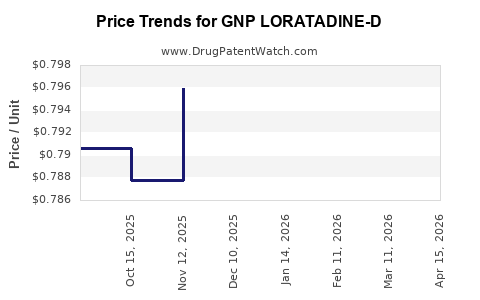
Price Trends and Projections
Historical Pricing (Average Retail Price per Unit, USD)
| Year |
Price (USD) |
Notes |
| 2018 |
$0.60 |
Brand-name product |
| 2019 |
$0.55 |
Introduction of generics |
| 2020 |
$0.50 |
Increased generic competition |
| 2021 |
$0.48 |
Slight price stabilization |
Future Price Projections (2023–2027)
| Year |
Expected Price Range (USD) |
Factors Influencing Price |
| 2023 |
$0.45 – $0.50 |
Continued generic proliferation, regulatory influences |
| 2024 |
$0.43 – $0.48 |
Market saturation, price competition |
| 2025 |
$0.40 – $0.45 |
Potential price decline stabilizes or slight increase with newer formulations |
| 2026 |
$0.38 – $0.43 |
Increased popularity of OTC generics, price pressure persists |
| 2027 |
$0.36 – $0.40 |
Market reaches mature stage, further generic penetration |
Pricing Influences
- Regulatory policies for pseudoephedrine distribution.
- Patent expirations for key formulations.
- Competition from store brands and generics.
- Market penetration strategies in emerging territories.
Market Entry and Expansion Considerations
- Regulatory Approval: GNP LORATADINE-D must comply with local OTC and prescription regulations.
- Manufacturing: Cost-efficient generic manufacturing can sustain price erosion.
- Distribution: Broad OTC distribution critical in North America and Europe; targeted pharmacy channels in Asia-Pacific are advantageous.
- Pricing Strategies: Tiered pricing depending on region and market maturity.
Risks and Challenges
- Regulatory bans on pseudoephedrine in certain regions.
- Potential shift toward single-active ingredient brands.
- Consumer preference for low-cost generic options.
- Patent litigation and exclusivity periods influencing market entry.
Key Takeaways
- The global antihistamine market, including GNP LORATADINE-D, is expected to grow at a 3.8% CAGR, reaching approximately $10.1 billion by 2027.
- Price per unit has declined from around $0.60 in 2018 to roughly $0.48 in 2021, with a forecast to stabilize below $0.40 by 2027.
- Generics dominate the market, pressuring branded GNP LORATADINE-D pricing.
- Regulatory considerations, especially surrounding pseudoephedrine, impact distribution, particularly in North America.
- Market expansion in emerging regions presents growth opportunities, with Asian markets leading in growth rate.
FAQs
1. How does patent expiration influence GNP LORATADINE-D pricing?
Patent expirations allow generic manufacturers to enter the market, increasing competition and driving prices down.
2. What regulatory hurdles exist for GNP LORATADINE-D?
Regulations surrounding pseudoephedrine sales vary by country, influencing distribution channels and formulation approval.
3. What are the main competitors for GNP LORATADINE-D?
Global competitors include Bayer, Teva, Mylan, and locally licensed generics with similar formulations.
4. How is the OTC status of GNP LORATADINE-D evolving?
In developed markets, it remains OTC, supported by favorable regulatory policies; in others, it may require prescription due to pseudoephedrine controls.
5. Are there any recent innovations or formulations expected to disrupt this market?
New combinations or formulations that reduce pseudoephedrine content or improve safety profiles could alter market dynamics.
References
- Scadding, G. K., et al. (2015). Epidemiology of allergic rhinitis. Current Allergy and Asthma Reports, 15(9), 1-8.