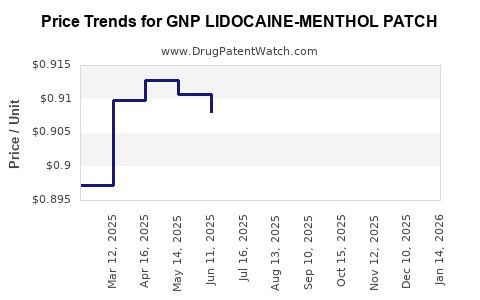
Last updated: February 13, 2026
Market Analysis and Price Projections for GNP Lidocaine-Menthol Patch
Market Overview
The GNP Lidocaine-Menthol Patch combines topical anesthetic properties of lidocaine with menthol's cooling effect, targeting localized pain management. This segment includes both prescription and over-the-counter (OTC) products utilized primarily for musculoskeletal pain, post-herpetic neuralgia, and minor injuries.
The global topical pain management market is projected to reach approximately $8.9 billion by 2027, growing at a compound annual growth rate (CAGR) of 4.5% from 2020 to 2027 [1]. Key drivers include increasing incidences of chronic musculoskeletal disorders, aging populations, and preference for non-invasive pain treatments.
The segment for lidocaine-based patches accounts for roughly 35% of this revenue, with menthol-enhanced patches gaining popularity due to perceived enhanced analgesic effects. Market penetration remains higher in North America and Europe, with emerging markets showing significant growth trajectories.
Competitive Landscape
Major market players include:
-
Zarsion (marketed as ZTLido): Prescription lidocaine patches with a focus on post-herpetic neuralgia.
-
Heron Therapeutics (Lidoderm): A leading brand in the US for post-herpetic neuralgia, with annual sales exceeding $150 million before patent expiration.
-
Generic manufacturers: Competing with lower prices in OTC segments.
Patent expirations and the rise of generic equivalents have contributed to declining prices in mature markets but created opportunities for new formulations.
Regulatory Status
In the US, the GNP Lidocaine-Menthol Patch will need FDA approval, likely via a new drug application (NDA). If marketed as an OTC, it must meet OTC drug monograph standards; if prescription-only, it must demonstrate safety and efficacy through clinical trials. Europe regulatory pathways include the EMA’s Committee for Human Medicinal Products (CHMP).
Price Projections
Current Pricing Benchmarks:
-
Prescription lidocaine patches, such as ZTLido, retail at approximately $30-50 per patch (ranging from 700mg to 1,200mg patch sizes), with a typical course involving 5-14 patches [2].
-
OTC menthol-lidocaine patches can retail at $10-20 for a pack of 4-8 patches [3].
Projected Pricing Trends:
-
Short-term (1-2 years): Entry prices for new GNP Lidocaine-Menthol Patch expected at $8-15 per patch in OTC segments, similar to existing menthol-lidocaine offerings.
-
Medium-term (3-5 years): With increased market acceptance and compliance, prices may stabilize around $10-12 per patch for OTC, driven by manufacturing efficiencies and competition.
-
Prescription market: Price points could be set at $25-40 per patch, aligning with existing prescription offerings, assuming comparable dosing and duration.
Pricing Factors:
-
Formulation costs: Encapsulation of lidocaine and menthol in patches, manufacturing scale.
-
Regulatory costs: Clinical trials and approval processes impact initial pricing.
-
Competition: Retailers’ pricing strategies for OTC products.
-
Reimbursement landscape: Insurance coverage can influence out-of-pocket costs, especially for prescription versions.
Market Adoption and Growth Opportunities
Potential growth avenues include:
-
Expansion into emerging markets, driven by increased healthcare access and urbanization.
-
Development of combination patches for multi-condition pain management.
-
Differentiation by including faster absorption or longer-lasting effects.
Market entry timelines are contingent on regulatory approval, with clinical data submission for NDA approval typically taking 2-3 years, and manufacturing setup requiring an additional year.
Key Takeaways
-
The GNP Lidocaine-Menthol Patch targets a sizable, growing pain management market, with projected revenue growth aligned with overall topical analgesics.
-
Expected price points are $8-15 per patch OTC and $25-40 for prescription formulations within 3-5 years.
-
Market entry depends heavily on regulatory approval, with both North American and European pathways requiring robust safety and efficacy data.
-
Competition from existing branded and generic lidocaine patches will influence initial positioning and pricing strategies.
-
Expansion prospects lie in emerging markets, combination therapies, and product innovation.
FAQs
Q1: What are the primary barriers to market entry for GNP Lidocaine-Menthol Patch?
A1: Regulatory approval, clinical trial costs, manufacturing scale-up, and overcoming established competitors.
Q2: How does the price of this patch compare to existing products?
A2: It is expected to be similar or slightly lower than existing prescription patches ($25-50) in the early stage, with OTC prices at $8-15 per patch.
Q3: What are key factors influencing pricing strategy?
A3: Manufacturing costs, regulatory expenses, competitive pricing, reimbursement policies, and market positioning.
Q4: What markets offer the greatest growth potential for this product?
A4: North America, Europe, and emerging markets in Asia-Pacific.
Q5: How does the combination of lidocaine and menthol enhance the product's market appeal?
A5: The combination provides immediate cooling sensation and localized nerve desensitization, potentially increasing efficacy and patient acceptance.
References
[1] MarketsandMarkets, "Topical Pain Management Market," 2022.
[2] GoodRx, "Lidocaine Patch Prices," 2023.
[3] Statista, "OTC Pain Relief Patches," 2021.