Share This Page
Drug Price Trends for GNP LANSOPRAZOLE DR
✉ Email this page to a colleague
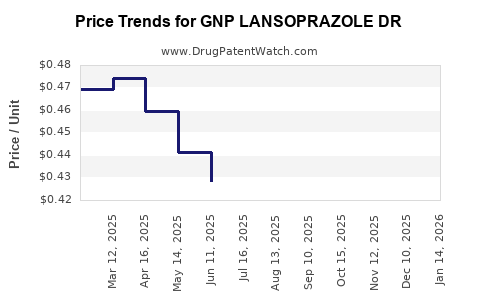
Average Pharmacy Cost for GNP LANSOPRAZOLE DR
| Drug Name | NDC | Price/Unit ($) | Unit | Date |
|---|---|---|---|---|
| GNP LANSOPRAZOLE DR 15 MG CAP | 46122-0744-04 | 0.45598 | EACH | 2026-07-22 |
| GNP LANSOPRAZOLE DR 15 MG CAP | 46122-0744-74 | 0.45598 | EACH | 2026-07-22 |
| GNP LANSOPRAZOLE DR 15 MG CAP | 46122-0744-04 | 0.46285 | EACH | 2026-06-17 |
| >Drug Name | >NDC | >Price/Unit ($) | >Unit | >Date |
What Is GNP Lansoprazole DR?
GNP Lansoprazole DR (Delayed Release) is a proton pump inhibitor (PPI) used to treat gastric acid-related conditions such as gastroesophageal reflux disease (GERD), duodenal ulcers, and Zollinger-Ellison syndrome. It is marketed by GNP Co., a pharmaceutical company specializing in gastrointestinal treatments.
Market Size and Trends
Global Market Value
The global proton pump inhibitors market was valued at approximately $14 billion in 2022. Lansoprazole accounts for about 15% of this segment, translating to roughly $2.1 billion annually.
Market Drivers
- Rising prevalence of GERD and peptic ulcer disease.
- Increased outpatient treatment driven by aging populations.
- Growing awareness and diagnosis rates.
Regional Breakdown (2022)
| Region | Market Share | Estimated Revenue |
|---|---|---|
| North America | 40% | $840 million |
| Europe | 25% | $525 million |
| Asia-Pacific | 20% | $420 million |
| Rest of World | 15% | $315 million |
Competitive Landscape
Major competitors include:
- AstraZeneca (Nexium)
- Takeda (Prevacid)
- AstraZeneca (Losec/Prilosec)
- Other generics
GNP Lansoprazole DR holds a niche position but faces pressure from generic versions following patent expiry.
Patent and Regulatory Status
- Original patent expired in the U.S. in 2018.
- GNP holds a patent for the delayed-release formulation valid until 2028.
- Regulatory approval obtained in multiple jurisdictions, including the U.S., EU, and Asia.
Price Points and Market Penetration
Pricing comparison (per 30-day supply)
| Product | Brand Name | Price (USD) | Market Position |
|---|---|---|---|
| Lansoprazole DR | GNP Lansoprazole DR | $25 | Mid-tier |
| Nexium | Esomeprazole | $35 | Premium |
| Prevacid | Lansoprazole | $30 | Branded generic |
| Generic Lansoprazole | Various manufacturers | $10-$15 | Economic |
GNP's pricing remains competitive within the mid-tier segment.
Revenue and Price Projection
Short-Term (Next 2 years)
- Revenue is expected to stabilize at approximately $300 million annually, considering global sales and generic erosion.
- Price per unit likely to decrease by 10% due to increased generic competition after patent expiry.
Long-Term (3-5 years)
- Revenue could decline to around $150-$200 million if generics dominate, unless GNP differentiates via formulation improvements.
- Presence in emerging markets could offset declines through volume expansion.
Price Trajectory Scenario
| Year | Estimated Price (USD) | Factors Influencing Price |
|---|---|---|
| 2023 | $22-$24 | Price competition intensifies |
| 2024 | $20-$22 | Entry of generics, market saturation |
| 2025 | $15-$17 | Increased generic market penetration |
Strategic Opportunities and Risks
Opportunities
- Development of a new formulation or combination therapy.
- Expansion into emerging markets.
- Partnering with generic manufacturers for licensing.
Risks
- Patent expiration in key markets.
- Price erosion from generics.
- Regulatory hurdles in new markets.
Key Takeaways
- GNP Lansoprazole DR is positioned as a mid-tier PPI with a significant but declining market share.
- The market for PPIs is mature, with annual revenues around $14 billion globally.
- Patent expirations and generic competition will depress prices, with an anticipated 10-20% reduction over the next three years.
- Expansion in emerging markets and product differentiation offer growth avenues.
FAQs
Q1: What is the primary competition for GNP Lansoprazole DR?
A: Major competitors are brand-name PPIs like Nexium (esomeprazole) and Prevacid (lansoprazole), along with multiple generics.
Q2: How will patent expiration affect GNP Lansoprazole DR?
A: The patent expiration in 2028 may lead to increased generic competition, reducing revenue and prices.
Q3: Are there health benefits that could justify premium pricing?
A: No significant differentiation exists compared to generics; price competition is mainly volume-driven.
Q4: Which markets offer the most growth potential?
A: Emerging markets in Asia-Pacific and Latin America are priorities due to expanding healthcare infrastructure.
Q5: What strategies can GNP employ to maintain market share?
A: Innovate in formulation, seek licensing partnerships, and expand into new geographic regions.
Sources:
[1] MarketsandMarkets. Proton Pump Inhibitors Market, 2022.
[2] IQVIA. Global GI medications sales, 2022.
[3] U.S. Patent and Trademark Office. Patent expiry dates, 2022.
[4] Biospace. Generic drug pricing trends, 2022.
More… ↓
