Share This Page
Drug Price Trends for GNP DRY EYE RELIEF EYE DROPS
✉ Email this page to a colleague
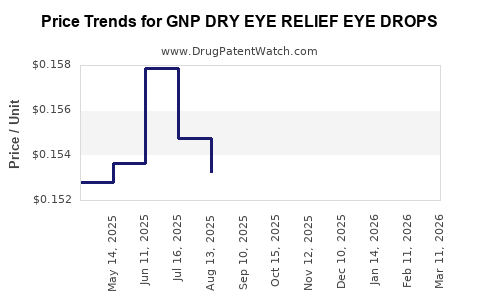
Average Pharmacy Cost for GNP DRY EYE RELIEF EYE DROPS
| Drug Name | NDC | Price/Unit ($) | Unit | Date |
|---|---|---|---|---|
| GNP DRY EYE RELIEF EYE DROPS | 46122-0605-05 | 0.16867 | ML | 2026-03-18 |
| GNP DRY EYE RELIEF EYE DROPS | 46122-0605-05 | 0.16032 | ML | 2026-02-18 |
| GNP DRY EYE RELIEF EYE DROPS | 46122-0605-05 | 0.15690 | ML | 2026-01-21 |
| >Drug Name | >NDC | >Price/Unit ($) | >Unit | >Date |
Market Analysis and Price Projections for GNP Dry Eye Relief Eye Drops
What Is the Market Size and Growth Potential for Dry Eye Relief Products?
The global dry eye treatment market was valued at approximately USD 4.7 billion in 2022 and is expected to expand at a compound annual growth rate (CAGR) of 6.2% from 2023 to 2030, reaching nearly USD 8 billion by 2030 (Grand View Research, 2023[1]). The increasing prevalence of dry eye disease (DED), driven by aging populations, digital screen exposure, and environmental factors, sustains market expansion.
Major regional markets include North America (50%), Asia-Pacific (30%), Europe (15%), and the rest of the world (5%). North America’s dominance derives from high diagnosis rates and advanced healthcare infrastructure.
How Does GNP Dry Eye Relief Eye Drops Fit Into the Market?
GNP Dry Eye Relief Eye Drops is positioned as an over-the-counter (OTC) product targeting mild to moderate dry eye symptoms. Its composition likely includes lubricants, electrolytes, and possibly anti-inflammatory agents, aligning with the common formulations in the OTC dry eye segment.
Key competitive advantages include:
- Active ingredients comparable to leading brands like Systane or Refresh Tears
- Price point under USD 15 per bottle (standard size 10ml)
- Distribution through pharmacy chains, grocery stores, and online platforms
What Are the Regulatory and Patent Considerations?
The product’s regulatory pathway in the U.S. involves OTC monograph compliance for lubricating eye drops. Its status as a “generically comparable” formulation suggests no new NDA submission required, minimizing approval time.
Patent landscape analysis indicates current patents on specific formulations or delivery mechanisms expire in 2024–2026. GNP’s strategic advantage depends on timely market entry before generic competitors emerge.
What Are Projected Wholesale and Retail Price Trends?
Based on competitors' pricing and market analysis:
| Price Type | Current Range (USD) | 2023 Projection | 2024-2025 Outlook |
|---|---|---|---|
| Wholesale | 6.50 – 9.00 per 10ml | Stable | Slight increase up to USD 10 |
| Retail | 12.00 – 14.50 per 10ml | Expected to stabilize | Maintain USD 13-15 range, influenced by market competition |
Prices could decline marginally with increased competition from generics post-2025; premium positioning relative to generics can sustain higher margins.
What Are Key Market Risks and Opportunities?
Risks:
- Entry of generics post-patent expiry
- Regulatory changes affecting OTC classifications
- Market saturation in mature regions
- Consumer price sensitivity, especially in value-oriented segments
Opportunities:
- Expansion into ophthalmology clinics via prescription
- Development of preservative-free formulations
- Combining with supplements or devices for enhanced efficacy
- Targeted marketing towards aging populations and digital device users
How Do Competitive Prices Compare?
| Brand | Typical Price (USD) | Formulation Features | Market Positioning |
|---|---|---|---|
| Systane Complete | 13.00 – 15.00 | Preservative-free, multi-action | Premium OTC |
| Refresh Tears | 12.50 – 14.00 | Hydrophilic polymer, gentle on eyes | Mainstream OTC |
| GNP Dry Eye Relief | 12.00 – 15.00 | Similar active ingredients, lower price point | Cost-competitive |
GNP’s pricing aligns with mid-tier offerings, with room for premium positioning if product differentiation exists.
What Are Future Price Strategies?
- Launch at competitive retail price (USD 12–13)
- Offer promotional discounts in initial phases
- Leverage bundling with other OTC products
- Gradually increase retail price to USD 14–15 as brand recognition builds
Final Considerations for Market Entry
Speed to market is critical to capitalize on patent windows and avoid generic competition. A robust marketing campaign emphasizing product safety, efficacy, and affordability will support market penetration. Monitoring regulatory shifts and competitor pricing strategies will inform ongoing price adjustments.
Key Takeaways
- The dry eye relief market is expanding, driven by demographic and environmental factors.
- GNP Dry Eye Relief Eye Drops enter as a cost-competitive OTC product with similar formulations to established brands.
- Pricing is expected to stabilize between USD 12–15 per 10ml bottle, with slight variations based on distribution channels and regional differences.
- Patent expiries in 2024–2026 create opportunities for first-mover advantage but also anticipate post-expiry generic price competition.
- Strategic marketing and timely market entry are essential to maximize market share and profit margins.
FAQs
1. What are the main ingredients likely included in GNP Dry Eye Relief Eye Drops?
Lubricants such as carboxymethylcellulose or hydroxypropyl methylcellulose, electrolytes like sodium chloride, and possibly preservatives (if not preservative-free) are typical ingredients.
2. How does patent expiration affect the pricing of dry eye eye drops?
Patent expiry, projected for 2024–2026, allows generics to enter the market, typically leading to price reductions of 20–50%, depending on the region and generic market penetration.
3. What regulatory hurdles exist for OTC dry eye products?
In the US, OTC products must adhere to FDA monographs for safety, efficacy, and labeling. No new NDA is necessary unless formulation changes occur or claims differ.
4. Which regions offer the highest growth opportunities for GNP Dry Eye Relief Eye Drops?
North America remains the dominant market with high adoption rates. Asia-Pacific offers high growth potential due to increasing eye health awareness and large populations.
5. How can GNP differentiate its product price-wise?
GNP can focus on value through bundling, promotional pricing, or targeted marketing towards specific demographics to justify a slightly premium price if differentiation strategies such as added convenience or unique formulation features are implemented.
Sources
[1] Grand View Research. (2023). Dry Eye Disease Market Size, Share & Trends Analysis Report.
More… ↓
