Share This Page
Drug Price Trends for GNP COUGH-COLD HBP TABLET
✉ Email this page to a colleague
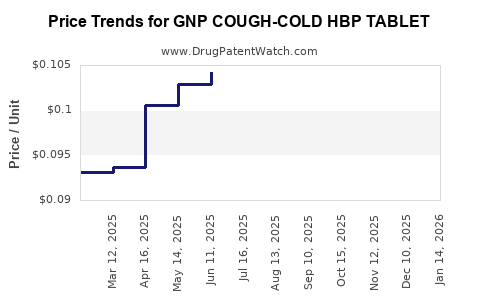
Average Pharmacy Cost for GNP COUGH-COLD HBP TABLET
| Drug Name | NDC | Price/Unit ($) | Unit | Date |
|---|---|---|---|---|
| GNP COUGH-COLD HBP TABLET | 46122-0705-73 | 0.10992 | EACH | 2026-07-22 |
| GNP COUGH-COLD HBP TABLET | 46122-0705-73 | 0.10916 | EACH | 2026-06-17 |
| GNP COUGH-COLD HBP TABLET | 46122-0705-73 | 0.10761 | EACH | 2026-05-20 |
| GNP COUGH-COLD HBP TABLET | 46122-0705-73 | 0.10803 | EACH | 2026-04-22 |
| GNP COUGH-COLD HBP TABLET | 46122-0705-73 | 0.10743 | EACH | 2026-03-18 |
| >Drug Name | >NDC | >Price/Unit ($) | >Unit | >Date |
GNP Cough-Cold HBP Tablet: Market Landscape and Price Forecast
GNP Cough-Cold HBP Tablet, a non-prescription medication indicated for the relief of cough, cold, and high blood pressure symptoms, faces a competitive generic market. Current pricing is influenced by active pharmaceutical ingredient (API) costs, manufacturing efficiency, and retail markup. Projections suggest a moderate price increase driven by inflation and supply chain pressures, with potential for price erosion due to ongoing generic competition and evolving therapeutic guidelines for hypertension management.
Market Dynamics for GNP Cough-Cold HBP Tablet
What is the current market size and projected growth for cough, cold, and hypertension medications?
The global cough, cold, and allergy remedies market was valued at approximately $60.8 billion in 2023. This market is projected to grow at a compound annual growth rate (CAGR) of 4.8% from 2024 to 2030, reaching an estimated $85.8 billion by 2030 [1]. The inclusion of hypertension management within a single product, even as a symptomatic relief agent, places GNP Cough-Cold HBP Tablet within a dual-market context.
The global hypertension drugs market alone was valued at $30.9 billion in 2023 and is expected to expand at a CAGR of 3.2% from 2024 to 2031, reaching $39.7 billion [2]. The overlap in patient demographics experiencing both cold symptoms and hypertension creates a specific niche.
Who are the key competitors and what is their market share?
The market for over-the-counter (OTC) cough and cold remedies is highly fragmented, with numerous manufacturers and brands. Key global players include:
- Reckitt Benckiser: Brands like Strepsils and Gaviscon.
- GSK Consumer Healthcare: Brands like Theraflu and Panadol.
- Sanofi: Brands like Sudafed (in some markets) and Theraflu.
- Johnson & Johnson: Brands like Benadryl and Tylenol.
- Bayer AG: Brands like Alka-Seltzer and Claritin [1].
In the generic segment, many smaller pharmaceutical companies compete on price. Without specific proprietary data on GNP Cough-Cold HBP Tablet's market share, it is understood to operate within this broader competitive landscape.
For the hypertension component, while GNP Cough-Cold HBP Tablet offers symptomatic relief, it does not replace primary antihypertensive therapies. The prescription hypertension drug market is dominated by classes such as:
- Angiotensin-Converting Enzyme (ACE) inhibitors
- Angiotensin II Receptor Blockers (ARBs)
- Calcium Channel Blockers
- Diuretics
- Beta-blockers [2].
Generic versions of these prescription drugs significantly impact the overall hypertension treatment cost, indirectly influencing patient perception of OTC combination products.
What are the primary ingredients and their cost implications for GNP Cough-Cold HBP Tablet?
A typical formulation for a cough, cold, and mild symptom management product might include:
- Cough Suppressant: Dextromethorphan Hydrobromide. API cost is generally stable but can fluctuate based on global supply and demand.
- Decongestant: Phenylephrine Hydrochloride or Pseudoephedrine Hydrochloride. Phenylephrine's API cost is moderate. Pseudoephedrine's cost and availability can be impacted by regulatory controls.
- Pain Reliever/Fever Reducer: Acetaminophen or Ibuprofen. These are high-volume APIs with generally low and stable costs.
- Antihistamine: Chlorpheniramine Maleate or Diphenhydramine Hydrochloride. API costs are typically modest.
The inclusion of a component for "HBP" (High Blood Pressure) in an OTC product is atypical for direct treatment. If it implies symptomatic relief of cold-related blood pressure fluctuations, it might involve mild vasodilators or diuretics not commonly found in OTC cough and cold formulations. If it refers to ingredients contraindicated in certain hypertensive patients, that is a different consideration. Assuming it refers to symptomatic management, the API cost would be a factor. Without specific ingredient disclosure for "HBP" management, it is difficult to quantify. However, ingredients generally used for mild blood pressure regulation (e.g., certain vasodilators) have moderate API costs.
The primary cost drivers for GNP Cough-Cold HBP Tablet will be the procurement of these APIs, manufacturing efficiency, packaging, and distribution. The generic nature of the product implies that the company aims for cost leadership.
What is the regulatory landscape impacting this product category?
Over-the-counter medications are regulated by national health authorities, such as the U.S. Food and Drug Administration (FDA) or the European Medicines Agency (EMA). Regulations cover:
- Drug Efficacy and Safety: Ensuring active ingredients are proven safe and effective for their intended uses.
- Labeling Requirements: Mandating clear instructions, warnings, and ingredient disclosure.
- Manufacturing Practices (cGMP): Adherence to Current Good Manufacturing Practices.
- Advertising and Promotion: Restrictions on unsubstantiated claims.
The "HBP" claim is particularly sensitive. If it implies treatment of hypertension, it would likely face significant regulatory hurdles for an OTC product. If it is positioned as symptomatic relief for cold-related blood pressure changes or as a product to be used with caution by hypertensive patients, regulatory scrutiny will differ. The FDA's approval process for combination OTC drugs is rigorous. For example, the FDA has reviewed phenylephrine as an oral decongestant, and in late 2023, the agency concluded it is not effective in its oral dosage form [3]. This could lead to market changes for products containing oral phenylephrine.
Pricing Analysis and Projections
What is the current pricing structure for GNP Cough-Cold HBP Tablet?
Pricing for generic OTC medications like GNP Cough-Cold HBP Tablet is determined by several factors:
- Wholesale Price: The price at which manufacturers sell to distributors or pharmacies. This is heavily influenced by API costs, manufacturing overhead, and desired profit margins.
- Retail Price: The price consumers pay at pharmacies or retail outlets. This includes wholesale cost, pharmacy markup (which can vary significantly), and retailer margin.
- Competitor Pricing: Generic drugs compete primarily on price. The lowest price point among comparable products often sets a benchmark.
Based on publicly available retail prices for comparable multi-symptom cough and cold relief products and basic hypertension symptom management aids (if such distinct OTCs exist), a 24-count bottle of GNP Cough-Cold HBP Tablet might range from $8 to $15. This is an estimation for a typical generic OTC product. Specific pricing would depend on the exact dosage, number of active ingredients, and the retailer's pricing strategy.
What factors will influence future price movements?
- API Costs: Fluctuations in the cost of key active pharmaceutical ingredients, driven by supply chain disruptions, geopolitical events, or changes in manufacturing capacity, can directly impact the wholesale price.
- Manufacturing and Operational Efficiency: Improvements or deteriorations in manufacturing processes, automation, and labor costs will affect production expenses.
- Inflationary Pressures: General economic inflation will increase the cost of raw materials, energy, labor, and transportation, leading to higher overall production costs.
- Regulatory Changes: New regulations regarding ingredient efficacy (as seen with phenylephrine) or labeling could necessitate reformulation, increasing development and manufacturing costs. Approval delays or new compliance requirements can also impact pricing.
- Competition and Market Saturation: As more generic manufacturers enter the market or existing ones expand, price wars can ensue, leading to downward pressure on prices.
- Demand Shifts: Changes in consumer health behaviors, seasonal variations in illness prevalence, and evolving medical advice regarding self-treatment for conditions like hypertension can influence demand and pricing power.
- Supply Chain Resilience: Investments in more robust and diversified supply chains can mitigate risks of shortages and price spikes but may involve higher initial costs.
What is the projected price range for GNP Cough-Cold HBP Tablet over the next 3-5 years?
Considering the factors above, the projected price range for GNP Cough-Cold HBP Tablet over the next 3-5 years is estimated as follows:
- Base Case Scenario (Moderate Inflation, Stable Supply Chain): A 2% to 4% annual price increase. This would place a 24-count bottle in the range of $8.50 to $17.00 by 2029.
- Optimistic Scenario (Cost Efficiencies, Reduced Competition): A 0% to 2% annual price increase. The range would be approximately $8.00 to $15.50.
- Pessimistic Scenario (API Shortages, High Inflation, Regulatory Hurdles): A 5% to 8% annual price increase. The range could reach $10.00 to $20.00 or higher for a 24-count bottle by 2029.
The inclusion of "HBP" in an OTC product presents a significant risk. If the formulation is deemed to make unsubstantiated claims for hypertension management, or if it contains ingredients that are inappropriate for certain hypertensive individuals, the product could face recalls or significant reformulations, impacting its long-term viability and price trajectory. The FDA's stance on oral phenylephrine's efficacy highlights the evolving regulatory environment for OTC ingredients.
Key Takeaways
- GNP Cough-Cold HBP Tablet operates within a fragmented and competitive OTC market, alongside a substantial prescription hypertension drug market.
- Current pricing is dictated by API costs, manufacturing efficiency, and retail markups, with an estimated current retail price of $8-$15 for a 24-count unit.
- Projected price increases of 2-4% annually are anticipated due to inflation and supply chain pressures, potentially reaching $8.50-$17.00 by 2029 under a base case scenario.
- Significant regulatory scrutiny related to the "HBP" claim and potential efficacy concerns with key ingredients (e.g., oral phenylephrine) pose the most substantial risk to future pricing and market viability.
Frequently Asked Questions
What specific ingredients are included in GNP Cough-Cold HBP Tablet to address "HBP" symptoms?
Specific ingredient details for the "HBP" component of GNP Cough-Cold HBP Tablet are not publicly disclosed in standard product information. Typically, OTC products address cough and cold symptoms. If an OTC product includes a component for high blood pressure (HBP) symptoms, it is likely for mild, temporary relief of blood pressure fluctuations associated with illness, not for chronic hypertension treatment, and would require careful regulatory review for appropriate ingredient claims and safety warnings.
How does the efficacy of oral phenylephrine impact products like GNP Cough-Cold HBP Tablet?
The U.S. FDA's recent conclusion that oral phenylephrine is not effective as a decongestant could lead to regulatory actions or voluntary market withdrawals for products containing it. If GNP Cough-Cold HBP Tablet contains oral phenylephrine as its decongestant, it may need to be reformulated with an alternative active ingredient, potentially impacting cost of goods and product positioning.
What is the difference between symptomatic relief of HBP and actual hypertension treatment in an OTC context?
Symptomatic relief of HBP in an OTC context would likely refer to transient, mild changes in blood pressure that might be temporarily exacerbated by cold and cough symptoms. Actual hypertension treatment involves managing a chronic medical condition with prescription medications and lifestyle changes designed to lower and control blood pressure over the long term. OTC products are generally not indicated for the treatment of chronic diseases like hypertension.
How does retail markup vary for OTC medications, and how does it affect the final consumer price?
Retail markups for OTC medications can vary significantly, typically ranging from 20% to 50% of the wholesale price. This markup covers the retailer's operational costs, labor, and profit margin. Consequently, a product with a $5 wholesale price could retail for anywhere from $6 to $7.50 or more, depending on the specific pharmacy or retailer.
What are the primary risks associated with an OTC product claiming to address symptoms related to high blood pressure?
The primary risks include:
- Regulatory Non-compliance: Claims for treating or managing hypertension are typically reserved for prescription drugs and require extensive clinical evidence. An OTC product making such claims without FDA approval for that indication would face severe regulatory action.
- Patient Misinformation: Consumers might mistakenly believe the product can manage their chronic hypertension, leading to inadequate treatment of their underlying condition and potential health complications.
- Adverse Events: Certain cold and cough ingredients can interact with hypertension medications or pose risks to individuals with uncontrolled high blood pressure. An OTC product must carefully identify contraindications.
- Market Rejection: If the "HBP" claim is perceived as misleading or unsubstantiated by consumers or healthcare professionals, it can lead to poor sales and damage brand reputation.
Citations
[1] Grand View Research. (2024). Cough, Cold And Allergy Remedies Market Size, Share & Trends Analysis Report By Product (Cough & Cold Remedies, Allergy Remedies), By Indication (Cough, Cold & Flu, Nasal Congestion, Allergy), By Distribution Channel (Hospital Pharmacies, Retail Pharmacies, Online), By Region, And Segment Forecasts, 2024 - 2030. Retrieved from https://www.grandviewresearch.com/industry-analysis/cough-cold-allergy-remedies-market
[2] Fortune Business Insights. (2024). Hypertension Drugs Market Size, Share & COVID-19 Impact Analysis, By Drug Class (ACE Inhibitors, ARBs, Calcium Channel Blockers, Diuretics, Beta Blockers, Others), By Route Of Administration (Oral, Intravenous), By Distribution Channel (Hospital Pharmacies, Retail Pharmacies, Online Pharmacies), And Regional Forecast, 2023-2030. Retrieved from https://www.fortunebusinessinsights.com/hypertension-drugs-market-103244
[3] U.S. Food and Drug Administration. (2023, September 13). FDA says oral phenylephrine is not effective as a decongestant. Retrieved from https://www.fda.gov/drugs/news-events-and-alerts/fda-says-oral-phenylephrine-not-effective-decongestant
More… ↓
