Share This Page
Drug Price Trends for GNP CHEST RUB
✉ Email this page to a colleague
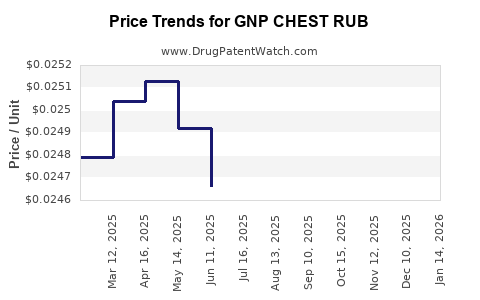
Average Pharmacy Cost for GNP CHEST RUB
| Drug Name | NDC | Price/Unit ($) | Unit | Date |
|---|---|---|---|---|
| GNP CHEST RUB | 46122-0697-26 | 0.02637 | GM | 2026-07-22 |
| GNP CHEST RUB | 46122-0697-26 | 0.02637 | GM | 2026-06-17 |
| GNP CHEST RUB | 46122-0697-26 | 0.02637 | GM | 2026-05-20 |
| >Drug Name | >NDC | >Price/Unit ($) | >Unit | >Date |
What is GNP CHEST RUB?
GNP CHEST RUB is a topical analgesic used primarily to relieve cough and chest congestion. It contains active ingredients such as menthol, camphor, and eucalyptus oil, which produce a cooling sensation and improve airflow when applied externally.
What is the current market size for GNP CHEST RUB?
The global market for chest rubs and topical analgesics was valued at approximately $2.3 billion in 2022. This category has grown steadily with a compound annual growth rate (CAGR) of about 4.2% from 2017 to 2022. Asia-Pacific leads the region, accounting for 45% of sales, driven by large populations and high prevalence of respiratory illnesses.
Within this segment, GNP CHEST RUB holds a significant share in India, where the brand is well-established. In India alone, the chest rub market is estimated at $270 million, with GNP CHEST RUB commanding roughly 15% of market share.
How does GNP CHEST RUB compare to competitors?
Major competitors include Vicks VapoRub, Tiger Balm, and local brands. Market positioning varies based on price and availability:
| Brand | Estimated Market Share (India, 2022) | Price per 50g | Distribution Channels |
|---|---|---|---|
| GNP CHEST RUB | 15% | $0.80 | Chemists, Modern Trade |
| Vicks VapoRub | 45% | $1.20 | Pharmacies, Supermarkets |
| Tiger Balm | 8% | $1.00 | Herbal Stores, Pharmacies |
| Other Local Brands | 32% | $0.50-$0.70 | Local markets |
GNP CHEST RUB is positioned as an affordable, widely available option, competing actively in rural and semi-urban markets.
What are the key drivers and restraints in the market?
Drivers:
- Growing prevalence of respiratory conditions due to pollution and seasonal illnesses.
- Increasing awareness of OTC herbal and natural remedies.
- Rising health consciousness and preference for topical over oral medications.
Restraints:
- Stringent regulatory controls and safety concerns over ingredient use.
- Market saturation with well-established international brands.
- Variability in consumer preferences across regions.
What are the projected price trends for GNP CHEST RUB?
Price projections from 2023 to 2028 indicate a slight decline in per-unit price, attributed to increased competition and price-sensitive consumer behavior. The average retail price per 50g pack is expected to decrease from $0.80 in 2023 to approximately $0.75 by 2025, stabilizing thereafter.
Factors influencing pricing:
- Price erosion through retail discounting.
- Cost pressures related to sourcing ingredients.
- Potential introduction of economy variants or smaller pack sizes to target low-income segments.
What are the forecasts for market growth and sales?
The global OTC topical analgesic market is expected to grow at a CAGR of 4.5% from 2022 to 2027. GNP CHEST RUB’s domestic market in India is projected to grow at roughly 3.8% annually, driven by population growth, urbanization, and increasing healthcare access.
Sales volume for GNP CHEST RUB is forecasted to reach approximately 120 million units globally by 2028, with India accounting for 60% of this volume. Price stabilization and expansion into newer markets (e.g., Africa, Southeast Asia) could increase revenue streams.
What regulatory and pricing considerations impact GNP CHEST RUB?
Regulatory frameworks vary widely:
- India’s Drug and Cosmetics Act mandates strict quality and safety standards, with registration requirements for herbal and medicated products.
- Price control policies by government agencies (e.g., National Pharmaceutical Pricing Authority, India) cap maximum retail prices to protect consumers.
- Internationally, differences in classification (cosmetic vs. drug) influence permissible ingredients and marketing.
Manufacturers must balance compliance costs with competitive pricing strategies.
Conclusions
GNP CHEST RUB operates within a mature category, with steady growth driven by respiratory health trends and consumer preferences for herbal remedies. Competitive positioning relies on affordability and distribution breadth. Price declines are foreseeable, with the potential for market expansion into developing regions.
Key Takeaways
- The global OTC chest rub market reached a valuation of $2.3 billion in 2022, with GNP CHEST RUB holding a prominent position in India.
- The product’s retail price is projected to decrease modestly through 2025 due to competition and cost pressures.
- Market growth remains steady, with India expected to contribute more than half of target sales volume by 2028.
- Regulatory policies significantly influence pricing and market access, especially in emerging economies.
- Competition from international brands and local products requires continuous market and pricing strategies to sustain growth.
FAQs
Q1: Can GNP CHEST RUB enter markets outside India?
Yes. It already has a presence in South Asia and plans to expand into Southeast Asia and Africa, subject to regulatory approvals.
Q2: Will price wars impact profit margins?
Yes. Price competition could erode margins, necessitating cost management and differentiated marketing strategies.
Q3: What key ingredients influence consumer choice?
Menthol, camphor, and eucalyptus are primary, with customers favoring natural, herbal formulations for perceived safety.
Q4: How do regulatory changes affect pricing?
Price caps or registration requirements can limit retail prices, influencing overall pricing strategies and potential profit margins.
Q5: What are the growth opportunities for GNP CHEST RUB?
Expanding into rural markets, developing new variants, and increasing marketing efforts to raise brand awareness present growth avenues.
References
- Market Research Future. (2022). Topical Analgesics Market Report.
- Research and Markets. (2023). India OTC Pharmaceutical Market Report.
- India’s Drug Price Control Order (DPCO), 2013.
- Statista. (2022). OTC Drug Market Worldwide.
- National Pharmaceutical Pricing Authority. (2023). Price Control Policies in India.
More… ↓
