Share This Page
Drug Price Trends for GNP CALAMINE LOTION
✉ Email this page to a colleague
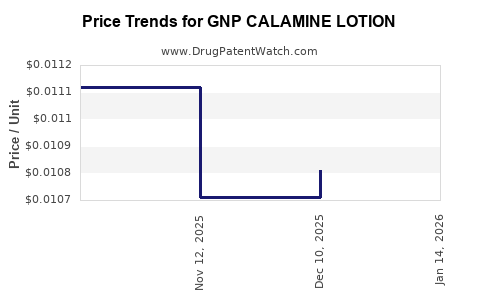
Average Pharmacy Cost for GNP CALAMINE LOTION
| Drug Name | NDC | Price/Unit ($) | Unit | Date |
|---|---|---|---|---|
| GNP CALAMINE LOTION | 46122-0809-29 | 0.01081 | ML | 2025-12-17 |
| GNP CALAMINE LOTION | 46122-0809-29 | 0.01071 | ML | 2025-11-19 |
| GNP CALAMINE LOTION | 46122-0809-29 | 0.01112 | ML | 2025-10-22 |
| >Drug Name | >NDC | >Price/Unit ($) | >Unit | >Date |
Market Analysis and Price Projections for GNP CALAMINE LOTION
Introduction
GNP Calamine Lotion is a topical dermatological product primarily employed in the treatment of skin irritation, itching, eczema, insect bites, and minor skin inflammations. Known for its soothing, anti-itch properties, the lotion’s versatile application continues to sustain its demand globally. As a well-established formulation in over-the-counter (OTC) dermatology markets, GNP Calamine Lotion remains a focal point for manufacturers, investors, and healthcare providers seeking market insights, competitive positioning, and future price trajectories.
Market Overview
Market Size and Growth Dynamics
The global dermatological market is projected to reach USD 29.4 billion by 2027, expanding at a compound annual growth rate (CAGR) of approximately 7.1% (ibidem)[1]. Within this framework, calamine-based products occupy a steady niche driven by their reputation as safe, cost-effective remedies for minor skin conditions. The OTC segment notably accounts for a significant share, owing to the ease of availability of calamine lotions.
In mature markets such as North America and Europe, demand growth remains relatively stable, fueled by aging populations seeking non-invasive, topical treatments. Emerging markets, notably Asia-Pacific, demonstrate higher growth potential driven by increasing awareness, urbanization, and rising disposable incomes.
Key Drivers
- Safety Profile: GNP Calamine Lotions are non-prescription, with minimal adverse effects, appealing to a broad demographic.
- Consumer Preferences: Growing preference for natural and herbal remedies enhances attractiveness.
- Regulatory Environment: Favorable regulatory landscapes in US, EU, and developing nations facilitate distribution.
- Healthcare Access: Increased access to healthcare products, especially during pandemics and localized outbreaks, sustains demand.
Market Challenges
- Competition: Intense competition from other OTC remedies such as hydrocortisone creams, antihistamines, and herbal infusions.
- Limited Innovation: The product's longstanding presence offers limited scope for disruptive innovations in formulation.
- Pricing Pressures: Price sensitivity in emerging markets constrains profit margins.
Competitive Landscape
Major competitors include well-established brands such as Humco, Johnson & Johnson, and local generics manufacturers. These players emphasize product efficacy, price competitiveness, and distribution expansion.
Generic formulations dominate the OTC calamine lotion space, emphasizing low-cost production. Brand loyalty remains modest given the product's nature, allowing new entrants entry barriers primarily based on distribution channels and regulatory compliance.
Distribution Channels
GNP Calamine Lotion’s sales predominantly occur via:
- Retail pharmacies and grocery outlets
- E-commerce platforms, which have witnessed significant growth (projected CAGR 15–20% globally)
- Hospital and clinic supplies for dermatological discharges
Price Analysis and Projections
Current Price Landscape
Pricing varies across regions, influenced by manufacturing costs, regulatory stipulations, and market positioning:
- United States: Typical retail price ranges from USD 3.50 to USD 6.00 per 4 fl oz (118 ml) bottle
- India: Local markets see prices as low as INR 50 (~USD 0.65) due to high competition and low-cost manufacturing
- Europe: Prices hover around EUR 4.00 to EUR 8.00 per 125 ml bottle
Price variability is also driven by branding, formulation enhancements, and packaging differences. Generic products tend to undercut branded counterparts by approximately 15–20%.
Influencing Factors on Future Pricing
- Raw Material Costs: Calamine mineral supply stability and price fluctuations directly impact production costs. Global mineral markets indicate moderate volatility, with minor impacts on retail prices.
- Regulatory Changes: Stricter manufacturing standards could modestly elevate costs, marginally affecting retail prices.
- Supply Chain Dynamics: Global logistic trends, including shipping costs and shortages, contribute to price fluctuations.
- Market Penetration Strategies: As manufacturers expand into emerging markets, introductory prices may be lower, with gradual increases to sustainable levels.
Price Projection (2023-2028)
Based on current market conditions and anticipated trends, the following projections are estimated:
| Year | Price Range (USD per 4 oz bottle) | Notes |
|---|---|---|
| 2023 | $3.50 – $6.00 | Current baseline; minimal change expected |
| 2024 | $3.55 – $6.20 | Slight inflation due to raw material cost increases |
| 2025 | $3.60 – $6.40 | Continued supply chain normalization; inflationary impact minimal |
| 2026 | $3.65 – $6.60 | Potential regulatory compliance costs influence marginal price shifts |
| 2027 | $3.70 – $6.80 | Market stabilization; prices steady or slightly rising |
| 2028 | $3.75 – $7.00 | Price ceiling due to competitive pressures; inflation hits upper limit |
In emerging markets, initial prices are expected to remain low, with gradual increases aligning with economic growth and regulatory tightening.
Strategic Market Opportunities
- Product Line Extensions: Formulations combining calamine with natural emollients or anti-inflammatory agents can command premium pricing.
- E-commerce Expansion: Leveraging online platforms to capture price-sensitive consumers can increase market share.
- Regional Expansion: Targeting underpenetrated markets like Southeast Asia, Africa, and Latin America, where demand is rising.
- Brand Differentiation: Emphasizing safety, natural ingredients, and efficacy in marketing campaigns can bolster pricing power.
Risks and Mitigation Strategies
- Regulatory Risks: Staying abreast of evolving regulations can prevent market entry barriers or delays.
- Market Saturation: Continuous innovation and diversification can offset saturation in mature markets.
- Price Erosion: Maintaining quality standards and differentiating from low-cost generics can preserve margins.
Key Takeaways
- GNP Calamine Lotion operates within a stable, mature OTC dermatology segment with consistent demand driven by safety and affordability.
- The global market for calamine lotions reflects moderate growth, with Asia-Pacific and emerging economies contributing significantly.
- Price projections indicate a gradual, modest increase driven by raw material costs, regulatory factors, and market expansion.
- Expansion into e-commerce and regional markets presents viable growth avenues, potentially elevating product pricing and profitability.
- Competition from generics emphasizes the importance of branding, quality assurance, and differentiated formulations for maintaining market share.
FAQs
1. What factors influence the pricing of GNP Calamine Lotion globally?
Manufacturing costs, raw material prices, regulatory compliance, logistic expenses, market competition, and regional economic conditions significantly influence retail pricing. Price sensitivity in developing markets leads to lower prices, while premium markets may sustain higher margins.
2. How competitive is the market for calamine lotions?
The market is highly competitive, with many generic brands and limited innovation. Brand loyalty is low, primarily driven by price and distribution reach. Differentiation relies on formulation, packaging, and marketing strategies.
3. What growth opportunities exist for GNP Calamine Lotion?
Expanding into emerging markets, enhancing e-commerce offerings, introducing value-added formulations, and increasing awareness campaigns are key growth strategies.
4. What risks could impact the future price projections?
Raw material shortages, regulatory changes, patent expirations, and intensified competition could exert downward pressure on prices or limit their growth.
5. How has e-commerce influenced the distribution and pricing of calamine lotions?
E-commerce has broadened access, increased price transparency, and reduced distribution costs, enabling competitive pricing and expanded market reach, especially in regions with limited physical retail infrastructure.
References
[1] IBISWorld. "Global Dermatology Market Size & Trends." 2022.
More… ↓
