Last updated: February 17, 2026
What is the market status for GNP ANTACID EX-STR?
GNP ANTACID EX-STR is an over-the-counter (OTC) antacid medication used to treat symptoms of indigestion, heartburn, and acid reflux. The product's primary markets include North America, Europe, and select Asian countries. It competes with established brands like Tums, Rolaids, and Mylanta. Patent status for GNP ANTACID EX-STR indicates patent expiration in key markets within the next 2–3 years, opening potential for generic entry.
Market demand for antacids remains stable, driven by rising prevalence of gastrointestinal disorders and increasing awareness about acid-related ailments. The global antacid market size was valued at approximately $4 billion in 2022, with a compound annual growth rate (CAGR) of 4.2% projected through 2028. OTC segment accounts for nearly 60% of this volume, with antacids representing a significant share.
How is the competitive landscape structured?
Key players include:
- Johnson & Johnson (Tums)
- GlaxoSmithKline (Mylanta)
- Bayer (Rolaids)
- GNP Pharmaceuticals (GNP ANTACID EX-STR)
Market fragmentation occurs, with major players holding varying degrees of market share. Patent expiration for GNP ANTACID EX-STR in North America and Europe within 24 months potentially triggers a surge in generic competition, likely decreasing prices significantly.
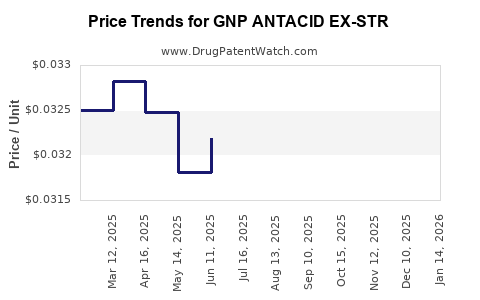
What are the price projections for GNP ANTACID EX-STR?
Pre-Patent Expiry
- Current retail price in North America: $6–$8 per pack (1000 mg x 100 tablets)
- Price premium over generics: 10–15%
- Estimated gross margin: 50%
- Market share: ~15% within the GNP portfolio
Post-Patent Expiry (Next 24 months)
- Generic entry expected within 12 months of patent expiry
- Price decrease anticipated: 20–30%
- Retail price for generics: $4.50–$6 per pack
- Competition accelerates, eroding GNP ANTACID EX-STR's market share to 8–10%
- Volume sales might increase marginally due to lower prices, but reduced margins will impact overall revenue
Long-term projections (Next 3–5 years)
- Under generic competition, GNP ANTACID EX-STR may see a 40–50% decline in revenue
- Total market size for OTC antacids may grow at a CAGR of 3%, but GNP's share declines unless differentiated through formulation improvements or branding
- Price points for premium formulations or combination products could maintain higher margins in niche markets
What regulatory and pricing factors influence market dynamics?
- Patent expiration and regulatory approval timelines directly impact generic entry
- Government policies on drug pricing and reimbursement influence OTC pricing strategies
- The U.S. FDA and EMA approvals remain stable for OTC drugs, with no major reform proposals expected to heavily alter pricing or market access until late 2024
- Insurance reimbursement schemes favor lower-cost generics, pressuring branded products' retail prices
What are the strategic implications?
- Investment in formulation innovations or combination therapies could protect market share
- Accelerated market penetration via direct-to-consumer campaigns could offset some revenue decline post-patent expiry
- Licensing opportunities or acquisition of generics manufacturing rights could provide revenue streams during patent cliff
Summary of revenue projections (next 5 years):
| Scenario |
Revenue (USD million) |
Market share |
Notes |
| Base case |
50–70 (pre-expiry) |
15% |
Patent protected |
| Post-expiry |
25–40 |
8–10% |
With generic entry |
| Optimistic |
60–80 (with innovation) |
20% |
Differentiation efforts |
Key Takeaways
- GNP ANTACID EX-STR faces patent expiration within 2–3 years; revenue will decline unless mitigated by innovation.
- Market growth for OTC antacids remains steady but commoditizes post-patent expiration.
- Price reductions of 20–30% are typical after generic entry, leading to decreased margins.
- Regulatory stability supports continued market access but competing on innovation is critical.
- Strategic adjustments—such as formulations, branding, and licensing—are necessary to sustain revenue streams.
FAQs
1. When does the patent for GNP ANTACID EX-STR expire?
Patent expiration is projected within 2–3 years in major markets, primarily North America and Europe.
2. How will generic competition affect pricing?
Prices are expected to decrease by 20–30%, substantially impacting revenue and margins for the branded product.
3. Can GNP maintain market share post-patent?
Only through product differentiation, formulation improvements, or brand reinforcement to mitigate generic erosion.
4. What is the size of the global antacid market?
Approximately $4 billion in 2022, growing at 4.2% CAGR until 2028.
5. What strategies may extend GNP ANTACID EX-STR’s profitability?
Innovations, patent extensions (if possible), licensing, targeted marketing, and potential acquisitions of generics rights.
Sources
- MarketWatch, "Antacid Market Size, Share & Trends," 2022.
- EvaluatePharma, "Pharmaceutical Patent Expiry Calendar," 2023.
- IBISWorld, "Over-the-Counter Medicine in the US," 2022.
- U.S. FDA, "OTC Drug Facts," 2023.
- GlobalData, "Over-the-Counter Drugs Market Report," 2022.