Share This Page
Drug Price Trends for GLYCERIN ADULT SUPPOSITORY
✉ Email this page to a colleague
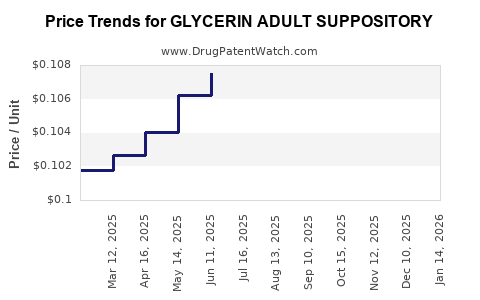
Average Pharmacy Cost for GLYCERIN ADULT SUPPOSITORY
| Drug Name | NDC | Price/Unit ($) | Unit | Date |
|---|---|---|---|---|
| GLYCERIN ADULT SUPPOSITORY | 70000-0572-01 | 0.10747 | EACH | 2026-07-22 |
| GLYCERIN ADULT SUPPOSITORY | 70000-0572-01 | 0.10856 | EACH | 2026-06-17 |
| GLYCERIN ADULT SUPPOSITORY | 70000-0572-01 | 0.11147 | EACH | 2026-05-20 |
| GLYCERIN ADULT SUPPOSITORY | 70000-0572-01 | 0.10986 | EACH | 2026-04-22 |
| >Drug Name | >NDC | >Price/Unit ($) | >Unit | >Date |
Glycerin Adult Suppository Market Analysis and Price Projections
Glycerin adult suppositories are primarily utilized as laxatives and stool softeners. The market is driven by an aging global population, increasing prevalence of gastrointestinal disorders, and the drug's established safety profile and affordability. Price projections indicate a stable to slightly increasing trend due to raw material costs and manufacturing overheads.
What is the Global Market Size and Growth Trajectory for Glycerin Adult Suppositories?
The global market for glycerin adult suppositories is a niche segment within the broader laxative and gastrointestinal drug market. While specific market size figures are not readily disaggregated for this singular product form, industry reports on laxatives provide relevant context. The global laxative market was valued at approximately USD 5.8 billion in 2023 and is projected to reach USD 7.5 billion by 2030, growing at a compound annual growth rate (CAGR) of 3.7% [1]. Glycerin suppositories represent a significant, albeit smaller, portion of this market, particularly in the over-the-counter (OTC) segment.
The growth trajectory is influenced by several factors:
- Demographics: An increasing elderly population, which is more prone to constipation due to physiological changes, medication side effects, and reduced mobility, is a primary driver [2].
- Lifestyle Factors: Sedentary lifestyles, poor dietary habits, and increased stress contribute to a higher incidence of chronic constipation.
- Accessibility and Affordability: Glycerin suppositories are widely available without a prescription and are cost-effective, making them a first-line treatment option for many consumers.
- Product Form Acceptance: Suppositories offer a localized and rapid onset of action, which is preferred by some patients over oral medications.
The market is characterized by a large number of generic manufacturers, leading to competitive pricing. Growth in emerging economies is also anticipated as healthcare access and awareness of gastrointestinal health improve.
What are the Key Drivers and Restraints for Glycerin Adult Suppository Market Growth?
Key Market Drivers:
- Aging Population: The United Nations projects that the proportion of people aged 65 and over will increase from 10% in 2022 to 16% in 2050 [3]. This demographic shift directly correlates with a higher demand for laxative products.
- Prevalence of Constipation: Chronic constipation affects an estimated 12% to 19% of the adult population globally [4]. This persistent health issue fuels continuous demand for effective relief.
- OTC Availability and Convenience: The ability to purchase glycerin suppositories without a prescription offers significant convenience and immediate access for consumers experiencing symptoms.
- Established Safety Profile: Glycerin is recognized as a safe and effective ingredient with a low incidence of adverse effects when used as directed [5]. This perceived safety encourages widespread adoption.
- Cost-Effectiveness: Compared to newer prescription medications for constipation, glycerin suppositories are substantially more affordable, making them an accessible option across all socioeconomic groups.
- Short-Term Symptomatic Relief: Glycerin suppositories provide a reliable and relatively quick method for relieving occasional constipation, addressing an immediate patient need.
Key Market Restraints:
- Competition from Alternative Laxatives: The market has numerous laxative types, including bulk-forming agents, osmotic laxatives, stimulant laxatives, and stool softeners, which compete for market share.
- Advancements in Novel Therapies: The development and marketing of new prescription drugs for chronic idiopathic constipation (CIC) and other gastrointestinal motility disorders present alternative treatment options, potentially impacting the demand for older, simpler remedies.
- Patient Preference for Oral Medications: Some patients exhibit a preference for oral dosage forms over suppositories due to ease of administration or personal aversion to rectal administration.
- Limited Efficacy for Chronic, Severe Cases: Glycerin suppositories are primarily indicated for occasional constipation. They may not be sufficiently effective for patients with severe, chronic, or complex gastrointestinal conditions requiring more potent or targeted therapies.
- Manufacturing and Supply Chain Costs: Fluctuations in the cost of raw materials, such as pharmaceutical-grade glycerin, and increasing manufacturing overheads can impact profit margins.
What is the Competitive Landscape and Key Players in the Glycerin Adult Suppository Market?
The competitive landscape for glycerin adult suppositories is fragmented and dominated by generic manufacturers. Barriers to entry are relatively low due to the mature nature of the product, established manufacturing processes, and readily available active pharmaceutical ingredients (APIs).
Key characteristics of the competitive landscape include:
- Numerous Generic Brands: The market features a multitude of brands, often produced by private label manufacturers or contract manufacturers, that compete primarily on price and distribution.
- Private Label Dominance: Many large retail pharmacy chains and supermarket brands offer their own private label versions of glycerin suppositories, which often capture a significant share of the retail market.
- Focus on Cost Efficiency: Manufacturers prioritize efficient production processes and supply chain management to maintain competitive pricing.
- Distribution Channels: Products are widely distributed through pharmacies (retail and hospital), mass merchandisers, supermarkets, and online retail platforms.
- Limited Product Differentiation: Since the API and dosage form are standardized, differentiation often comes from packaging, brand recognition, and price.
While specific market share data is not publicly available for individual glycerin suppository manufacturers due to the generic nature of the market, companies that are significant players in the broader OTC laxative and gastrointestinal drug space often have a presence in this segment. These may include:
- Perrigo Company plc: A leading global provider of OTC health and wellness solutions.
- Reckitt Benckiser Group plc: A multinational consumer goods company with a portfolio of health products.
- Bayer AG: A global enterprise with core competencies in the fields of healthcare and agriculture, which also produces OTC medications.
- Local and Regional Manufacturers: Numerous smaller pharmaceutical companies and contract manufacturers operate across different geographical regions, serving local markets.
The absence of significant patent protection for the basic glycerin suppository formulation means innovation is focused on delivery mechanisms or combination products rather than fundamental API advancements.
What are the Production Aspects and Regulatory Considerations for Glycerin Adult Suppositories?
Production Aspects:
Glycerin adult suppositories are manufactured using a well-established pharmaceutical process. The primary active ingredient is pharmaceutical-grade glycerin, which is a humectant and osmotic laxative.
The typical manufacturing process involves:
- Raw Material Sourcing: Pharmaceutical-grade glycerin (USP/EP) and suppository bases (e.g., polyethylene glycols or fatty bases, although glycerin itself often forms the base or is dissolved in water to form the base) are procured from qualified suppliers.
- Mixing and Melting: Glycerin, often combined with water or a suitable base, is heated and mixed to achieve a homogenous solution.
- Molding: The molten mixture is poured into suppository molds of the desired shape and size (typically 2-5 grams for adult suppositories).
- Cooling and Solidification: The filled molds are cooled, allowing the suppositories to solidify.
- Packaging: Solidified suppositories are removed from molds and individually packaged in blister packs, foil wrappings, or plastic containers to protect them from moisture and contamination.
- Quality Control: Throughout the process, rigorous quality control tests are performed to ensure purity, potency, uniformity, and compliance with pharmacopoeial standards.
Key specifications typically include:
- Glycerin Content: Usually ranges from 75% to 95% of the suppository weight, depending on the specific formulation and intended action (hyperosmotic or lubricant).
- Melting Point: Suppository bases have specific melting points to ensure they remain solid at room temperature but melt or dissolve at body temperature.
- Disintegration Time: The time it takes for the suppository to break down at body temperature.
- Purity of Ingredients: Compliance with pharmacopoeial standards (e.g., USP, EP, JP) for glycerin and other excipients.
Regulatory Considerations:
Glycerin adult suppositories are regulated as non-prescription drugs (OTC) in most major markets. Regulatory bodies oversee their safety, efficacy, manufacturing, labeling, and marketing.
Key regulatory aspects include:
- Drug Approval: Manufacturers must comply with the regulations of the respective health authorities in the countries where the product is sold. In the U.S., this falls under the Food and Drug Administration (FDA). In Europe, it's the European Medicines Agency (EMA) and national competent authorities.
- Good Manufacturing Practices (GMP): Manufacturing facilities must adhere to GMP guidelines to ensure consistent quality and safety of the drug product. This includes stringent requirements for facilities, equipment, personnel, documentation, and quality control.
- Labeling Requirements: Product labels must provide clear and accurate information regarding indications, dosage, administration, warnings, precautions, contraindications, and ingredients, in compliance with regional regulations.
- API Quality Standards: Glycerin used must meet strict pharmaceutical grade standards (e.g., USP, EP) to ensure purity and absence of contaminants.
- Post-Market Surveillance: Manufacturers are responsible for monitoring adverse events and reporting them to regulatory authorities, contributing to ongoing product safety assessment.
- Pharmacopoeial Monographs: Glycerin suppositories and their components are often described in official pharmacopoeias, which define the quality standards and testing methods.
The absence of patents on the core glycerin suppository formulation simplifies market entry for generic manufacturers but also means that regulatory compliance and efficient, high-quality manufacturing are key competitive differentiators.
What are the Price Dynamics and Projections for Glycerin Adult Suppositories?
The pricing of glycerin adult suppositories is largely dictated by the OTC market dynamics, generic competition, and raw material costs.
Current Price Dynamics:
- Low Unit Cost: Glycerin suppositories are among the most affordable laxative options available. A pack of 12 adult suppositories typically ranges from USD 3 to USD 10, depending on the brand, quantity, and retail channel.
- Brand vs. Generic: While there are brand-name products, the vast majority of sales are for generic formulations or private label products, which are priced lower.
- Volume-Based Pricing: Manufacturers often offer tiered pricing based on order volume for wholesale and institutional buyers.
- Retail Markup: Retail prices reflect the wholesale cost plus retailer markups, which vary significantly between pharmacies, supermarkets, and online retailers.
Factors Influencing Price Projections:
- Raw Material Costs: The primary active ingredient is glycerin. Global glycerin prices can fluctuate based on supply and demand dynamics in related industries, such as biodiesel production. Significant increases in crude oil prices or disruptions in fatty acid supply can indirectly impact glycerin costs. Pharmaceutical-grade glycerin is a specialty product, and its price is generally more stable but still subject to these broader influences.
- Manufacturing Overhead: Energy costs, labor costs, and compliance with evolving GMP standards contribute to manufacturing expenses.
- Competitive Pressure: The high number of generic competitors limits the ability of manufacturers to significantly increase prices without losing market share. Pricing is generally kept low to maintain sales volume.
- Demand Stability: Demand for glycerin suppositories is expected to remain relatively stable due to the persistent prevalence of constipation and the product's established position as a first-line, affordable treatment. Significant shifts in demand are unlikely without major changes in healthcare practices or consumer behavior.
- Inflationary Pressures: General economic inflation, affecting all aspects of production and distribution, will likely exert a modest upward pressure on prices.
Price Projections:
Based on these factors, price projections for glycerin adult suppositories are for a stable to slightly increasing trend.
- Short-Term (1-2 years): Expect prices to remain largely stable, with minor increases (1-3%) to account for moderate inflation in raw material and manufacturing costs.
- Medium-Term (3-5 years): The projected CAGR for the broader laxative market (3.7%) suggests a potential for modest price increases within this range, also driven by inflation and gradual increases in manufacturing standards. However, intense competition will likely cap any significant price hikes. Prices are projected to increase by an average of 2-4% annually.
- Long-Term (5+ years): Prices will continue to be influenced by global economic conditions, raw material volatility, and regulatory changes. However, the fundamental affordability and efficacy of glycerin suppositories as an occasional laxative are expected to maintain demand and price stability.
The market is unlikely to experience significant price volatility unless there are substantial disruptions in the global glycerin supply chain or a major shift in regulatory landscapes affecting OTC laxatives.
Key Takeaways
Glycerin adult suppositories represent a stable segment within the OTC laxative market, driven by demographics and the persistent prevalence of constipation. The market is highly competitive due to the presence of numerous generic manufacturers and private label brands, which maintains a low-price equilibrium. While raw material costs and general inflation exert modest upward pressure, intense competition is expected to limit significant price increases, projecting a stable to slightly increasing price trend over the next five years.
Frequently Asked Questions
-
What is the primary mechanism of action for glycerin adult suppositories as a laxative? Glycerin works by drawing water into the bowel through osmosis, softening the stool and stimulating bowel contractions. It also acts as a lubricant.
-
Are there any significant patent expirations that would impact the glycerin adult suppository market? The basic formulation of glycerin suppositories is well-established and off-patent. Innovation in this area typically focuses on packaging or combinations, rather than the core active ingredient or dosage form itself.
-
How do glycerin adult suppositories compare in price to other types of laxatives (e.g., stimulant laxatives, bulk-forming agents)? Glycerin adult suppositories are generally among the most affordable laxative options available on a per-unit or per-dose basis, especially when compared to many prescription medications or even some branded OTC alternatives.
-
What are the primary supply chain risks associated with the production of glycerin adult suppositories? The main supply chain risk is the availability and price volatility of pharmaceutical-grade glycerin, which can be influenced by global demand from other industries like biodiesel production. Disruptions in manufacturing or transportation of excipients can also pose risks.
-
Can glycerin adult suppositories be considered for long-term management of chronic constipation? Glycerin adult suppositories are primarily recommended for occasional or short-term relief of constipation. For chronic constipation, a healthcare professional should be consulted to determine the underlying cause and appropriate long-term treatment strategy, which may involve other types of laxatives or medications.
Citations
[1] Grand View Research. (2023). Laxatives Market Size, Share & Trends Analysis Report By Type (Bulk-forming, Osmotic, Stimulant, Stool Softeners), By Distribution Channel (Hospital Pharmacies, Retail Pharmacies, Online), By Region, And Segment Forecasts, 2023 - 2030. [2] National Institute on Aging. (2022). Constipation. National Institutes of Health. [3] United Nations Department of Economic and Social Affairs, Population Division. (2022). World Population Prospects 2022. [4] M. S. Lacy, & J. M. Chang. (2015). Update on the Management of Chronic Constipation. Gastroenterology Clinics of North America, 44(1), 137–145. [5] U.S. Food and Drug Administration. (n.d.). Drug Topics: Laxatives.
More… ↓
