Share This Page
Drug Price Trends for GLIPIZIDE-METFORMIN
✉ Email this page to a colleague
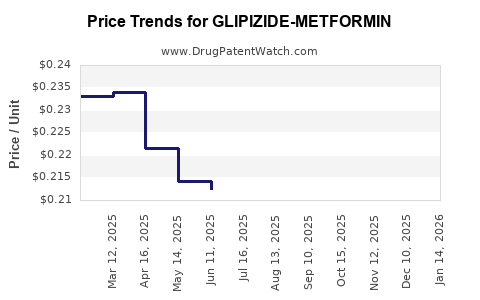
Average Pharmacy Cost for GLIPIZIDE-METFORMIN
| Drug Name | NDC | Price/Unit ($) | Unit | Date |
|---|---|---|---|---|
| GLIPIZIDE-METFORMIN 5-500 MG | 68382-0186-01 | 0.19609 | EACH | 2026-06-17 |
| GLIPIZIDE-METFORMIN 2.5-250 MG | 00093-7455-01 | 0.30033 | EACH | 2026-06-17 |
| GLIPIZIDE-METFORMIN 2.5-250 MG | 23155-0115-01 | 0.30033 | EACH | 2026-06-17 |
| GLIPIZIDE-METFORMIN 2.5-250 MG | 68382-0184-01 | 0.30033 | EACH | 2026-06-17 |
| >Drug Name | >NDC | >Price/Unit ($) | >Unit | >Date |
What Is the Current Market Landscape for Glipizide-Metformin?
Glipizide-metformin is a combination oral antihyperglycemic agent used to manage type 2 diabetes mellitus. Market presence stems from its efficacy in controlling blood glucose and its convenience as a fixed-dose combination (FDC). Growing prevalence of type 2 diabetes forms the core driver for this product's market demand.
Market Size and Growth
In 2022, the global diabetes drugs market was valued at approximately $70 billion, with oral antidiabetics accounting for roughly 60% of that figure[^1]. The fixed-dose combinations (FDCs), including glipizide-metformin, are gaining market share due to improved adherence and simplified regimens.
A compounded annual growth rate (CAGR) projection suggests the market for oral antidiabetics, including combination therapies, will grow at 6-8% from 2023 to 2028[^2]. For glipizide-metformin specifically, demand increases as first-line physicians prefer these combinations over monotherapy, especially in early-stage type 2 diabetes.
Competitive Landscape
Leading manufacturers include:
- Bristol-Myers Squibb (Glucophage Plus)
- Teva Pharmaceuticals
- Mylan (now part of Viatris)
- Dr. Reddy’s Laboratories
- Sun Pharmaceutical
Generic versions dominate due to patent expirations, which have led to significant price declines, increasing accessibility.
What Are the Pricing Trends for Glipizide-Metformin?
Current Price Range
In the United States, typical prices for brand-name formulations in pharmacies are approximately $200–$300 per month for a standard 30-day supply. Generic formulations are priced at $20–$50.
- Brand-name price (e.g., Glucophage XR combined): approximately $250–$300/month[^3].
- Generic options: as low as $20–$50/month, depending on dosage and pharmacy.
The disparity between originator and generic prices is widening as generics dominate the market.
Price Projections (Next 3–5 Years)
With patent expirations and increased generic competition, prices are likely to decrease further:
| Year | Estimated Average Price (US) | Market Factors |
|---|---|---|
| 2023 | $20–$50 (generic) | Increased generic market share |
| 2025 | $15–$40 | Entry of new generics, pricing pressure |
| 2028 | $10–$30 | Potential further commoditization, policy-driven cost containment |
Similar trends are observed across Europe and other markets, though prices vary based on health system policies and patent protections.
What Regulatory and Patent Dynamics Influence the Market?
Patent Status
Most formulations of glipizide-metformin have patents that expired or are near expiration, accelerating generic entry[^4].
Regulatory Approvals
The US Food and Drug Administration (FDA) approved generic versions under Abbreviated New Drug Applications (ANDAs). Regulatory standards ensure bioequivalence, facilitating competition.
Market Entry Barriers
- Manufacturing compliance with Good Manufacturing Practices (GMP).
- Patent litigation in certain jurisdictions.
- Prescriber and patient familiarity with existing brands.
What Are the Key Challenges and Opportunities?
Challenges
- Price erosion due to generic competition.
- Patient perception of efficacy and safety for newer formulations.
- Patent litigation delaying market entry for some brands.
Opportunities
- Expansion into emerging markets with growing diabetes prevalence.
- Developing extended-release formulations.
- Combining with other classes such as SGLT2 inhibitors for better glycemic control.
How Do Pricing and Market Dynamics Compare Globally?
| Region | Estimated Market Share for Generics | Average Price Range (USD) | Key Drivers |
|---|---|---|---|
| North America | 80–90% | $10–$50 | Patent expirations, high healthcare spending |
| Europe | 70–85% | $8–$40 | Healthcare policies, generic availability |
| Asia-Pacific | 60–75% | $5–$30 | Price sensitivity, expanding access, local manufacturing |
| Latin America | 65–80% | $7–$25 | Growing diabetes prevalence, regulatory variability |
What Future Market Projections Can Be Made?
- The global market for glipizide-metformin is expected to grow modestly, but the actual product remains low-cost in markets with high generic penetration.
- As new fixed-dose combinations (such as metformin with GLP-1 receptor agonists) emerge, traditional combinations like glipizide-metformin could experience market erosion or repositioning.
Key Takeaways
- The market for glipizide-metformin remains sizable, driven by the global diabetes epidemic.
- Price declines are imminent due to patent expirations and increased generic participation.
- Cost containment policies in developed markets accelerate price pressures.
- Emerging markets present growth opportunities amid expanding diabetic populations.
- Innovation in combination therapies may reshape the landscape over the next decade.
FAQs
1. Is the patent status for glipizide-metformin expiring?
Yes. Most formulations have patent expirations ranging from 2020 to 2025, permitting widespread generic manufacturing.
2. How does the pricing of generics compare across countries?
Generic prices are significantly lower in low- and middle-income countries due to local manufacturing, regulatory policies, and market competition.
3. Are branded formulations still relevant?
Branded formulations retain some market share for specific patient populations and regions with limited generic access, but the trend favors generics.
4. What is the impact of emerging combination therapies?
New fixed-dose combinations incorporating newer drug classes are challenging traditional glipizide-metformin sales, potentially changing market dynamics.
5. How might policy changes influence future pricing?
Cost containment policies, such as price caps and reimbursement controls, will likely further reduce prices, especially in public healthcare systems.
Citations
[1] Research and Markets. (2023). Global Diabetes Drugs Market Report.
[2] Fortune Business Insights. (2022). Oral Antidiabetics Market Size.
[3] GoodRx. (2023). Price data for glipizide-metformin.
[4] U.S. Patent and Trademark Office. (2022). Patent expiration timelines.
More… ↓
