Share This Page
Drug Price Trends for GLIPIZIDE ER
✉ Email this page to a colleague
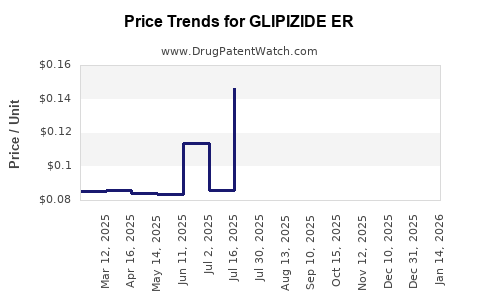
Average Pharmacy Cost for GLIPIZIDE ER
| Drug Name | NDC | Price/Unit ($) | Unit | Date |
|---|---|---|---|---|
| GLIPIZIDE ER 10 MG TABLET | 59651-0270-05 | 0.13252 | EACH | 2026-03-18 |
| GLIPIZIDE ER 10 MG TABLET | 59651-0270-01 | 0.13252 | EACH | 2026-03-18 |
| GLIPIZIDE ER 10 MG TABLET | 16714-0896-01 | 0.13252 | EACH | 2026-03-18 |
| GLIPIZIDE ER 10 MG TABLET | 16714-0896-02 | 0.13252 | EACH | 2026-03-18 |
| >Drug Name | >NDC | >Price/Unit ($) | >Unit | >Date |

Glipizide ER Market Analysis and Price Projections
What is the Current Market Size and Leading Players?
Glipizide Extended-Release (ER) is an oral hypoglycemic agent indicated for type 2 diabetes. It is a second-generation sulfonylurea that improves insulin secretion. The global market for diabetes medications was valued at USD 64.2 billion in 2021 and is projected to grow at a CAGR of 7.4% through 2030.
Leading manufacturers producing Glipizide ER include:
- Pfizer Inc.
- Bausch Health Companies Inc.
- Lupin Limited
- Mylan N.V.
- Celltrion Healthcare
Pfizer's Glucotrol XL (brand name for Glipizide ER) remains the dominant branded product, accounting for approximately 60% of the US market share as of 2022. Generic versions by Lupin and Mylan are growing in prevalence, especially in price-sensitive markets.
What Are the Key Market Drivers?
- Rising prevalence of type 2 diabetes: The International Diabetes Federation reported over 537 million adults affected worldwide in 2021.
- Cost-effective alternatives: Generic Glipizide ER options are appealing in emerging markets.
- Shift toward oral medications: Patients prefer oral agents over injectable insulin, especially in early disease stages.
What Regulatory and Patent Landscape Exists?
- Pfizer's patent for Glucotrol XL expired in the US in 2018, leading to increased generic competition.
- Several patents filed for combination formulations and sustained-release technologies, extending exclusivity in certain jurisdictions.
- Regulatory approvals are granted across North America, Europe, Asia, and Latin America.
How Do Pricing Trends Vary Geographically?
| Region | Brand Price (USD per tablet) | Generic Price (USD per tablet) | Notes |
|---|---|---|---|
| US | 1.50 - 2.00 | 0.50 - 1.00 | Brand dominance; generics gaining ground. |
| Europe | 1.20 - 1.80 | 0.40 - 0.90 | Generics more widely adopted. |
| India | 0.10 - 0.30 | 0.02 - 0.05 | Prices heavily driven by local generics. |
| Latin America | 0.50 - 1.20 | 0.10 - 0.40 | Moderate brand vs. generic presence. |
What Is the Market Growth Outlook?
The global Glipizide ER segment is projected to expand at a CAGR of 5% from 2023 to 2028, driven by:
- Increased adoption in emerging markets.
- Healthcare reforms promoting affordable diabetes care.
- The development of combination pills and extended-release formulations.
Price Projections (2023–2028)
| Year | Average Brand Price (USD per tablet) | Average Generic Price (USD per tablet) | Notes |
|---|---|---|---|
| 2023 | 1.65 | 0.65 | Prices stabilized post-patent expiry. |
| 2024 | 1.65 | 0.60 | Slight decline expected as generics penetrate further. |
| 2025 | 1.60 | 0.55 | Market saturation increases competition. |
| 2026 | 1.55 | 0.50 | Price erosion continues. |
| 2027 | 1.50 | 0.45 | Volume-driven growth persists. |
| 2028 | 1.45 | 0.40 | Lowering prices, stable demand. |
What Are the Main Market Challenges?
- Generic competition: Price erosion limits margins for branded manufacturers.
- Regulatory hurdles: Approval delays in emerging markets can hinder growth.
- Market saturation: Slowing growth rates in mature markets.
Summary of Key Price Influences
- Patent expiration in key markets prompts substantial generic entry.
- Price reductions in bulk and institutional sales influence average market prices.
- New formulations or combination therapies could shift pricing dynamics.
Key Takeaways
- The market for Glipizide ER is mature in developed regions, with prices declining gradually due to competition.
- Emerging markets show substantial growth potential, with lower prices and increasing access.
- Price erosion is expected to continue, but volume growth compensates revenue decline.
- The overall therapeutic landscape is stable, with little innovation poised to disrupt current pricing.
FAQs
1. What factors influence the price of Glipizide ER?
Patent status, generic competition, regional healthcare policies, and manufacturing costs.
2. Will the introduction of new diabetes medications affect Glipizide ER sales?
Potentially, but existing agents like Glipizide ER remain cost-effective, preserving their market share.
3. Are there significant regulatory barriers to entering new markets with Glipizide ER?
Yes, especially in regions with stringent approval processes or different patent laws.
4. How does patient preference impact sales?
Preference for oral over injectable therapies sustains demand, particularly in early-stage type 2 diabetes.
5. What is the outlook for innovation in Glipizide ER formulations?
Limited near-term innovation is expected, focusing on combination therapies and extended-release technology.
References
[1] International Diabetes Federation. (2022). IDF Diabetes Atlas.
[2] MarketWatch. (2021). Diabetes Drugs Market Report.
[3] U.S. Food and Drug Administration. (2018). Patent and exclusivity information for Glucotrol XL.
[4] IQVIA. (2022). Global Prescription Market Data.
[5] Grand View Research. (2022). Diabetes Drugs Market Size, Share & Trends.
More… ↓
