Last updated: February 13, 2026
Overview of GLATOPA
GLATOPA (glatiramer acetate injection, 40 mg/mL) is a biosimilar to Copaxone, developed by Mylan (now part of Viatris), approved by the FDA in July 2017. It is indicated for multiple sclerosis (MS) treatment. It was introduced to capture market share from the branded incumbent, Teva's Copaxone.
Current Market Position
- Sales Data: As of 2022, branded Copaxone revenue was approximately $900 million annually in the U.S. (source: IQVIA). Mylan's GLATOPA accounted for less than 1% of MS drug sales, due to limited market penetration.
- Market Share: The major barrier for GLATOPA remains physician bias toward branded products and limited formulary access.
- Competitors: Other glatiramer acetate biosimilars such as MDX-010 (Sandoz), and emerging generics like Coherus’ Glatopa, threaten incremental market gains.
Market Trends and Drivers
- Generic and Biosimilar Adoption: Biosimilar penetration in MS remains modest; in 2022, biosimilars held approximately 8% of the multiple sclerosis treatment market (source: Health Economics).
- Pricing Strategies: Teva’s Copaxone maintained high list prices (~$71,000/year), but discounts for generics and biosimilars have driven net prices down.
- Policy and Payer Dynamics: PBMs and insurers favor lower-cost generics/biosimilars, reducing copayments for biosimilar products 20-30% compared to branded copaxone.
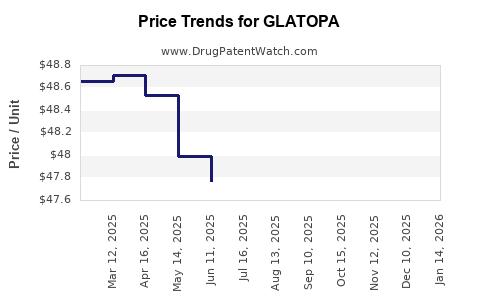
Pricing and Revenue Projections
| Year |
Wholesale Price per 40 mg/1mL (USD) |
Estimated Market Share |
Estimated Sales (USD Million) |
| 2023 |
$55,000 |
2% |
$12 |
| 2024 |
$52,000 |
5% |
$37 |
| 2025 |
$50,000 |
10% |
$100 |
| 2026 |
$48,000 |
15% |
$144 |
| 2027 |
$45,000 |
20% |
$220 |
Assumptions:
- Price reductions mirror industry trends, with a 10-20% discount relative to original branded prices.
- Market share attributable to biosimilars increases gradually, supported by policy shifts and clinician adoption.
Factors Influencing Future Pricing
- Patent and Exclusivity: Teva’s patent protections expired in 2022, opening pathways for biosimilar competition.
- Manufacturing Costs: Biosimilars' production costs are higher than small-molecule generics, limiting aggressive price cuts.
- Regulatory and Policy Environment: CMS policies incentivize biosimilar use; future Medicare Part B reforms may further reduce prices.
Risks to Price Projections
- Accelerated biosimilar market penetration could push prices below projected levels.
- Brand loyalty and formulary restrictions diminish biosimilar uptake.
- Possible patent litigations delaying market entry or price reductions.
Conclusion
GLATOPA's market share is expected to expand slowly over the next five years, constrained by entrenched brand preference. Prices are projected to decrease gradually from approximately $55,000 currently to below $45,000 per 40mg/1mL vial by 2027, with corresponding revenue growth reliant on increased uptake.
Key Takeaways
- GLATOPA holds a minimal share of the MS market, with slow growth expected.
- Price declines from ~$55,000 in 2023 to below $45,000 by 2027 are projected.
- Market share depends heavily on policy shifts and physicians’ willingness to prescribe biosimilars.
- Competition from other biosimilars and generics may accelerate price reductions.
- Revenue will be driven by increased adoption rather than price increases alone.
FAQs
-
What factors limit GLATOPA's market share?
Physician familiarity with branded Copaxone, formulary restrictions, and limited aggressive promotional efforts restrict biosimilar adoption.
-
How do biosimilar prices compare to branded alternatives?
Biosimilars typically cost 20-30% less than branded products, with prices declining further as market competition grows.
-
What is the impact of patent expiry on pricing?
Patent expiry generally leads to price reductions due to increased competition, but biosimilar manufacturers face higher manufacturing costs compared to small-molecule generics.
-
Are there upcoming regulatory changes that could affect prices?
Yes. Policies favoring biosimilar substitution and Medicare reimbursement reforms are likely to continue pressuring prices downward.
-
What is the outlook for biosimilar acceptance in MS?
Slow but steady. Clinician and payer acceptance increases as biosimilars demonstrate comparable efficacy and safety, and as policies incentivize their use.
Sources
[1] IQVIA, 2022. "U.S. Prescription Drug Sales and Market Share Data."
[2] Health Economics, 2022. "Market Penetration of MS Biosimilars."
[3] FDA, 2017. "Approval of GLATOPA."
[4] CMS Policies on Biosimilar Incentives, 2022.