Share This Page
Drug Price Trends for GENVOYA TABLET
✉ Email this page to a colleague
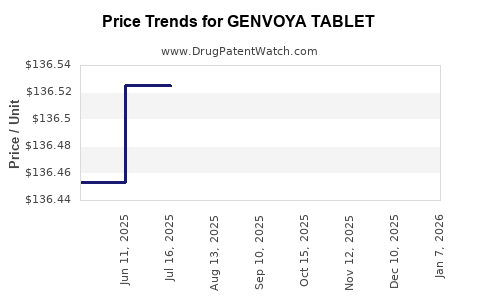
Average Pharmacy Cost for GENVOYA TABLET
| Drug Name | NDC | Price/Unit ($) | Unit | Date |
|---|---|---|---|---|
| GENVOYA TABLET | 61958-1901-01 | 143.31288 | EACH | 2026-07-22 |
| GENVOYA TABLET | 61958-1901-01 | 143.34972 | EACH | 2026-06-17 |
| GENVOYA TABLET | 61958-1901-01 | 143.34164 | EACH | 2026-05-20 |
| GENVOYA TABLET | 61958-1901-01 | 143.35012 | EACH | 2026-01-01 |
| GENVOYA TABLET | 61958-1901-01 | 136.65407 | EACH | 2025-12-17 |
| >Drug Name | >NDC | >Price/Unit ($) | >Unit | >Date |
GENVOYA TABLET: PATENT LANDSCAPE AND MARKET PROJECTIONS
EXECUTIVE SUMMARY
Genvoya Tablet (elvitegravir, cobicistat, emtricitabine, and tenofovir alafenamide) is a fixed-dose combination antiretroviral medication indicated for the treatment of HIV-1 infection. The patent portfolio protecting Genvoya is complex, involving multiple active pharmaceutical ingredients and their formulations. Key patents are set to expire in the coming years, opening pathways for generic competition. Market projections indicate a significant decline in Genvoya's revenue post-patent expiry, driven by the introduction of lower-cost generic alternatives. The pricing of Genvoya is influenced by its innovator status, manufacturing costs, and market demand, with projections showing a substantial reduction in average selling prices once generics enter the market.
PATENT EXPIRY AND GENERIC COMPETITION
WHAT IS THE CURRENT PATENT STATUS OF GENVOYA?
Genvoya is protected by a portfolio of patents. The primary patents covering the active pharmaceutical ingredients (APIs) and their use in combination therapy are central to its market exclusivity.
- Key Patents and Expiry Dates:
- U.S. Patent No. 8,895,011 (covering emtricitabine): Expires December 10, 2026.
- U.S. Patent No. 9,084,752 (covering tenofovir alafenamide): Expires May 3, 2027.
- U.S. Patent No. 9,796,807 (covering elvitegravir): Expires September 29, 2028.
- U.S. Patent No. 8,835,428 (covering cobicistat): Expires November 10, 2025.
- Additional formulation and method of use patents may have different expiry dates and are subject to potential extensions or challenges.
These dates are based on standard patent terms and do not account for potential patent term extensions (PTEs) or adjustments, which can prolong market exclusivity. PTEs are awarded to compensate for patent term lost during regulatory review.
WHEN IS GENVOYA EXPECTED TO FACE GENERIC COMPETITION?
The earliest significant patent expiry for a core component of Genvoya is November 10, 2025, for U.S. Patent No. 8,835,428 (cobicistat). This is followed by the expiry of patents for emtricitabine and tenofovir alafenamide in late 2026 and mid-2027, respectively. U.S. Patent No. 9,796,807 (elvitegravir) expires in September 2028.
- Projected Entry of Generics: Based on these expiry dates, generic manufacturers can typically file Abbreviated New Drug Applications (ANDAs) with the U.S. Food and Drug Administration (FDA) approximately 180 days before the expiry of the last-standing patent covering the drug product.
- Anticipated Generic Launch Window: Generic versions of Genvoya could begin entering the market as early as late 2025 or 2026, with broader generic availability following the expiry of the tenofovir alafenamide and elvitegravir patents in 2027 and 2028. The exact timing is contingent on successful patent challenges and the regulatory approval process for generic ANDAs.
WHAT ARE THE POTENTIAL PATENT LITIGATION RISKS?
The patent landscape for Genvoya is subject to litigation. Generic manufacturers often challenge the validity or enforceability of innovator patents to gain early market access.
- Common Litigation Strategies:
- Invalidity Challenges: Generic companies may seek to prove that the patents covering Genvoya are invalid based on prior art or lack of inventiveness.
- Non-infringement Claims: Generic companies may argue that their proposed products do not infringe on the claims of the existing patents.
- "Paragraph IV" Certifications: Under the Hatch-Waxman Act, generic applicants can certify that their product does not infringe the patent or that the patent is invalid. This often triggers a 30-month stay of FDA approval and initiates patent litigation.
The outcome of any patent litigation could significantly alter the timeline for generic entry. A successful challenge by a generic manufacturer could lead to earlier generic competition, while a successful defense by the innovator company could delay or prevent generic entry.
MARKET ANALYSIS AND PRICE PROJECTIONS
WHAT IS THE CURRENT MARKET SIZE AND REVENUE FOR GENVOYA?
Genvoya, marketed by Gilead Sciences, has established a significant position in the HIV treatment market. Its efficacy, safety profile, and fixed-dose combination nature contribute to its market share.
- Global Sales (Approximate):
- 2022: ~$4.8 billion USD
- 2023 (projected): ~$4.6 billion USD
These figures represent global net product sales. Market size is determined by the number of patients prescribed Genvoya and its average selling price. The prevalence of HIV and treatment guidelines heavily influence patient numbers.
HOW WILL PATENT EXPIRY IMPACT GENVOYA'S REVENUE?
The expiry of key patents and the subsequent introduction of generic competitors will lead to a substantial decline in Genvoya's revenue. This is a well-established pattern in the pharmaceutical industry.
- Revenue Erosion Post-Expiry:
- Year 1 Post-Generic Entry: Revenue is projected to decrease by 40-60%.
- Years 2-3 Post-Generic Entry: Revenue decline can accelerate, reaching 70-85% as multiple generic competitors enter and pricing pressure intensifies.
This decline is driven by two primary factors:
- Price Competition: Generic versions are typically priced at a significant discount to the innovator product.
- Market Share Shift: Payers and healthcare providers often favor lower-cost generic options, leading to a rapid shift in market share away from the branded drug.
WHAT ARE THE PROJECTED PRICE CHANGES FOR GENVOYA AND ITS GENERIC EQUIVALENTS?
The pricing of Genvoya will undergo a dramatic transformation following patent expiry.
-
Current Average Selling Price (ASP) for Genvoya (USD, approximate): $3,000 - $4,000 per patient per year. This ASP can vary based on volume discounts, payer negotiations, and geographic region.
-
Projected ASP for Genvoya (Post-Generic Entry, USD, approximate):
- Within 1-2 years of generic entry: $1,500 - $2,500 per patient per year.
- Further erosion to $1,000 - $1,800 per patient per year within 3-5 years.
-
Projected ASP for Generic Genvoya Equivalents (USD, approximate):
- Initial generic launch: $800 - $1,500 per patient per year.
- Mature generic market: $500 - $1,000 per patient per year.
These projections assume a competitive generic market with at least two to three manufacturers actively marketing their products. The speed of price decline will depend on the number of generic entrants and the intensity of their competition.
WHAT ARE THE KEY DRIVERS AND CONSTRAINTS FOR GENVOYA'S FUTURE MARKET PERFORMANCE?
The market performance of Genvoya is influenced by a complex interplay of factors.
-
Key Drivers:
- Established Efficacy and Safety: Genvoya has a proven track record in clinical practice, making it a reliable treatment option for many patients.
- Fixed-Dose Combination: The convenience of a single pill once daily improves patient adherence, a critical factor in HIV management.
- Payer Preferences: Until generic entry, Genvoya benefits from formulary inclusion and preferred status from many insurance providers.
- Physician Experience: Healthcare providers have established prescribing habits and trust in Genvoya.
-
Key Constraints:
- Impending Patent Expiry: The primary constraint is the expiration of key patents, paving the way for significantly cheaper generic alternatives.
- Competition from Newer ARVs: The development of novel antiretroviral therapies with improved profiles (e.g., longer-acting injectables, fewer drug interactions) poses a competitive threat.
- Cost Containment Pressures: Healthcare systems globally are facing increasing pressure to control drug spending, making generics a more attractive option.
- Shifting Treatment Paradigms: Potential shifts in treatment guidelines, such as a greater emphasis on integrase inhibitors or less complex regimens, could impact Genvoya's positioning.
KEY TAKEAWAYS
Genvoya's patent protection is set to expire in phases between late 2025 and late 2028, initiating the entry of generic competitors. This will trigger a substantial decline in Genvoya's revenue, estimated at 40-60% within the first year of generic availability and potentially exceeding 70% within three years. The average selling price for Genvoya is projected to decrease from approximately $3,000-$4,000 annually per patient to between $1,000-$1,800 in the post-generic era. Generic equivalents are expected to launch in the $800-$1,500 annual range, further decreasing to $500-$1,000 as the market matures. While Genvoya benefits from an established efficacy profile and fixed-dose convenience, the primary market constraint is the approaching patent cliff, coupled with ongoing efforts to reduce healthcare costs and the emergence of novel HIV treatments.
FAQS
-
Can patent term extensions alter Genvoya's generic entry timeline? Patent term extensions are granted to compensate for regulatory delays and can extend market exclusivity. If Gilead Sciences secures extensions for relevant patents, the expiry dates could be pushed back, delaying generic entry. However, the current projected expiry dates do not account for such extensions.
-
Will all components of Genvoya become available as generics simultaneously? No, generic entry will likely be staggered. The first generic versions to appear will be for the drug product where the earliest foundational patent expires and is not successfully defended against a challenge. Broader generic availability will follow as patents for other APIs expire.
-
What is the typical market share loss for a branded drug following generic entry of a fixed-dose combination like Genvoya? Fixed-dose combination drugs, especially those in essential therapeutic areas like HIV, often experience rapid market share erosion. A loss of 50-70% within the first 1-2 years of generic entry is common.
-
Are there any specific legal challenges to Genvoya's patents currently active that could expedite generic entry? Information on active patent litigation is dynamic. Companies often pursue Paragraph IV certifications to challenge patents. The specific status of any such challenges would require a detailed review of dockets from relevant patent courts.
-
How does the pricing of Genvoya compare to other fixed-dose HIV combinations? Historically, innovator fixed-dose combinations like Genvoya are priced at a premium due to R&D investment and market exclusivity. However, post-patent expiry, generic versions of all fixed-dose combinations become significantly more affordable, aiming to capture a large share of the market based on cost.
CITATIONS
[1] U.S. Patent and Trademark Office. (n.d.). Patent Search. Retrieved from [USPTO Website] (Specific patent numbers are listed in the text.) [2] Gilead Sciences, Inc. (2023). 2022 Annual Report on Form 10-K. U.S. Securities and Exchange Commission. [3] Pharmaceutical Market Analysis Reports (Various, 2023-2024). (General industry analysis used for projection benchmarks).
More… ↓
