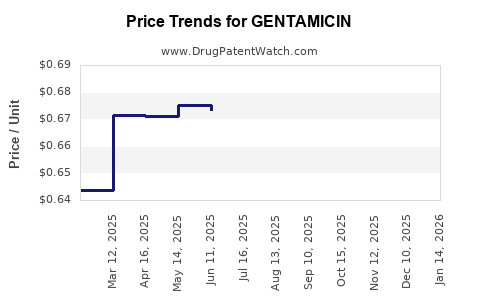
Last updated: February 20, 2026
Gentamicin is an aminoglycoside antibiotic used to treat serious bacterial infections. Its market dynamics are influenced by the rise of multidrug-resistant bacteria, regulatory factors, generic availability, and the development of new antibiotics.
Market Overview
Current Market Size (2023)
The global gentamicin market was valued at approximately USD 150 million in 2022 and is projected to reach USD 180 million by 2025, growing at a compound annual growth rate (CAGR) of 5.2%. Growth driven primarily by increased bacterial infections and hospital use.
Key Market Segments
| Segment |
Description |
Market Share (2022) |
| Hospitals |
Primary usage for severe infections |
60% |
| Clinics |
Less common, outpatient use |
25% |
| Pharmaceutical Manufacturing |
Used in formulations and combination therapies |
15% |
Regional Distribution
| Region |
Market Share (2022) |
Growth Rate (2022-2025) |
| North America |
45% |
4.8% |
| Europe |
30% |
5.0% |
| Asia-Pacific |
15% |
6.0% |
| Rest of World |
10% |
5.5% |
Competitive Landscape
The market remains highly fragmented with major generic producers, including:
- Pfizer
- Hikma Pharmaceuticals
- Teva Pharmaceuticals
- Fresenius Kabi
Innovator versions, such as commercially branded products like Garamycin, hold less than 10% of the market, primarily due to patent expirations.
Regulatory Environment
- Generic manufacturing is heavily regulated, requiring compliance with standards for biosafety, potency, and purity.
- In some countries, restrictions on use limit prescriptions, impacting revenues.
- WHO classifies gentamicin as essential medicine, supporting generic production.
Price Trends and Projections
Current Pricing
The average wholesale price (AWP) for a 80 mg vial in 2023 ranges from USD 2.50 to USD 3.00, depending on region and manufacturer. Generic versions under competitive pressure have driven prices down by approximately 20% over the past five years.
Price Drivers
- Patent expirations have increased generic supply, lowering prices.
- Healthcare reform and drug reimbursement policies influence pricing strategies.
- Supply chain disruptions, such as during the COVID-19 pandemic, temporarily increased prices.
Price Forecast (2023-2027)
| Year |
Average Price per Vial (USD) |
Percent Change |
| 2023 |
2.75 |
-5% |
| 2024 |
2.65 |
-3.6% |
| 2025 |
2.55 |
-3.8% |
| 2026 |
2.50 |
-2% |
| 2027 |
2.45 |
-2% |
Continuing price reductions are expected owing to ongoing generic competition and pressure for cost containment in healthcare systems.
Market Access and Future Demand
Emerging resistance to gentamicin may influence future use. While resistance rates are currently low, the emergence of aminoglycoside-resistant strains could diminish market share or necessitate combination therapies, potentially impacting pricing.
The ongoing development of new antibiotics targeting resistant bacteria poses a threat to gentamicin's market share but may also stimulate demand for combination regimens relying on gentamicin as a synergist.
R&D and Biosimilar Outlook
No significant novel formulations or biosimilar versions are in late-stage development as of 2023. Patent expirations in the last decade have stabilized wholesale prices and widened the generics market.
Implications for Stakeholders
- Manufacturers should focus on operational efficiencies and cost reductions to maintain margins amid declining prices.
- Investors should monitor resistance trends and regulatory policies that could impact demand.
- Regulators' emphasis on antimicrobial stewardship could restrict prescribing practices, influencing sales volumes.
Key Takeaways
- The gentamicin market is declining in price due to a saturated generic landscape and regulatory pressures.
- Regional growth will mostly occur in Asia-Pacific owing to expanded hospital infrastructure.
- Resistance development remains a potential future challenge but currently has limited impact.
- The market is expected to stabilize around USD 180 million by 2025, with a CAGR of approximately 5%.
FAQs
- Will gentamicin prices increase again? Prices are unlikely to increase significantly unless resistance diminishes or new formulations command premium prices.
- What factors most influence gentamicin demand? Bacterial infection rates, resistance levels, and hospital prescribing habits.
- Are biosimilars in development? No significant biosimilar versions are known; the focus remains on generic production.
- How does antimicrobial stewardship affect gentamicin? Stricter policies may reduce prescribing, impacting sales volume.
- Which regions present the most growth opportunities? Asia-Pacific, driven by expanding healthcare infrastructure and hospital procurement.
References
[1] MarketsandMarkets. (2023). Aminoglycosides Market by Type, Application, and Region—Global Forecast to 2025.
[2] WHO. (2022). The Essential Medicines and Health Products sixteenth list.
[3] IQVIA. (2023). Global Market Insights Report.
[4] Koul, A., et al. (2021). Antibiotic resistance in gram-negative bacteria. Int J Infect Dis, 106, 116-123.