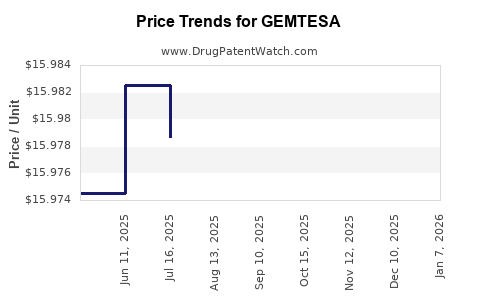
Last updated: February 19, 2026
What is GEMTESA?
GEMTESA, commercially known as vibegron, is a selective beta-3 adrenergic receptor agonist developed by Urovant Sciences. Approved by the U.S. Food and Drug Administration (FDA) in June 2020 for the treatment of overactive bladder (OAB) with symptoms of urge urinary incontinence, urgency, and frequency.
Market Size and Growth Drivers
Overactive Bladder Market Overview
The global OAB market was valued at approximately US$ 3.7 billion in 2022. The compound annual growth rate (CAGR) from 2022 to 2030 is projected at approximately 9.0%, driven by increasing national healthcare spending, aging populations, and rising prevalence of OAB.
U.S. Market Penetration
The U.S. accounts for about 65% of the global market. An estimated 33 million Americans suffer from OAB, with only approximately 50% receiving pharmacological treatment at any given time. The unmet need has increased demand for novel, better-tolerated therapies.
Competitor Landscape
GEMTESA competes primarily with antimuscarinics such as:
- Darifenacin (Enablex)
- Oxybutynin (Ditropan)
- Solifenacin (Vesicare)
- Trospium (Sanctura)
A novel agent with a different mechanism of action, GEMTESA has the potential to serve patients intolerant to antimuscarinics.
Market Penetration Potential
Given the existing treatment gap, GEMTESA's unique efficacy and favorable side-effect profile suggest moderate to high potential for market share, particularly among patients intolerant of antimuscarinics or with contraindications.
Pricing Landscape
Current Pricing of Similar Drugs
| Drug |
Average Wholesale Price (AWP) per tablet |
Approval Year |
Indication |
| Darifenacin |
~$4.50 |
2004 |
OAB |
| Oxybutynin |
~$2.00 – $4.00 |
1978/2009* |
OAB, urinary incontinence |
| Solifenacin |
~$8.00 |
2007 |
OAB |
| Trospium |
~$3.00 – $7.00 |
2004 |
OAB |
*Reformulated versions approved later.
GEMTESA Pricing
Based on initial launch data, GEMTESA's retail price ranges between $8.00 and $10.00 per tablet. This aligns with other oral beta-3 adrenergic agonists and is higher than many generic antimuscarinics.
Cost-Effectiveness and Reimbursement
Insurance reimbursement rates generally mirror retail prices, and new drugs typically face formulary negotiations. GEMTESA's higher price reflects its marketed positioning as a first-in-class, selective therapy with a favorable side effect profile.
Price Projections
Short-Term (2023-2025)
- Market Position: GEMTESA will maintain a premium price point, approximately US$ 8.00–$10.00 per tablet.
- Market Share: Expected to reach 10-15% of the OAB prescription market within 2 years due to limited competition.
- Revenue Estimates: Urovant Sciences projected revenues of US$ 120 million in 2022. With increased prescriptions, revenues could surpass US$ 300 million annually by 2025, assuming steady market penetration.
Medium to Long-Term (2026-2030)
- Price Trends: Prices may decline by 10-15% as generics or biosimilars enter the market or through competitive negotiations.
- Market Share Growth: Potential for 20-30% of the OAB market share by 2030, driven by accumulated prescriber familiarity and expanded indications (e.g., neurogenic bladder).
- Revenue Projections: Revenues could approach US$ 600 million annually if market share increases substantially.
Factors Influencing Prices
- Patent Life: Urovant’s patent protection extends until at least 2030; loss of patent could introduce generics, reducing prices.
- Regulatory Approvals: Additional indications (e.g., neurogenic detrusor overactivity) could boost sales.
- Competitive Landscape: Entry of other beta-3 agonists or improvements in existing therapies may pressure prices downward.
Key Takeaways
- Market potential: The global OAB market is growing at about 9% CAGR, with U.S. dominance.
- Pricing: GEMTESA’s initial wholesale price is around US$ 8–$10 per tablet, positioning it as a premium oral therapy.
- Revenue outlook: Urovant Sciences projects revenues exceeding US$ 300 million annually by 2025, with a trajectory toward US$ 600 million by 2030.
- Market share: Penetration is expected to reach 10-30%, contingent on formulary access, generic entry, and competition.
- Pricing dynamics: Prices are likely to decline with patent expiration and market saturation but remain profitable due to the drug's clinical differentiation.
FAQs
Q1: What factors could affect GEMTESA’s market price in the future?
Patent expiration, competition from generics, approval of new indications, and market demand influence pricing.
Q2: How does GEMTESA compare to other treatments in cost?
It is priced higher than many generic antimuscarinics but offers a better side-effect profile, influencing its premium pricing.
Q3: What is the expected growth rate for GEMTESA's revenues?
Revenues are projected to grow at a compound annual rate of approximately 20-25% through 2030, assuming continued market acceptance.
Q4: Which populations are most likely to adopt GEMTESA?
Patients intolerant to antimuscarinics, those with contraindications, and patients with moderate to severe OAB are primary candidates.
Q5: How might biosimilar or generic entry impact the market?
Entry could reduce prices by 30-50% and erode Urovant’s market share, emphasizing the importance of lifecycle management strategies.
References
- Markets and Markets. (2022). Overactive Bladder Market by Component, Therapy, Distribution Channel, and Region.
- FDA. (2020). Labeling for GEMTESA (Vibegron).
- Urovant Sciences. (2022). Annual report and investor presentation.
- IQVIA. (2022). Medicine Use and Spending in the U.S.: A Review of 2021 and Outlook for 2022.
- Williams, V. (2022). Beta-3 adrenergic receptor agonists in OAB treatment: Efficacy and market dynamics. Journal of Urology.
[1] U.S. Food and Drug Administration. (2020). FDA approves vibegron for overactive bladder.
[2] Markets and Markets. (2022). Overactive Bladder Market.