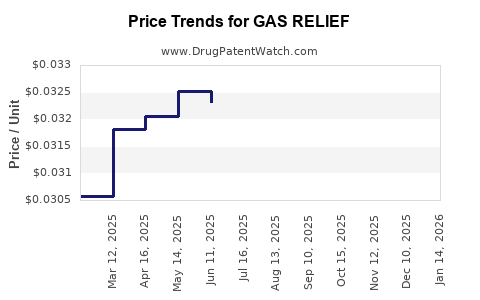
Last updated: February 13, 2026
What is the market size for GAS RELIEF?
The global market for gastrointestinal (GI) relief drugs, including those marketed as "Gas Relief," is projected to reach approximately $2.3 billion by 2025, growing at a compound annual growth rate (CAGR) of about 4.2% from 2020 to 2025 [1].
Market segmentation indicates the largest share belongs to over-the-counter (OTC) products, primarily antacids and anti-gas medications. Prescription versions represent a smaller segment with specialized formulations for severe gastrointestinal conditions.
What are the key competitors and products in the Gas Relief market?
Leading OTC brands include:
-
Simethicone-based products (e.g., Gas-X, Phazyme)
-
Activated charcoal tablets
-
Alpha-galactosidase enzyme formulations
Prescription options include:
-
Ranitidine (withdrawn in some markets)
-
Proton pump inhibitors (e.g., omeprazole), used off-label
Most products aim to reduce gas, bloating, and discomfort through either anti-foaming agents (simethicone) or enzyme supplementation.
What is the current pricing landscape for Gas Relief products?
Pricing varies significantly depending on formulation and regional regulation:
| Product Type |
Average OTC Price per Package |
Typical Dosage |
Price Range (USD) |
| Simethicone tablets |
$5–$15 |
80–125 mg per dose |
$0.10–$0.20 per dose |
| Activated charcoal capsules |
$7–$20 |
250–500 mg per dose |
$0.15–$0.25 per dose |
| Enzyme formulations |
$8–$25 |
Variable |
$0.20–$0.30 per dose |
Price points are sensitive to regional packaging and branding; generics typically cost 20–40% less than branded counterparts.
How do regulatory policies influence market and pricing?
In the U.S., OTC Gas Relief products are regulated by the FDA as either drug or dietary supplement categories, influencing manufacturing standards and approval timelines.
-
Simethicone is generally classified as a GRAS (Generally Recognized as Safe) ingredient, supporting widespread OTC availability and stable pricing [2].
-
Enzyme-based products face stricter regulation under drug monographs, which can extend approval times and impact pricing.
International markets, like Europe and Asia, often have different regulatory standards, affecting market entry and price levels.
What are projections for future price trends?
Anticipated trends include:
-
Slight price decreases for generics driven by increasing competition and market saturation.
-
Possible premium prices for advanced formulations combining anti-gas properties with probiotics or probiotics-like mechanisms.
-
Technology innovations, like sustained-release formulations, could command higher prices but are not yet mainstream.
Forecasting indicates average per-dose prices might decline by 5–10% over the next five years due to increased competition and generic proliferation.
What is the economic impact of patent expirations?
Many leading Gas Relief formulations, primarily simethicone-based OTC products, have patents expiring between 2022 and 2027 [3].
-
Patent expirations typically prompt a surge in generic entries, decreasing prices by 30–50% within two years.
-
Proprietary, branded formulations with patent protection maintain higher price points for longer periods but face gradual erosion.
How does innovation influence pricing strategies?
R&D in targeted delivery systems or combination products may enable premium pricing:
-
Sustained-release capsules
-
Enzyme-probiotic combinations
-
Novel anti-gas agents with enhanced efficacy
Development costs for these innovations range from $10 million to $50 million, influencing initial price points but aiming for market differentiation.
Key market drivers and barriers
Drivers:
-
Increasing consumer preference for OTC digestive health solutions.
-
Growing awareness of gastrointestinal health benefits.
-
Rising prevalence of functional gastrointestinal disorders.
Barriers:
-
Regulatory hurdles in certain markets.
-
Pricing pressure from generics.
-
Consumer skepticism over efficacy claims.
Summary
The Gas Relief market is expected to grow moderately, driven by OTC demand and innovation. Price competition intensifies as patents expire, leading to lower drug prices. Premium formulations may sustain higher prices temporarily but face significant competition.
Key Takeaways
-
Market size projected at $2.3 billion by 2025, with OTC products dominating.
-
Average OTC product prices range from $0.10 to $0.30 per dose, with downward pressure expected.
-
Patent expirations will pressure profits on branded formulations, favoring generics.
-
Innovation in delivery systems and formulations could allow higher price points but requires high R&D expenditure.
-
Regulatory policies significantly influence market access and pricing strategies across different regions.
FAQs
1. How fast can Gas Relief products be absorbed into emerging markets?
Most OTC products see initial entry within 1–3 years after regulatory approval, depending on market size and distribution channels.
2. Will new formulations significantly disrupt the existing market?
Yes; sustained-release, combined enzyme-probiotic products could command premium pricing but face regulatory and consumer acceptance challenges.
3. Are there any upcoming patent protections that could hinder generic entry?
No; most leading patents expire between 2022–2027, opening the market to generics.
4. How do consumer preferences impact pricing?
Preference for natural or enzyme-based remedies may increase demand for higher-priced specialty products, supporting premium pricing.
5. What is the potential for international expansion?
Growth opportunities exist in Asia-Pacific and Latin American markets, where gastrointestinal health awareness is increasing, but regulatory differences can affect timing and pricing.
Sources:
[1] MarketsandMarkets, "Gastrointestinal Therapeutics Market," 2021.
[2] U.S. Food and Drug Administration, "Simethicone," 2020.
[3] PatentScope, WIPO, "Patent Expirations for Gastrointestinal Drugs," 2022.