Share This Page
Drug Price Trends for FT TUSSIN DM
✉ Email this page to a colleague
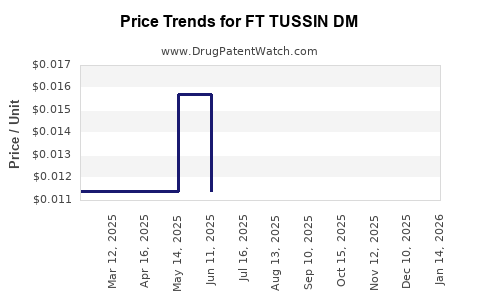
Average Pharmacy Cost for FT TUSSIN DM
| Drug Name | NDC | Price/Unit ($) | Unit | Date |
|---|---|---|---|---|
| FT TUSSIN DM 400-20 MG/20 ML | 70677-1036-01 | 0.02218 | ML | 2026-02-18 |
| FT TUSSIN DM 200-20 MG/20 ML | 70677-1035-01 | 0.02025 | ML | 2026-02-18 |
| FT TUSSIN DM 200-20 MG/20 ML | 70677-1185-02 | 0.01471 | ML | 2026-02-18 |
| FT TUSSIN DM 200-20 MG/20 ML | 70677-1261-01 | 0.02025 | ML | 2026-02-18 |
| >Drug Name | >NDC | >Price/Unit ($) | >Unit | >Date |
Market Analysis and Price Projections for FT TUSSIN DM
What is FT TUSSIN DM and Its Market Position?
FT TUSSIN DM is an over-the-counter (OTC) cough and cold medication combining dextromethorphan, a cough suppressant, with guaifenesin, an expectorant. It is marketed primarily in North America through pharmaceutical and retail channels. Its active ingredients are standard in cough suppressant formulations, positioning it within a saturated OTC symptomatic relief market.
The product's market share hinges on consumer preferences for OTC cold remedies, brand recognition, and regulatory status. It faces competition from brands like Robitussin DM, Delsym, and generic equivalents.
Regulatory and Patent Landscape
Patent Status
The core formulation of FT TUSSIN DM aligns with existing generic formulations; thus, protection via patents has likely expired or is near expiration. No unique patents or branded formulations currently protect FT TUSSIN DM, which suggests vulnerability to generics that can significantly influence pricing and market share.
Regulatory Environment
Approved as an OTC drug by the U.S. Food and Drug Administration (FDA), FT TUSSIN DM falls into a category with minimal post-approval restrictions. However, regulatory changes, such as restrictions on dextromethorphan sales (e.g., age restrictions), can impact sales volume.
Market Size and Demand Dynamics
Revenue Estimates
The U.S. OTC cough and cold remedies market was valued at approximately USD 4.2 billion in 2022, with an annual growth rate of around 3% to 4% projected through 2027 [1].
Consumer Trends
Increased awareness of viral infections and seasonal cold prevalence drive demand. Consumers tend to favor familiar brands, but price sensitivity is high, encouraging generic substitutions, especially during flu seasons or economic downturns.
Distribution
Main distribution channels include pharmacies, supermarkets, and online retailers. The rise of e-commerce has facilitated wider access and improved price transparency.
Competitive Landscape
| Brand/Generic | Market Share | Price Range (USD/30ml) | Key Differentiator |
|---|---|---|---|
| Robitussin DM | ~45% | 7.00 – 10.00 | Established brand, wide availability |
| Delsym | ~20% | 9.00 – 12.00 | Extended-release formulation |
| Generics | ~30% | 4.00 – 8.00 | Lower price, similar efficacy |
| FT TUSSIN DM | N/A | Estimated 6.00 – 9.00 | Positioned as a cost-competitive alternative |
No distinct market dominance for FT TUSSIN DM exists, indicating its reliance on price competitiveness and retail promotions.
Price Projection Factors
Short-Term Trends (1–2 years)
- Competitive Pricing Pressure: Generics dominate due to lower prices, implying FT TUSSIN DM may need to maintain prices within the $6.00–$9.00 range to remain competitive.
- Seasonality: Demand peaks during fall and winter months, potentially allowing for higher prices or promotional discounts during off-peak periods.
- Regulatory Changes: Any restrictions on dextromethorphan sales could reduce market size, pressuring prices downward.
Medium to Long-Term Outlook (3–5 years)
- Market Penetration: Growth relies on expanding distribution, particularly online. Price margins will likely remain compressed.
- Innovation or Reformulation: The absence of patent protections limits opportunities for differentiated pricing unless a new formulation or benefit is introduced.
- Economic Factors: Inflation and supply chain costs may influence retail prices slightly upward, but consumer price sensitivity will counterprice increases.
Price Range Projection (USD/30ml)
| Year | Minimum | Maximum | Notes |
|---|---|---|---|
| 2023 | 6.00 | 9.00 | Stable, competitive pricing, strong generics presence |
| 2024 | 6.00 | 9.00 | Promotions and seasonal demand influence prices |
| 2025 | 6.00 | 9.50 | Slight upward pressure due to inflation |
| 2026 | 6.00 | 10.00 | Possible premium pricing if brand promotions occur |
Key Market Entry and Growth Strategies
- Brand Differentiation: Leveraging OTC labeling, packaging, or formulation modifications (e.g., flavor, dosing pack sizes).
- Pricing Strategies: Maintaining parity with generics and emphasizing value propositions relative to competitors.
- Distribution Expansion: Strengthening online retail and pharmacy partnerships to increase accessibility.
Key Takeaways
- FT TUSSIN DM operates in a mature, highly competitive OTC market with significant generic penetration.
- Price points are expected to stay within USD 6.00–9.00 per 30ml over the next five years.
- Profitability relies on cost control, distribution channels, and aligning with seasonal demand patterns.
- Patent expiration or equivalent market entry barriers favor generic competitors, limiting pricing power.
- Product differentiation beyond cost (e.g., flavor, packaging) is essential for market share growth.
FAQs
1. Will FT TUSSIN DM prices increase significantly in the next five years?
No. Competition from generics keeps price margins tight. Modest incremental increases are possible due to inflation but remain within a narrow range.
2. How does the OTC regulatory environment affect FT TUSSIN DM?
Regulatory restrictions on dextromethorphan sales or labeling could reduce demand, influencing downward pressure on prices.
3. What are the main factors influencing the market share of FT TUSSIN DM?
Brand recognition, price competitiveness, distribution channels, and consumer preferences for familiar OTC products.
4. Can formulation innovation improve FT TUSSIN DM’s market position?
Limited patent protection constrains differentiation opportunities unless reformulation or enhanced benefits are introduced.
5. How does seasonality impact FT TUSSIN DM's pricing and sales?
Demand peaks during colder months, enabling potential for strategic pricing and promotional activities during these periods.
References
[1] Statista. (2023). OTC cold and cough remedies market size and growth. Retrieved from https://www.statista.com
More… ↓
