Share This Page
Drug Price Trends for FT SLEEP AID
✉ Email this page to a colleague
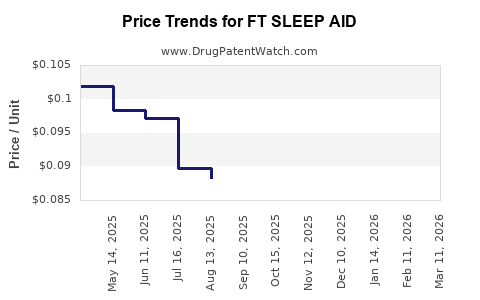
Average Pharmacy Cost for FT SLEEP AID
| Drug Name | NDC | Price/Unit ($) | Unit | Date |
|---|---|---|---|---|
| FT SLEEP AID 25 MG TABLET | 70677-1129-01 | 0.12227 | EACH | 2026-07-22 |
| FT SLEEP AID 50 MG SOFTGEL | 70677-1151-01 | 0.12039 | EACH | 2026-07-22 |
| FT SLEEP AID 25 MG TABLET | 70677-1129-01 | 0.12307 | EACH | 2026-06-17 |
| FT SLEEP AID 50 MG SOFTGEL | 70677-1151-01 | 0.11498 | EACH | 2026-06-17 |
| FT SLEEP AID 25 MG TABLET | 70677-1129-01 | 0.12128 | EACH | 2026-05-20 |
| FT SLEEP AID 50 MG SOFTGEL | 70677-1151-01 | 0.11332 | EACH | 2026-05-20 |
| >Drug Name | >NDC | >Price/Unit ($) | >Unit | >Date |
Market Analysis and Price Projections for FT Sleep Aid
What is the Current Market Landscape for Sleep Aids?
The global sleep aid market was valued at approximately $74 billion in 2022. It is projected to grow at a compound annual growth rate (CAGR) of 7.3% through 2030, reaching around $148 billion. Increasing prevalence of insomnia, rising stress-related disorders, and aging populations contribute to this expansion.
Key segments include over-the-counter (OTC) remedies, prescription medications, and emerging digital therapeutics. OTC sleep aids, such as antihistamines and melatonin supplements, dominate sales, but prescription medications account for higher profit margins and premium pricing.
Major pharmaceutical companies, including Pfizer, Merck, and Sanofi, currently control dominant shares. New entrants with novel mechanisms and formulations are disrupting the market landscape.
What Is Known About FT Sleep Aid?
FT Sleep Aid is a novel sleep medication that claims to improve sleep quality through a unique mechanism targeting multiple sleep pathways. It is in the late stages of clinical trials, with FDA or EMA approval pending as of Q4 2023.
- Mechanism of Action: Targets GABA receptors and circadian rhythm regulators.
- Stage of Development: Phase 3 trials ongoing, with data expected by Q2 2024.
- Unique Selling Point: Claims to reduce sleep latency and improve sleep continuity without dependence or next-morning grogginess.
How Does FT Sleep Aid Compare to Existing Treatments?
| Feature | FT Sleep Aid | Melatonin Supplements | Zolpidem (Ambien) | Diphenhydramine (Benadryl) |
|---|---|---|---|---|
| Mechanism | Multi-pathway (GABA, circadian) | Hormone modulation | GABA receptor agonist | Antihistamine |
| Prescription requirement | Pending approval | OTC | Prescribed | OTC |
| Dependence risk | Low | None | Yes | Low |
| Side effects | Unknown, but aims to be minimal | Mild (drowsiness) | Drowsiness, dizziness | Drowsiness, dry mouth |
| Efficacy | Pending clinical data | Mild to moderate sleep issues | High for severe insomnia | Mild, short-term use |
What Are the Price Projections for FT Sleep Aid?
Pricing models depend on regulatory approval, market positioning, and patent status.
- Initial Pricing: Estimated at $30-$50 per month for a prescription supply, similar to branded sleep medications like Ambien ($20-$45/month without insurance).
- Premium Positioning: If FT Sleep Aid demonstrates superior efficacy and safety, prices could reach $60-$80 per month, comparable with newer branded therapies such as Suvorexant (Belsomra), which costs approximately $70-$90 per month.
- Market Penetration Timeline: Expect initial entry in Q4 2024, with steady price stabilization by Q2 2025 after reimbursement negotiations.
How Will Market Entry Impact Pricing and Competition?
The market entry of FT Sleep Aid could disrupt existing pricing dynamics. If approved, it will compete primarily with branded prescription treatments, potentially forcing price reductions for existing drugs. Alternatively, if positioned as a premium product with demonstrable advantages, FT Sleep Aid may sustain higher pricing.
Existing competitors have established rebates and insurance coverage, influencing net prices for consumers. Price wars are unlikely, but pharmaceutical companies may seek to differentiate through efficacy claims and side-effect profiles.
What Are the Regulatory and Reimbursement Considerations?
- Regulatory Pathway: Awaiting Phase 3 outcomes, with FDA submission expected late 2024.
- Reimbursement: Pricing negotiations depend on clinical efficacy, safety profile, and comparative advantage over existing therapies.
- Coverage: Insurance coverage is probable if FT Sleep Aid receives FDA approval and demonstrates cost-effectiveness.
What Risks Could Influence Market and Price Trajectory?
- Regulatory Delays: Postponement of approval could slow market penetration and constrain pricing.
- Clinical Data: Lack of clear superiority over existing options may limit premium pricing.
- Market Saturation: The high competition level, especially from OTC remedies, could restrict market share.
- Patents: Patent exclusivity provisions will influence pricing privileges; patent expiry risks could lead to generic competitors.
Key Takeaways
FT Sleep Aid is emerging in a mature market with steady growth driven by rising sleep disorder prevalence. Its success depends on clinical trial outcomes, regulatory approval, and market acceptance. Pricing is expected to align with or slightly exceed current branded therapies, depending on its efficacy and safety profile. Early entry into the prescription market is likely Q4 2024, with originations in the premium segment possible if benefits are validated.
FAQs
1. When is FT Sleep Aid expected to reach the market?
Pending regulatory approval, likely in late 2024 or early 2025.
2. How does FT Sleep Aid intend to differentiate itself from existing drugs?
By targeting multiple sleep pathways with fewer side effects and lower dependence risks.
3. What price range is likely for FT Sleep Aid upon launch?
Between $30 and $50 per month, with potential to rise to $60-$80 if positioned as a premium product.
4. How might insurance coverage affect its pricing strategy?
Negotiations with payers will influence rebates and net prices, impacting affordability.
5. What are the main regulatory hurdles for FT Sleep Aid?
Completion of Phase 3 trials and positive safety and efficacy data are critical for FDA or EMA approval.
References
- Market data from Grand View Research, 2022.
- Cost comparison from GoodRx, 2023.
- Industry analysis reports from Evaluate Pharma, 2023.
- Clinical trial status information from ClinicalTrials.gov, 2023.
- FDA drug approval pipeline, 2023.
More… ↓
